There is a specific kind of exhaustion that comes from trying to look unbroken. You know the feeling. It’s the energy you burn trying to present a seamless, perfect exterior to the world while internally, you feel like a shattered plate held together by nothing but sheer willpower and panic.
We live in an era that demands optimization. For years, the message has been to "fix" yourself, to hack your biology, to optimize your routine, and to erase your flaws until you are a shiny, productive machine. But if you look around, you’ll notice a shift. People are tired. The "Over-Optimization Backlash" is real. We are collectively realizing that trying to return to a "mint condition" version of ourselves after trauma or failure isn't just impossible; it’s the wrong goal entirely.
When you drop a ceramic bowl, it breaks. Your instinct is probably to sweep up the pieces and throw them away, or perhaps glue them back together so carefully that no one notices the crack. But there is a different approach, one that argues the broken version is actually superior to the original.
This is the philosophy of Kintsukuroi, or "golden repair." It suggests that your scars are not evidence of your failure, but proof of your resilience.
The Philosophy of the Golden Repair
Kintsukuroi (often interchangeable with Kintsugi) is a Japanese art form that dates back to the 15th century. Legend has it that a shogun broke a favorite tea bowl and sent it to China for repairs. It came back held together by ugly metal staples. It was functional, but it was hideous. The shogun was displeased, so he tasked his own craftsmen with finding a better way.
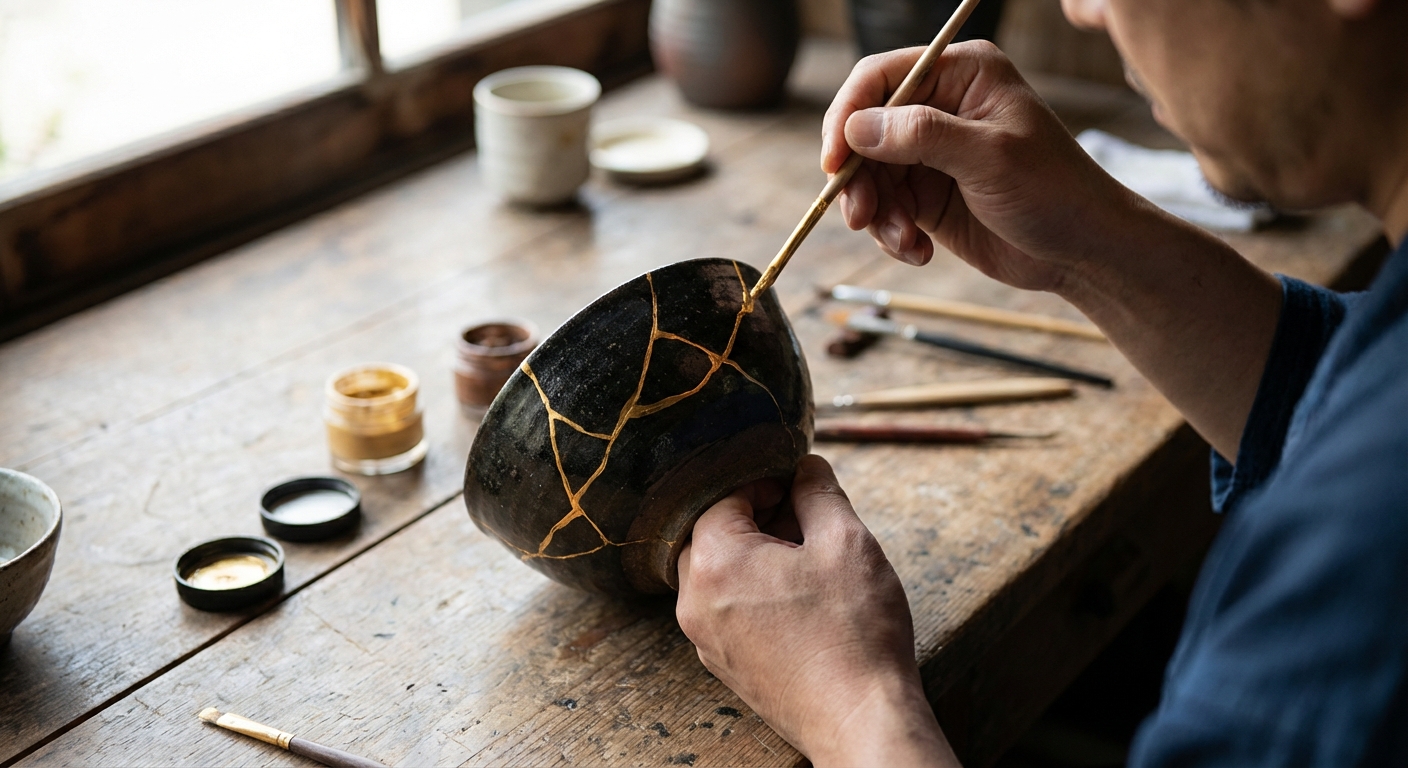
Their solution was revolutionary. Instead of trying to hide the damage, they mixed lacquer with powdered gold, silver, or platinum. They rejoined the pieces, leaving the cracks clearly visible—glimmering, in fact.
The bowl wasn't just fixed; it was transformed. It became more valuable than it had been when it was new. The break was no longer a tragedy to be hidden; it was a piece of history to be celebrated.
This is a profound shift from how we usually handle our own psychological breaks. In the West, we tend to treat trauma, grief, and failure as things to "get over." We want to bounce back. We want to return to baseline. We want to be "good as new."
But you can never be "good as new" after a significant life event. You are changed. The Kintsukuroi philosophy embraces this. It relies on the concept of Wabi-Sabi, which finds beauty in things that are imperfect, impermanent, and incomplete. It accepts that the natural cycle of life involves wear, tear, and eventual breakage.
When you apply this to your life, you stop trying to erase your history. You stop trying to Photoshop your personality. You accept that the cracks are where the light—and the gold—get in.
The Psychological Framework: Post-Traumatic Growth
This isn't just poetic philosophy; it is backed by modern psychological understanding. We often hear about Post-Traumatic Stress, but there is another side to that coin: Post-Traumatic Growth (PTG).
PTG is the theory that individuals can experience positive psychological change as a result of struggling with highly challenging life circumstances. It’s the mental equivalent of a bone healing stronger at the fracture site.
When you go through something difficult—a divorce, a job loss, a health crisis, or a period of deep depression—your previous understanding of the world shatters. The "bowl" of your life is broken. You can’t hold soup in it anymore.
The "repair" process involves rebuilding your worldview. Psychological science supports what the Kintsugi artists knew centuries ago: healing is not about erasing damage but integrating it into a new, more resilient whole.
This resonates with the current cultural moment. We are seeing a pivot away from "performance-based" mental health. We are done with the influencers pretending their lives are flawless. We are craving "emotional repair" and durability. We want to know that when we break, we can be put back together.
A healed person is not someone who has never been hurt. A healed person is someone who has integrated their hurt into their character and used it to become wiser, more empathetic, and more grounded.
Actionable Steps: How to Apply the Gold
Understanding the metaphor is easy; living it is hard work. You cannot mend a bowl by thinking about it. You have to get your hands dirty with the lacquer. Here is how you apply the principles of Kintsukuroi to your own emotional recovery.
1. Inventory the Pieces (Radical Acceptance)
Before you can repair anything, you have to acknowledge the break. You have to get down on your hands and knees and look at the shards.
This is the phase of radical acceptance. It is the refusal to pretend that everything is fine. You have to identify the specific losses. What actually broke? Was it your trust? Your self-esteem? Your physical health? Your financial security?
This is often the most painful part because it requires you to stop running. You have to sit in the mess.
I know what this feels like on a visceral level. Years ago, I carried an extra 110 pounds of body weight. I was using food to numb out, binge-eating until I couldn't feel anything else. When I finally stopped and looked at the damage, it was overwhelming. I had "broken" my metabolism, my skin was stretched to its limit, and my self-worth was in tatters. I had to look at those pieces—the loose skin, the health markers, the years lost to lethargy—and own them. I couldn't pretend I had always been fit. I had to accept that I was starting from a place of significant damage.
You cannot fix what you will not face. Gather the pieces. Don't hide them.
2. Apply the Lacquer (The Discipline of Healing)
In the physical art form, the lacquer acts as a strong adhesive. In your life, the "lacquer" represents the foundational tools of recovery and discipline.
This is where the real work happens. This is not about feeling good; it is about doing the things that bind you back together. This includes:
- Community: We heal in relationships. You need friends, family, or a support group who act as the clamps holding the pieces together while the glue dries.
- Professional Help: Sometimes the break is too complex for DIY repair. Therapy is often the strongest bonding agent available.
- Physiological Discipline: Your brain is part of your body. You need sleep. You need movement. You need breath control. You need nutritious food. You cannot repair a shattered mind with a broken body.
- Stillness: In a noisy world, you need quiet. Whether this is through prayer, deep silence, or spending time in nature, you need to lower the noise floor so the pieces can set.
The lacquer takes time to dry. You cannot rush this. If you try to use the bowl before the adhesive is set, it will fall apart again. Give yourself the grace of time.
3. Gild the Scars (Reframing the Narrative)
The final step is dusting the repair with gold. This is the cognitive shift. This is where you decide what the story means.
If you stop at step two, you just have a repaired bowl with visible cracks. Step three is where you turn the cracks into art. This involves finding the "wisdom" in the hardship.
This does not mean you have to be glad the trauma happened. You don't have to be thankful for the car accident or the heartbreak. That is toxic positivity. Instead, you acknowledge that because it happened, you have gained something you didn't have before.
maybe you are more compassionate now. Maybe you are less judgmental of others who are struggling. Maybe you have a deeper reliance on your faith. Maybe you simply know, deep in your gut, that you can survive difficult things.
That knowledge is the gold.
When you re-author your narrative from "I am broken and damaged" to "I have been broken, and I have rebuilt myself," you change the way you move through the world. You stop hiding your history. You realize that the version of you that exists now is more interesting, more durable, and more capable than the version of you that existed before the fall.
The Value of the Break
There is a tremendous freedom in realizing you don't have to be perfect. The "unbroken" version of you was likely naive and fragile. The "mended" version of you has proof of survival.
The world doesn't need more people pretending to be flawless china dolls. The world needs more people who are honest about their cracks, who have done the hard work of repair, and who are willing to show the gold in their seams.
Your scars are not ugly. They are the map of your survival. They are the gold dust in the lacquer. Wear them openly.