

It is 11:00 PM. You know you should be asleep. Your body feels heavy, your eyes are dry, and you have to be up in seven hours. Yet, your hand reaches for the phone on the nightstand. Just one last check of the news, one last email, one last scroll through the feed. Thirty minutes later, you are wide awake, your mind racing, and that heavy feeling of sleepiness has vanished completely. You aren't alone in this nightly battle.
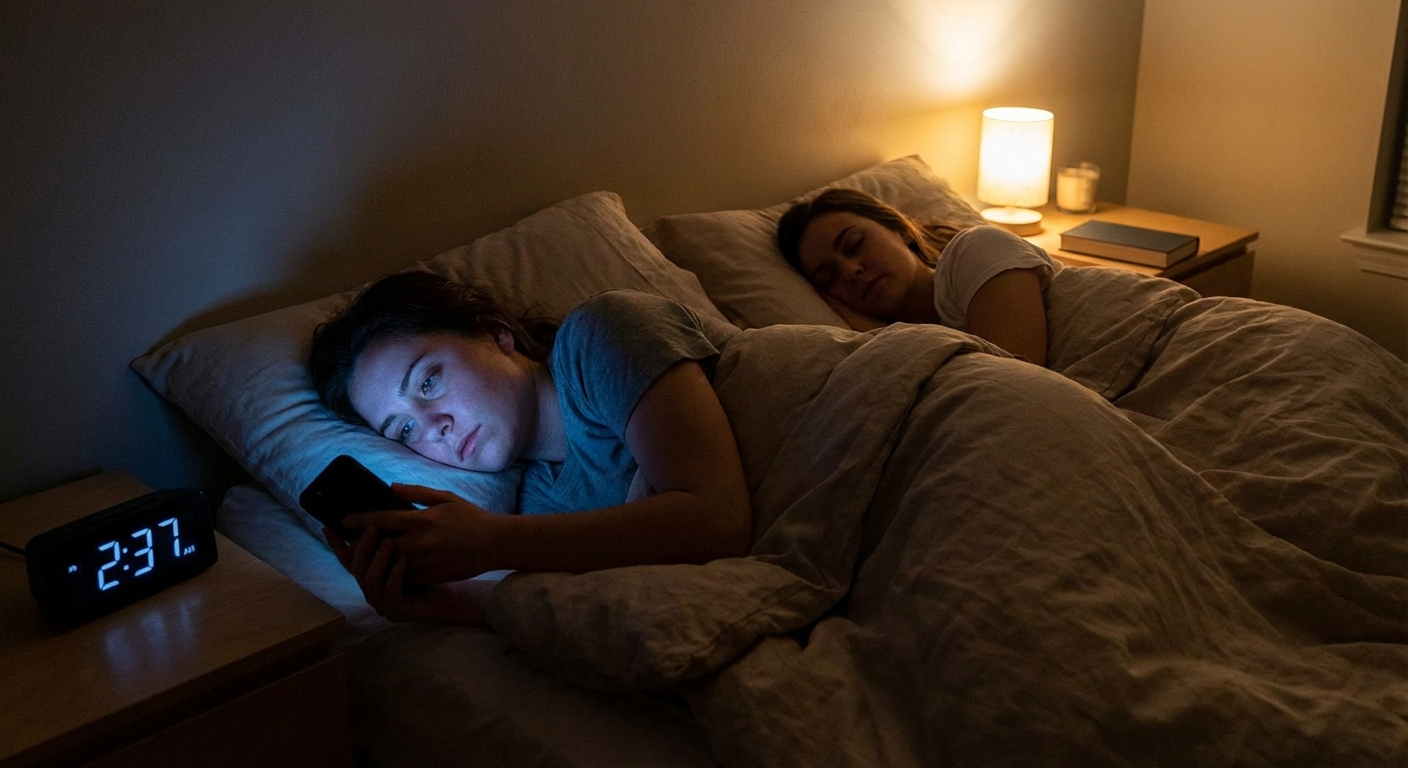
A major report released just this week, the sixth annual Global Sleep Survey from March 2026, revealed a staggering contradiction in how we live. While 53% of people worldwide now rank sleep as the single most important behavior for a healthy life, over half of those same people report getting quality rest only four nights a week or less. We know what we need, but we seem incapable of doing it. This "sleep gap" is being ripped wide open by our evening digital habits. We are seeing record highs in severe sleep deprivation, particularly among teenagers, driven largely by the glowing rectangles we hold in front of our faces.
We treat sleep like a switch we can flip off and on, but it is actually a complex chemical process. When you stare into a screen before bed, you aren't just delaying sleep; you are chemically dismantling your body's ability to rest.
The Biological Mechanism
To understand why your phone is the enemy of your rest, you have to understand the pineal gland. Think of this tiny gland in the center of your brain as the factory foreman for your sleep cycle. Its job is to produce melatonin, a hormone that doesn't just make you drowsy—it signals to every cell in your body that it is time to repair and recover.
Under natural conditions, this system works perfectly. As the sun sets and light fades, your eyes send a signal to a cluster of cells called the suprachiasmatic nucleus (SCN). The SCN then tells the pineal gland, "It’s dark. Start the production line." Melatonin floods your system, your body temperature drops, your blood pressure lowers, and you drift off.
The problem is that your brain is easily tricked. It cannot tell the difference between the sun and a smartphone.
Screens emit high-energy, short-wavelength light, specifically in the 450–485 nanometer range. To your eyes and your brain, this specific shade of blue light means one thing: it is noon. It is the peak of the day. It is time to be alert, hunt, gather, and work.
When you blast your retinas with blue light at midnight, you are screaming at your brain that the sun is high in the sky. The specialized photoreceptors in your eyes—intrinsically photosensitive retinal ganglion cells—detect this blue light and slam the brakes on the pineal gland. The foreman shuts down the factory. The production of melatonin stops dead in its tracks. You might feel tired physically, but chemically, your brain is wired for midday activity.
The 50% Suppression Effect
This isn't just a minor reduction in sleep quality. The impact is massive and measurable. Clinical research published in The Journal of Clinical Endocrinology & Metabolism has shown just how devastating light exposure can be. The data indicates that exposure to room light and screens in the hours preceding bedtime can suppress melatonin levels by greater than 50% in the majority of people.
Think about that number. You are operating on half the recovery fuel you need.
When you suppress melatonin by that magnitude, you are effectively shortening your "biological night." Even if you manage to close your eyes and fall unconscious for seven hours, your body hasn't been in its restorative state for that entire time. You wake up feeling groggy, irritable, and mentally foggy because, hormonally speaking, you didn't get a full night's sleep. You got a shallow, chemically interrupted nap.
I know how hard this habit is to break because I have lived it. There was a period in my life where I was completely hooked on late-night gaming and doom-scrolling. I would tell myself I was just "winding down" after a long day of work, but in reality, I was ramping my brain back up. I would sit in the glow of the monitor until 2:00 AM, convinced I was just a "night owl" by nature. The truth was, I was systematically destroying my sleep architecture. It wasn't until I forced myself to quit the late-night screens that I realized I wasn't an insomniac; I was just over-stimulated.
The suppression of melatonin does more than just make you tired the next day. It desynchronizes your circadian rhythm—the internal clock that dictates everything from your digestion to your immune system. When you shift this clock by staying on your phone, you are effectively giving yourself jet lag every single night, without ever leaving your house.
Practical Steps for Digital Hygiene
You do not have to live like a monk to get better sleep, but you do need to have some discipline. If you want to reclaim your rest and stop the 50% suppression of your vital hormones, you need to change your environment. Here is a pragmatic approach to digital hygiene that actually works.
1. The 60-Minute Hard Stop
This is the most effective and the most difficult step. You need a strict cut-off time for all handheld electronic devices 60 minutes before you intend to sleep. If you want to be asleep by 11:00 PM, the phone goes away at 10:00 PM. Not on the nightstand, not under the pillow—away. Put it in the kitchen or the living room to charge.
This hour gives your pineal gland the head start it needs to ramp up melatonin production. Without the constant input of blue light, your brain can naturally transition into a parasympathetic state, which is the "rest and digest" mode necessary for deep sleep.
2. Red-Shift Your Reality
We live in a modern world, and sometimes you cannot avoid screens entirely. If you must use a device after sunset, you need to mitigate the damage.
- Software Solutions: Install apps or use built-in settings that "red-shift" your display. This pulls the blue wavelengths out of the screen and replaces them with warmer, orange tones. It looks strange at first, but your eyes will adjust.
- Hardware Solutions: Consider wearing blue-light-blocking glasses if you are watching TV or working late. Look for amber or red-tinted lenses, as these are the only ones that block the specific spectrum that inhibits melatonin. Clear "computer glasses" usually aren't strong enough for nighttime protection.
3. Change Your Environmental Lighting
It is not just your phone; it is your house. Most modern homes are filled with bright white LED bulbs that mimic daylight. If you blast your bathroom lights while brushing your teeth right before bed, you are dosing yourself with blue light.
- Switch your bedside lamps to warm-toned, low-wattage bulbs.
- Use red or orange nightlights in the hallway and bathroom.
- Dim the main lights in your living area two hours before bed.
4. Replace the Habit
The hardest part of putting the phone away is the boredom. You need to fill that void with something that promotes stillness rather than stimulation. Instead of scrolling, try reading a physical book (paper, not a tablet). Engage in quiet contemplation or prayer.
In the Christian Orthodox tradition, there is a profound emphasis on ending the day in silence and prayer, turning the mind away from the chaos of the world and toward inner peace. Even if you are not religious, the physiological benefit of this practice is undeniable. It centers the mind, slows the breathing, and prepares the spirit for rest. It is the antithesis of the chaotic, dopamine-fueled rush of social media.
The Long-Term View
Reclaiming your hormonal rhythm is one of the single best investments you can make for your future health. When you stop suppressing your melatonin, you aren't just sleeping better; you are regulating your appetite, stabilizing your mood, and giving your brain the time it needs to clear out metabolic waste.
The "sleep gap" is real, but it is not inevitable. You have the power to close it. It requires the discipline to say "no" to the screen and "yes" to the silence. Tonight, when the clock strikes that hour before bed, make the choice to protect your biology. Put the phone down, turn off the bright lights, and let your body do the work it was designed to do.
