You know the feeling intimately. It is late, the house is finally quiet, and the harsh blue light of your phone is the only thing illuminating the bedroom. You open Instagram just to check one notification, and suddenly, twenty minutes have vanished.
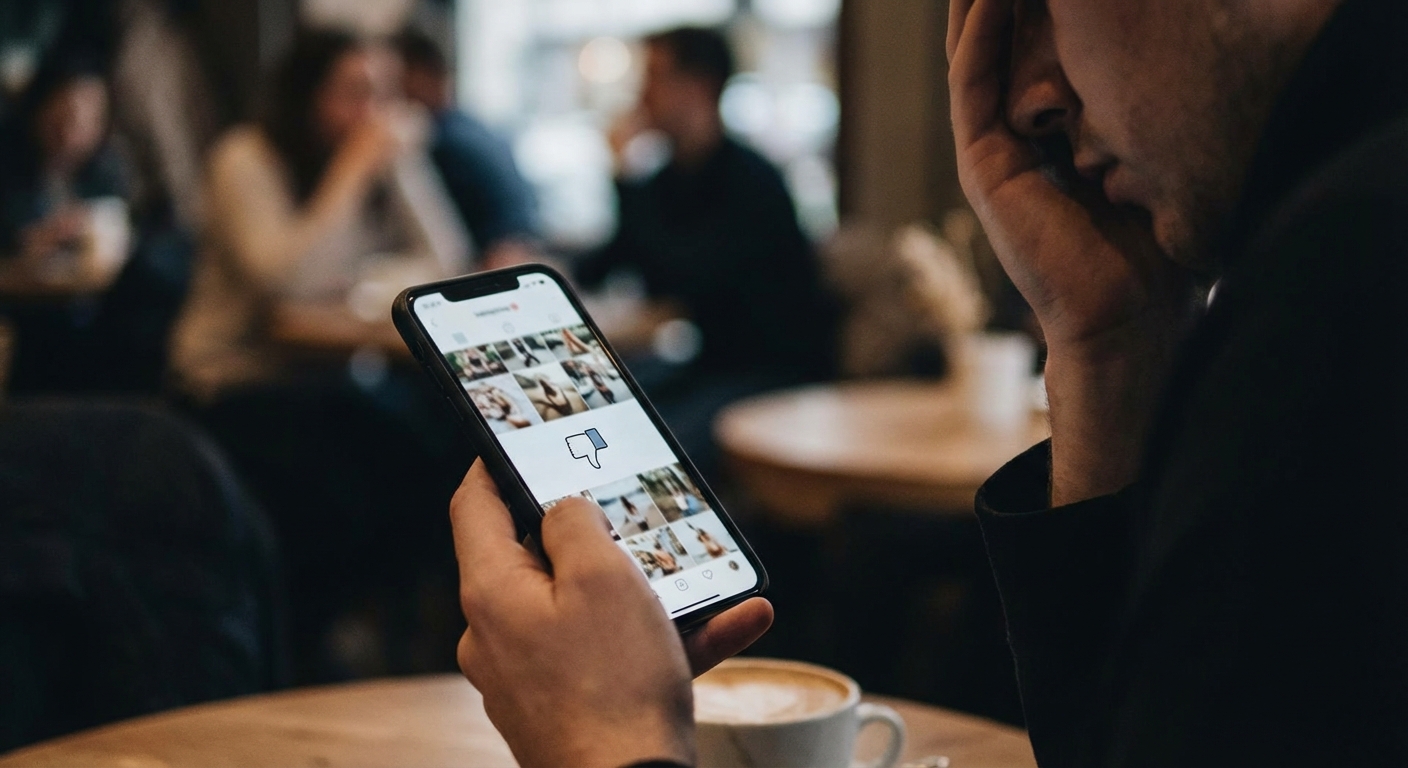
But it isn't just the lost time that bothers you. It is the heavy, sinking sensation in your chest. You see a former colleague’s promotion, a friend’s perfectly renovated kitchen, or an influencer’s seemingly effortless vacation in the Mediterranean. You look around at your own messy room and your tired reflection in the dark screen, and you feel it: the "scroll-and-sigh."
You feel smaller. You feel behind. You feel like everyone else has been handed a manual for life that you never received.
I want you to know something important right now: You are not crazy, and you are not broken. Your brain is simply doing exactly what it evolved to do, but it is doing it in an environment that has been engineered to exploit your deepest insecurities. This isn't just a bad habit; it is a psychological mechanism running on overdrive.
The Core Idea: We Are Built to Compare
To understand why a simple app can ruin your mood in under sixty seconds, we have to look at the wiring under the hood. Back in 1954, a psychologist named Leon Festinger proposed the Social Comparison Theory.
The concept is simple but profound. Festinger argued that humans have an innate, biological drive to evaluate themselves. We need to know where we stand in the pack. When we cannot find an objective standard—like a scoreboard or a ruler—to measure our abilities or opinions, we instinctively compare ourselves to the people around us.
For our ancestors, this was a survival tool. Comparing yourself to the tribe’s best hunter taught you how to improve. Comparing yourself to the slowest runner taught you that you needed to be faster to escape a predator. It kept us alive.
But here is the problem: for most of human history, our comparison pool was small. You only had to compare yourself to the other people in your village. Maybe there was one guy who was stronger than you, or one family that had slightly nicer goats.
Today, you are not competing with the village. You are competing with the top 1% of the entire human population, curated by an algorithm that knows exactly what triggers you. You are comparing your blooper reel—your messy mornings, your financial stress, your bad hair days—to everyone else’s highlight reel.
When you engage in "Upward Social Comparison"—looking at people you perceive as better, smarter, or richer—it usually triggers one of two things: inspiration or inadequacy. In the digital world, where filters and edits remove all flaws, inadequacy almost always wins.
The Algorithmic Trap
This dynamic has shifted from a personal struggle to a global crisis. As of March 2026, the situation has become so severe that legal and safety frameworks are finally catching up to the technology. We are seeing a massive surge in litigation, with over 2,400 pending cases in the Adolescent Social Media Addiction litigation.
Why is this happening now? Because the platform isn't a neutral town square. It is a "comparison engine."
Instagram’s design specifically targets our psychological vulnerabilities. The algorithm doesn't care about your mental health; it cares about retention. It prioritizes content that elicits a reaction. Recent 2026 updates to the algorithm have doubled down on relationship-driven signals, effectively "habit-coding" your brain to seek validation through likes and comments.
The system utilizes "intermittent reinforcement." This is the same psychological hook used in slot machines. You pull the lever (scroll the feed), and sometimes you get a reward (a funny video, a like from a crush), and sometimes you get nothing. This unpredictability keeps you pulling the lever.
But the cost is high. Current data suggests that nearly 80% of users report comparing their real lives to the online lives of others. This creates a vicious cycle. When you feel low or depressive, you are statistically more likely to engage in harmful social comparison. You scroll to numb the pain, but the scrolling feeds you images that make the pain worse.
The platform knows this. That is why, as of March 2026, we are seeing the rollout of AI-powered "Proactive Parental Alerts" in major markets like the US and UK. These systems notify parents when teens repeatedly engage in high-risk searches related to mental health. While these tools are a step forward, they are also a stark admission that the machine is dangerous by default.
The Envy Spectrum: Malicious vs. Benign
Not all envy is created equal. Researchers distinguish between two very different types of envy that occur when we scroll, and understanding the difference is key to protecting your peace.
First, there is Benign Envy. This is the "good" kind. You see someone who has achieved something you want—maybe they ran a marathon or launched a business—and you think, "Wow, if they can do that, maybe I can too." This type of comparison motivates self-improvement. It pushes you to discipline yourself and take action.
Then, there is Malicious Envy. This is the dark side. This happens when you see someone’s success and you don't just want what they have; you feel resentment that they have it. You want to pull them down. Malicious envy is linked to poorer mental health, hostility, and a crumbling sense of self-worth.
The danger of Instagram is that it blurs the line. You might start with benign interest in a fitness influencer, but after seeing their perfect abs every single day while you struggle to get to the gym, that interest curdles into malicious envy. You start looking for flaws. You start feeling bitter.
I know this territory well. Years ago, before I lost 110 pounds, I used to obsessively follow fitness accounts. I told myself it was for "motivation." But every time I saw a guy with 5% body fat, I didn't feel motivated. I felt disgusted with myself. I would look at their "Day 1 vs. Day 365" transformations and feel like a failure because my "Day 1" seemed to last for years. It wasn't until I stopped looking at them and started focusing on my own daily discipline—my own quiet battle—that the weight actually started to come off. I had to unsubscribe from the fantasy to do the real work.
Practical Mitigation: Breaking the Cycle
You cannot simply "decide" to stop comparing yourself to others. It is a biological imperative. However, you can change the environment in which that comparison happens. You can rig the game in your favor.
Here are three concrete steps to reclaim your brain from the algorithm.
1. Audit Your Feed for "Micro-Influencers"
The era of the untouchable celebrity influencer is fading. In 2026, the trend is shifting toward "sustainability storytelling" and niche, authentic creators.
Go through your following list with a ruthless eye. If an account makes you feel poor, ugly, or lazy, unfollow it immediately. It does not matter if they are a "nice person." If their content triggers your inadequacy, they have to go. Replace them with creators who share the messy middle of the journey, not just the glossy finish line. Look for people who are honest about their struggles.
2. Utilize "Quiet Mode" and Recommendation Resets
You need to break the dopamine loop. Instagram has introduced features like "Quiet Mode" and tools to reset your recommendations. Use them.
Turn on Quiet Mode to silence notifications during your focused hours and your rest hours. More importantly, use the reset tools to wipe your Explore page. If your Explore page is full of things that make you envious, nuke it. Tell the algorithm you are not interested. Force the machine to show you art, comedy, or landscapes—anything that doesn't trigger a status comparison.
3. Monitor Usage Thresholds
We have hard data on this now. Health reports from 2026 indicate a sharp "dose-response" relationship between time spent on social media and mental health issues. Specifically, spending more than three hours a day on these platforms is linked to a 2x higher risk of experiencing significant mental distress.
Set a hard cap. Use the screen time tools built into your phone. If three hours sounds like a lot, you might be surprised to see how easily you hit it. Aim for under 60 minutes. Treat your attention like a bank account; stop letting strangers make withdrawals.
Conclusion
The "highlight reel" is never going to go away. Humans will always want to show off their best moments. That is natural. But you do not have to consume it.
Your self-worth is not determined by how well you stack up against a digital phantom. It is determined by your own actions, your own discipline, and your own connection to reality.
Put the phone down. Step away from the blue light. Find some silence. The real world—the one with texture, nuance, and truth—is waiting for you, and it is far more forgiving than the algorithm.