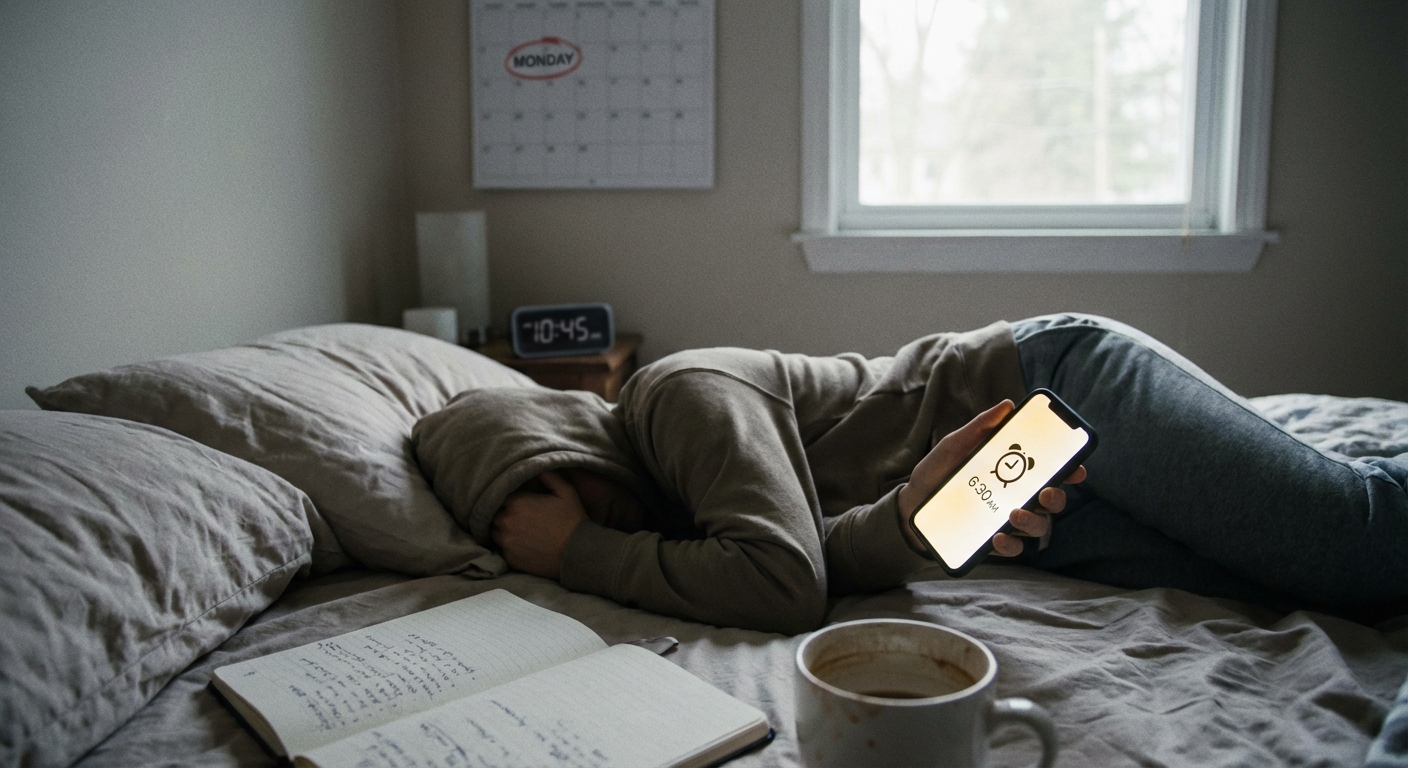
You slept in on Saturday. You slept in on Sunday. So why does Monday feel like you were hit by a bus? It isn’t just the "Monday Blues" or a lack of coffee. It is physiological whiplash, and you are doing it to yourself every single week.
The Core Idea: Living in Two Time Zones
Most of us live two different lives. We have our "work life," dictated by the alarm clock, the commute, and the boss. Then we have our "real life" on the weekends, dictated by when our body actually wants to fall asleep and wake up. We treat the weekend like a pressure valve, finally letting ourselves sleep until 10:00 AM or 11:00 AM to "catch up" on the debt we accumulated during the week.
We call this relaxing. Science calls it "social jet lag."
As of March 2026, this issue has moved from niche sleep labs to the front pages of newspapers. Following British Columbia’s historic decision to adopt permanent Daylight Saving Time, sleep researchers are sounding the alarm. They aren't just worried about losing an hour of sleep once a year; they are worried about a permanent, society-wide state of circadian misalignment. The experts are warning that forcing millions of people to wake up in the dark while the sun sets later creates a biological environment where our internal clocks never quite sync with the outside world.
Social jet lag is the discrepancy between your body’s internal biological clock and the social clock you are forced to adhere to for work or school. When you wake up at 6:30 AM on Friday but sleep until 10:30 AM on Saturday, you haven't just "rested." You have physiologically flown across three or four time zones.
Your body doesn't know it's the weekend. It just knows that the sun is up, but you are in a dark room. It knows that yesterday you ate breakfast at 7:00 AM, but today you are eating it at noon. This confusion forces your biological systems to constantly recalibrate. By the time your body adjusts to the "weekend time zone," Monday morning rolls around, and you drag it back to the "work time zone." You are living in a perpetual state of jet lag without ever leaving your house.
The Biological Mismatch: The Myth of Catching Up
There is a pervasive myth that sleep is like a bank account. We think that if we withdraw five hours of sleep during the week, we can deposit five hours on the weekend and balance the ledger.
It does not work that way.
The human body thrives on rhythm, not just duration. Your circadian rhythm—the internal 24-hour clock that regulates everything from hormone release to digestion—does not care about your social calendar. When you shift your sleep window by several hours, you create a biological mismatch.
Think of your body like an orchestra. The conductor is your circadian rhythm. When you keep a consistent schedule, the conductor keeps the strings, brass, and percussion in perfect time. Digestion happens when it should. Cortisol spikes in the morning to wake you up. Melatonin rises in the evening to put you down.
When you engage in social jet lag, you are effectively swapping out the sheet music halfway through the performance. The percussion section thinks it’s time to sleep, but the brass section thinks it’s time to eat lunch. The result is noise, not music.
This isn't just a matter of feeling groggy. It is an economic disaster. A massive 2026 analysis of 80,000 workers showed that this specific type of fatigue is a primary driver of declining labor productivity. The study found that social jet lag costs the Japanese economy approximately ¥1 trillion annually. When you scale that down to your individual life, the cost is just as high. You are operating at a cognitive deficit, struggling to focus, and feeling perpetually exhausted because your body is fighting to figure out what time it actually is.
The Physiological Cost: It’s More Than Just Tiredness
The consequences of this weekly time travel go far beyond needing an extra shot of espresso. The damage is systemic, affecting your heart, your waistline, and your mind.
Let’s talk about your metabolism. This is where the data gets terrifying. Your body processes food differently depending on the time of day and your circadian alignment. When your sleep schedule is erratic, your glucose regulation goes haywire.
Research suggests that for every single hour of social jet lag you experience—for example, waking up at 8:00 AM instead of your usual 7:00 AM—the risk of being overweight or obese increases by approximately 33%. That is a staggering number. It means that sleeping in on Saturday isn't just affecting your Sunday night sleep; it is actively fighting against your fitness goals.
I know this struggle personally. Years ago, I was carrying around an extra 110 pounds. I was desperate to lose it. I counted calories, I obsessed over macros, and I punished myself in the gym. But my sleep was chaos. I would stay up until 2:00 AM gaming or working on web development projects during the week, fueled by stress and caffeine, and then crash until noon on the weekends. I told myself I was "recovering." In reality, I was wrecking my metabolism. It wasn't until I applied the same discipline to my sleep schedule as I did to my diet that the weight actually stayed off. I had to stop treating sleep like a luxury I could binge on and start treating it like a physiological requirement.
Systematic reviews confirm this connection. There is a consistent, positive association between social jet lag and increased Body Mass Index (BMI), fat mass, and waist circumference. Your body, confused by the shifting schedule, holds onto energy stores because it perceives stress. It doesn't know when the next "day" will start, so it defaults to survival mode.
The toll extends to your mental health as well. Your brain relies on sleep consistency to process emotions and clear out metabolic waste. When you disrupt that rhythm, you disrupt your emotional regulation. Recent 2026 meta-analyses found that individuals with two or more hours of social jet lag have an 87% higher risk of developing depressive symptoms compared to those with consistent schedules.
If you are feeling anxious, foggy, or low, look at your alarm clock before you look at your external stressors. You might be inducing a state of physiological depression simply by shifting your wake-up time.
Actionable Synchronization: How to Fix It
The solution is simple, but it is not easy. It requires discipline. It requires you to value your health more than the momentary pleasure of hitting the snooze button. You have to stop living in two time zones and commit to one.
Here is how you align your clock and stop the damage.
1. Prioritize Wake-Time Consistency
This is the golden rule. You must anchor your biological clock by waking up at the same time every day. Yes, that includes Saturday. Yes, that includes Sunday.
Your wake-up time is the anchor for your entire circadian rhythm. If you normally wake up at 6:30 AM for work, you cannot sleep until 10:00 AM on Saturday without paying a price. If you absolutely must sleep in, limit the difference to no more than 60 minutes. This creates a "socially acceptable" buffer that doesn't completely derail your biology.
2. Seek Morning Light Exposure
Light is the primary zeitgeber—time giver—for the human body. It is the signal that tells your brain the day has begun. Immediately upon waking, expose yourself to bright, natural sunlight.
This isn't just about waking up; it is about setting a timer. When sunlight hits your eyes, it suppresses melatonin and starts a countdown. Your body will naturally begin to feel tired 14 to 16 hours after that first blast of light. If you want to fall asleep earlier on Sunday night so you aren't wrecked on Monday, the process starts with sunlight on Sunday morning.
3. Implement an Evening Digital Curfew
If morning light is the accelerator, blue light at night is the brake. The blue light emitted by phones, tablets, and televisions mimics daylight. If you are staring at a screen at 11:00 PM, you are chemically tricking your brain into thinking it is noon.
This delays your circadian phase, pushing your internal clock later and later. This makes it impossible to wake up on time the next day, fueling the cycle of sleep deprivation and weekend overcompensation. You need a hard cut-off. Turn the screens off at least one hour before your target bedtime. Read a physical book. engage in prayer, or sit in quiet contemplation. Let your brain understand that the day is ending.
4. Gradual Shifting
If your schedule is currently a disaster, do not try to fix it all in one night. You cannot force your body to shift three hours instantly.
If you have been waking up at noon on weekends, don't set the alarm for 7:00 AM this Saturday. You will feel miserable and you will likely fail. Instead, shift your schedule in 15-to-30-minute increments. Walk the clock back slowly over several days. This allows your internal systems to adjust without the shock to the system.
Conclusion
We live in a culture that rewards hustle and treats sleep like an inconvenience. We wear our exhaustion like a badge of honor and view the weekend sleep-in as our reward. But the biology is clear: consistency matters more than duration.
You cannot binge sleep any more than you can binge starve. Your body requires a steady, predictable rhythm to function at its peak. The "Monday Blues" are not a personality flaw; they are a symptom of a body that is being dragged across time zones every single week.
The good news is that you have full control over this. You don't need a prescription or expensive equipment. You need the discipline to set a schedule and stick to it. By aligning your social clock with your biological clock, you aren't just getting better sleep—you are protecting your heart, your metabolism, and your mind. Stop fighting your own biology. Set the alarm, open the curtains, and live in one time zone.