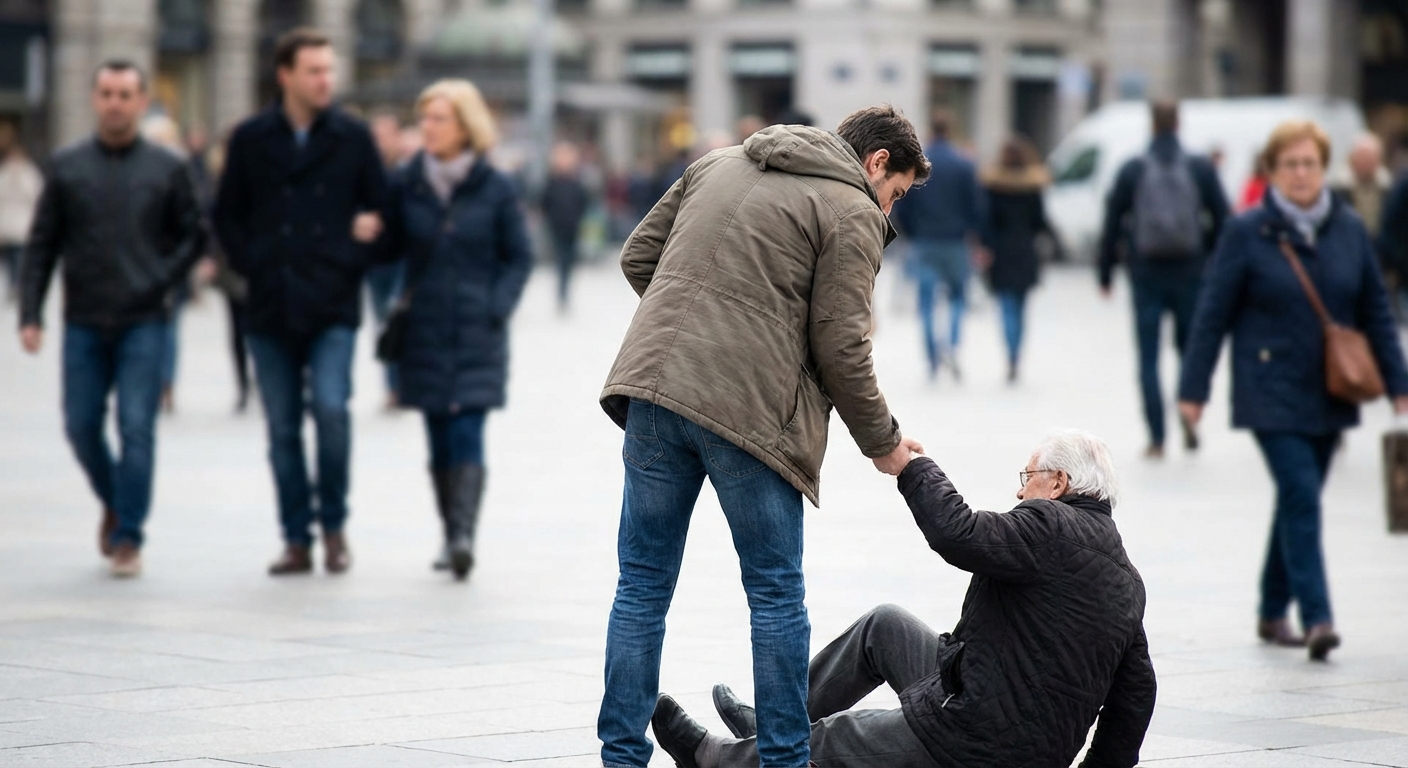
You’re walking down a busy city street. It’s rush hour. Dozens of people are brushing past you, eyes glued to their phones or fixed on the horizon. Suddenly, ten feet away, a man clutches his chest and crumples to the concrete.
What happens next?
If you follow standard psychological theory, you might expect the crowd to rush in. Safety in numbers, right? But history and decades of research tell us the opposite happens. People freeze. They look at each other. They assume someone else—someone more qualified, someone with a medical degree, just someone else—is already dialing 911.
Now, change the scene.
You are walking on a quiet trail. It’s early morning. There is not another soul in sight. The same man is walking ahead of you. He clutches his chest and falls.
In this scenario, the dynamic shifts instantly. You don't look around. You don't wonder if a doctor is nearby. You know, with terrifying clarity, that you are the only thing standing between this man and a tragedy.
As of March 5, 2026, organizations like "Right To Be" are conducting massive, localized "Active Bystander" trainings to combat a rising trend of public apathy. But there is a secret component to this training that often gets overlooked: the power of the solo responder. We often talk about the "Bystander Effect" as a reason why people don't help. But we rarely talk about the inverse—the "Singular Helper Phenomenon"—and how being alone actually hot-wires your brain for action.
The Core Idea: The Weight of One
We have spent the last sixty years misunderstanding the Bystander Effect. We tend to think of it as a flaw in human character, a sign that we are becoming colder or less caring. But it isn't a character flaw; it is a situational glitch.
The classic definition of the Bystander Effect relies on "diffusion of responsibility." Imagine responsibility as a 100-pound weight. If there are ten people witnessing an emergency, that weight is divided by ten. Everyone feels about ten pounds of pressure. That’s not enough to force action. It’s easy to shrug off ten pounds.
However, when you are the lone witness, you are carrying the full 100 pounds. This is the "Individual Effect." The internal psychological cost of doing nothing skyrockets because there is no one else to deflect the blame onto. You cannot tell yourself, "Well, the guy in the red jacket probably has it covered." There is no guy in the red jacket.
The numbers back this up. Research consistently indicates that in solo-witness scenarios, intervention rates can be as high as 85%. Compare that to a dismal 31% when people believe others are also witnessing the event.
This tells us something profound about human nature. We aren't naturally apathetic; we are naturally collaborative to a fault. When we see a group, our brains default to a "team" setting where we wait for a leader. When we are alone, we are forced to become the leader.
The Neuroscience of Solo Action
Your brain is an efficiency machine. It is constantly trying to save energy. When you are in a crowd, your brain enters a mode of reduced "motor preparation."
Think of your brain like a car engine. In a group setting, the engine is idling. The neural linkage between seeing an event and doing something about it is weakened. This is because your brain perceives the shared responsibility as a safety buffer. It lowers the emotional stakes of a bad outcome. If things go wrong in a group, the "fault" is shared.
When you are alone, the chemistry changes. A study by Marwa El Zein highlighted that while group decisions feel less burdensome because the blame is shared, solo situations trigger a much higher "sense of agency."
Agency is your subjective awareness that you are the one in control. It is the feeling of "I am doing this." When you are the only witness, your brain’s motor cortex lights up. You aren't idling anymore; you are revving the engine. The path from visual perception ("He fell down") to motor action ("Run to him") is clear of obstacles.
I see this dynamic play out in my own professional life constantly. In my work as a web developer and marketer, I often juggle multiple projects at once. When I’m part of a massive team launching a corporate campaign, it’s incredibly easy to assume someone else checked the tracking codes or proofread the copy. The "group" absorbs the anxiety. But when I’m freelancing on a solo project and the site goes down at 2 AM, that safety net is gone. The panic is immediate, but so is the fix. I don't wait for an email. I don't schedule a meeting. I just dive into the code and fix it, because the weight of that failure sits entirely on my shoulders.
That is the same neural pathway that activates when you see a car accident on a lonely road. The "weight" forces the movement.
Practical Steps for the Solo Responder
Knowing the science is great, but it doesn't always stop the freeze response. Even when you are alone, the shock of a sudden crisis can lock you in place. You need a framework to bridge the gap between "I should help" and "I am helping."
The most effective framework used in modern training is the "5Ds," adapted here for the solo responder.
1. Direct
This is the gold standard when you are alone. You don't need to check with anyone else. You walk up and engage. The best way to break your own psychological freeze is to use your voice. Ask, "Are you okay?" or state, "I am here to help." Hearing your own voice solidifies your sense of agency. It makes the situation real.
2. Distract
Sometimes, direct intervention is dangerous, especially if the "emergency" is a conflict between two other people. If you are alone and unarmed, you don't want to physically jump into a fight. Instead, cause a distraction. Drop something loud. Shout that the police are coming. Ask one of the aggressors a nonsensical question like, "Do you know what time it is?" This snaps their brains out of the conflict loop and turns their attention to you, de-escalating the immediate violence.
3. Delegate (Even When Alone)
This sounds contradictory. How can you delegate if you are the only one there? You delegate to the system. If the situation is beyond your physical control—a fire, a violent crime, a severe medical event—your first move is to bring others into the equation. Call 911. By doing this, you are shifting the burden from your limited shoulders to a professional infrastructure. You are still the hero of the moment, but your "action" is acting as the communication bridge.
4. Document
If you cannot safely intervene, and you have already called for help, your role becomes that of the witness. Record the event. This is an act of service. In our legal system, video evidence or detailed notes can mean the difference between justice and ambiguity. However, never prioritize filming over saving a life if you are capable of helping.
5. Delay
This is for after the fact. If you couldn't act in the moment, you can still help once the dust settles. Check on the victim after the aggressor leaves. specific offers of comfort ("Can I sit with you?" or "Do you need water?") can mitigate the trauma of the event.
Overcoming Evaluation Apprehension
One of the biggest hurdles to helping is the fear of looking stupid. Psychologists call this "Evaluation Apprehension."
We worry that we will rush over to help someone who is just tying their shoe, and we will look foolish. We worry that we will try to perform CPR and do it wrong, and everyone will judge us.
When you are in a group, this fear is paralyzing. You feel the eyes of the crowd on you before you even move.
But when you are alone, this hurdle vanishes. There is no audience. There is no one to roll their eyes if you ask, "Are you okay?" and the person says, "Yeah, I just dropped my contact lens."
This is the hidden superpower of the solo responder. You have the freedom to be wrong. You have the freedom to overreact. It is infinitely better to apologize for an awkward check-in than to walk away from a dying person because you were afraid of being embarrassed.
The Power of Agency
This phenomenon works because it destroys "Pluralistic Ignorance." This is the fancy term for looking at other people to see how you should feel.
In a crowd, you look at the guy next to you. He looks calm (because he is trying to look cool). You think, "Well, he isn't panicking, so it must not be an emergency." He is looking at you, thinking the exact same thing. It is a feedback loop of inaction.
When you are alone, the mirror is broken. You are forced to rely on your own gut instinct. You have to consult your own moral compass, your own eyes, and your own ears. And usually, your gut is right.
We live in a world that is increasingly connected digitally but disconnected physically. You might find yourself alone in situations more often than you expect. Don't fear that isolation. Embrace the clarity it brings.
When there is no one else to watch, no one else to blame, and no one else to judge, you are free to do the one thing that matters: act.