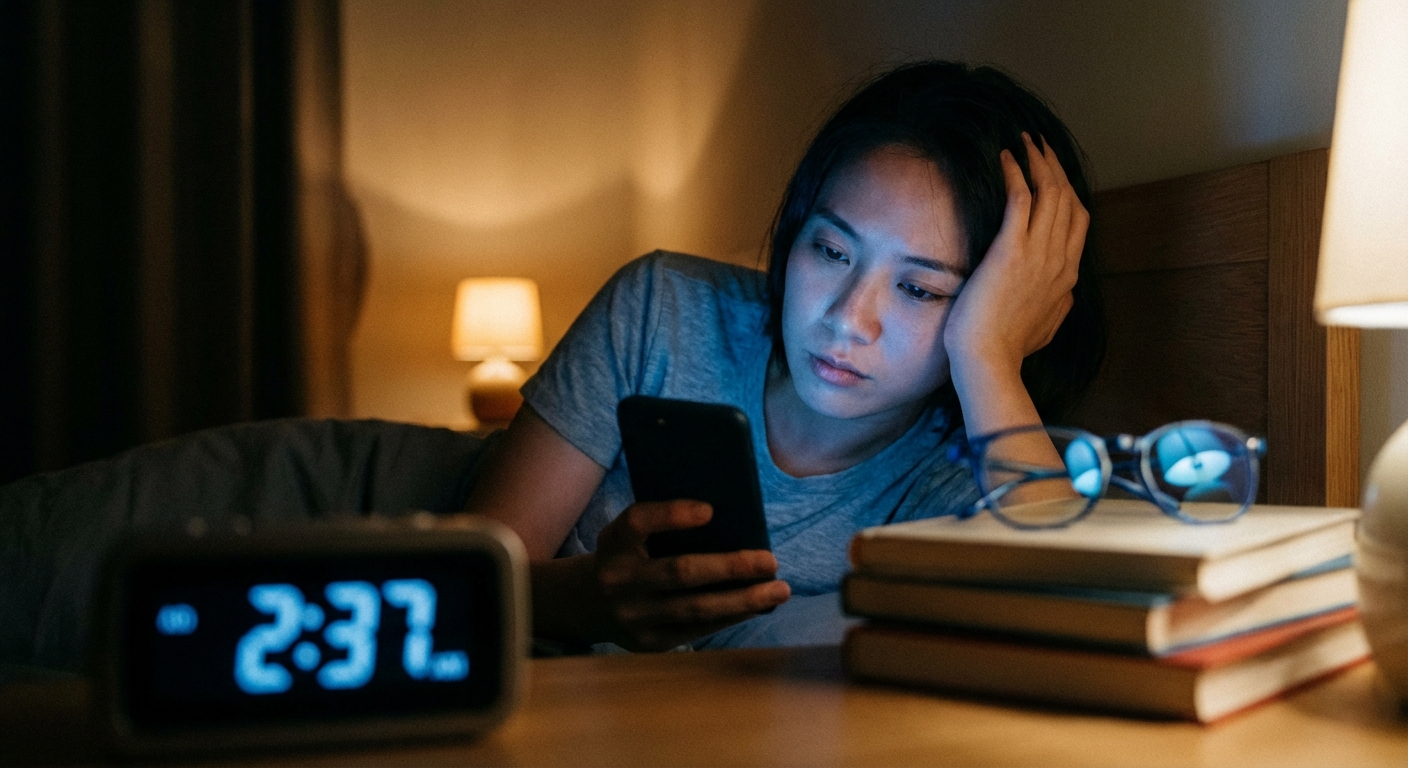
We’ve all been there. It’s 10:30 PM, and you tell yourself you’re just going to check your email one last time or scroll through your feed for five minutes to "wind down." The next time you look at the clock, it’s 1:15 AM. You feel wired but exhausted, your eyes are dry, and you know tomorrow is going to be a struggle.
For years, we treated this as a discipline problem. We told ourselves we just needed more willpower. But as we settle into 2026, the conversation has shifted dramatically. We now know that counting screen hours is obsolete. It’s not just about how long you look at the screen; it’s about what that specific light is doing to your biology.
This isn’t just a personal hunch. On March 3, 2026, the UK government launched the world's most ambitious consultation on digital wellbeing, explicitly targeting features like infinite scroll and the high-engagement algorithms that drive sleep deprivation. The consensus is in: your phone isn’t just distracting you. It is physically altering the chemical and structural makeup of your brain.
The Biological Bypass
To understand why "just putting the phone away" feels physically painful, you have to understand the machinery of your eyes. Most of us think our eyes are just cameras—they take in images and send them to the visual cortex so we can see. But that’s only half the story.
Your eyes have a secondary, hidden function. There are specialized cells in your retina called intrinsically photosensitive retinal ganglion cells (ipRGCs). These cells don't care about shapes, colors, or the funny meme your friend just sent you. They only care about the intensity and frequency of light. specifically, blue light in the 480nm range.
Here is the kicker: these cells bypass your visual center entirely. They have a direct hotline to the Suprachiasmatic Nucleus (SCN).
Think of the SCN as your brain's Master Clock. It tells every organ in your body when to be active and when to rest. When you stare at your phone at 11 PM, those ipRGCs scream at the Master Clock that it is noon. They mimic the frequency of the midday sun perfectly.
Your brain, trying to be helpful, responds immediately. It slams the brakes on melatonin production—the hormone required for deep restorative sleep—and instead keeps your cortisol levels primed for daytime activity. You might feel tired physically, but chemically, your brain believes it is time to hunt, gather, or work. You are creating a jet-lag state without ever leaving your zip code, night after night.
The "Rewiring" Mechanism
If the problem were only a few nights of bad sleep, you could catch up on the weekend. But the research emerging in 2026 points to something more permanent. We are seeing evidence of neuroplasticity working against us.
Neuroplasticity is your brain’s ability to reorganize itself by forming new neural connections. It’s how you learn a new language or how to drive a car. But your brain is neutral; it will reinforce bad habits just as strongly as good ones. Chronic exposure to high-energy visible (HEV) light at night, combined with the dopamine loops of social media, is literally rewiring your neural circuitry.
Specifically, we are looking at the amygdala and the prefrontal cortex.
The amygdala is your brain's threat detection center. It manages fear, anxiety, and emotional regulation. Recent studies suggest that chronic evening blue light exposure "rewires" the medial amygdala circuit. It makes the connection stronger, louder, and more sensitive. This means you aren't just tired; you are physically becoming more prone to anxiety and avoidance behaviors. You are training your brain to be on high alert.
Simultaneously, the lack of restorative sleep impairs the prefrontal cortex. This is your brain's CEO. It handles impulse control, planning, and rational thought. When you sleep-deprive this area, it goes offline.
I know this sensation intimately. A few years ago, I was stuck in a loop of late-night gaming and doom-scrolling. I would tell myself I was relaxing, but in reality, I was frying my dopamine receptors. I wasn't just tired during the day; I was foggy, reactive, and unable to focus on deep work. My "CEO" was asleep at the wheel, and my amygdala was driving the bus. It wasn't until I completely severed that nighttime connection that I realized how much brain fog I had accepted as normal. I had to quit the gaming and the scrolling entirely to get my brain back.
When you combine a hyper-active fear center with a sluggish executive center, you get a brain that is anxious, impulsive, and unable to regulate its own emotions. Furthermore, this circadian misalignment increases inflammatory markers in the brain tissue itself. We are talking about physical inflammation in the neural pathways, which is a precursor to cognitive decline and depression.
Practical Steps for Brain Hygiene
So, if the phone is a biological weapon against your sleep, how do you disarm it? You don't need to move to a cabin in the woods, but you do need to be ruthless about your light environment.
1. The Digital Sunset
This is the most critical step. You need a hard cutoff time for blue light exposure, ideally two hours before bed. This is often called a "Digital Sunset."
This means the phone does not enter the bedroom. Period. If you use your phone as an alarm clock, stop. Buy a cheap analog alarm clock. The excuse of "I need it for the alarm" is the addict talking. If your phone is within reach, you will check it. By removing the device physically, you prevent the ipRGC activation that suppresses melatonin.
Instead of scrolling, fill that time with low-stimulation activities. Read a physical book. Engage in quiet contemplation or prayer. In the Christian Orthodox tradition, there is a profound emphasis on evening stillness and silence to settle the heart before sleep. Whether you are religious or not, the physiological benefit of silence and lack of optical stimulation is undeniable.
2. Morning Blue Light Therapy
Here is the paradox: blue light isn't "bad." It’s only bad at the wrong time. In the morning, you actually need a massive dose of it.
Morning blue light anchors your circadian rhythm. It tells the SCN that the day has started, which starts a countdown timer for melatonin release 12-14 hours later. If you want to sleep better at night, you need to get outside within 30 minutes of waking up. Ten minutes of sunlight in your eyes (not staring directly at the sun, but being outdoors) sets the rhythm for the whole day.
3. Shift to Finite Media
The infinite scroll is designed to keep you in a state of "seeking." It triggers a dopamine loop that never resolves. This keeps your brain in a state of low-grade agitation.
Shift your consumption to finite media. Watch a movie (it ends). Read a chapter (it ends). Listen to a podcast episode (it ends). Finite media allows your brain to experience a narrative arc and a conclusion, which provides a sense of closure and allows the brain to transition into rest mode much easier than the bottomless pit of a social feed.
Conclusion
We are moving past the era of "screen time" guilt. This isn't about being a luddite or hating technology. It is about biology.
Your brain was designed to sync with the sun. It was designed to have periods of intense focus and periods of deep, dark rest. When you blast your retinas with blue light at midnight, you aren't just breaking a rule; you are breaking your biochemistry.
The shift from "Digital Detox" to "Brain Hygiene" is about respect. Respect for the complex, fragile, and incredible machinery inside your skull. You wouldn't pour sand into the gas tank of your car. Stop pouring blue light into your brain at 1 AM.
The rewire is possible. The inflammation can settle. The focus can return. But it starts with the simple, difficult act of pressing the power button and embracing the dark.