It is March 2026, and the conversation around our homes has shifted. We are finally moving away from the frantic, aggressive decluttering that dominated the early 2020s. We are tired of just throwing things away only to buy more. Instead, we are seeing a rise in "Intentional Ownership." This isn't about living in an empty white box; it is about curating a life where every object serves a purpose. It is about quiet living. And there is no better tool to kickstart this profound shift than the 100-Thing Challenge.
The Philosophy of Intentionality
The concept of the 100-Thing Challenge isn't new, but its relevance has never been sharper. It was popularized years ago by Dave Bruno, a man who realized that the "American Dream" had morphed into a nightmare of excess. He felt a "suffocating weight" from modern consumer culture—a feeling most of us know intimately. We work hard to buy things, then we work harder to house, clean, organize, and eventually discard those things. It is a cycle that drains our energy and steals our peace.
Bruno’s challenge was a grassroots rebellion. He wanted to prove that a person could not just survive, but actually thrive, with only 100 personal items. The number 100 is not a magic spell. It is an arbitrary threshold designed to force a psychological break. When you have no limit, you keep everything "just in case." When you have a hard limit, you are forced to make value judgments. You have to decide what actually matters.
I know a thing or two about the suffocating nature of excess and the discipline required to shed it. Years ago, I lost 110 pounds and stopped binge eating. The physical transformation was obvious to everyone around me, but the mental shift was exactly the same as this challenge. I had to stop mindlessly consuming—whether it was food or habits—and start making hard, conscious choices about what I allowed into my life. Shedding that weight taught me that holding onto "excess" doesn't make you safer or happier; it just makes it harder to move. The 100-Thing Challenge is simply weight loss for your home.
This movement is about recognizing that clutter isn't just physical; it is mental. In a world of digital screaming and physical overstimulation, our homes should be sanctuaries of silence and stillness. By limiting your physical possessions, you are essentially building a fortress against the chaos of the outside world.
Practical Steps for Your Challenge
If you are ready to stop shuffling clutter and start living, you need a plan. You cannot simply open a closet and hope for the best. You need a strategy that acknowledges the reality of your life. Here is how to execute the challenge without losing your mind.
1. Set Your Personal Rules
The biggest mistake people make is trying to be a purist. If you are a single nomad, maybe you can count every fork and spoon. But if you are a parent with a mortgage? That is impossible. You need to define what counts as "yours."
Dave Bruno famously established the "personal vs. shared" rule. This is critical. Do not count family items like the couch, the television, the plates, or the toaster. Those are shared infrastructure. You are counting your personal possessions: your clothes, your gadgets, your hobby gear, your accessories. This makes the challenge sustainable and prevents you from becoming a tyrant to your family.
2. Category Sorting and Triage
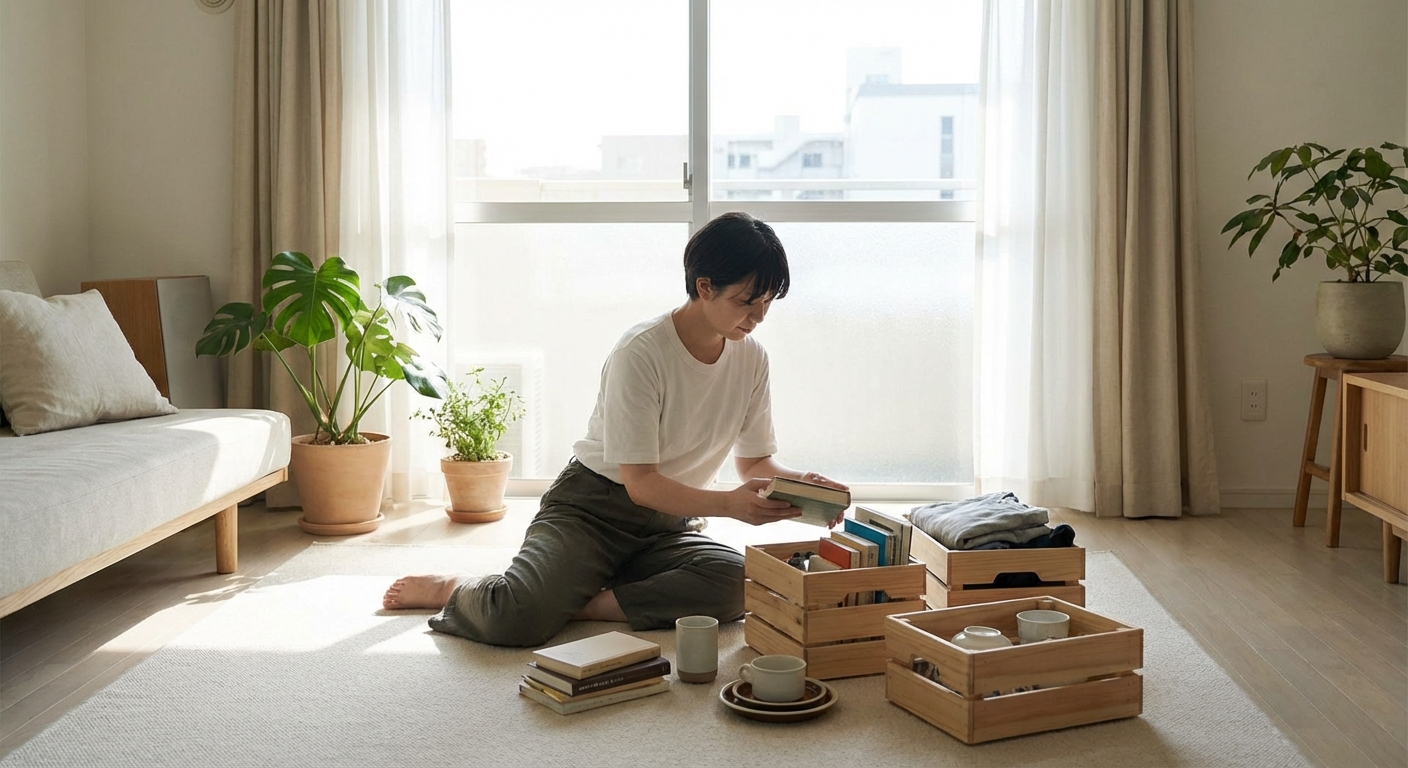
Once you know the rules, you need to see the enemy. Pull everything you own out of the closets and drawers. Yes, all of it. Seeing it in one pile is often enough to trigger a realization of how much you have accumulated.
Sort every single item into three distinct piles:
- Pile A (Must-Keep): These are the non-negotiables. The clothes you wear weekly, the tools you use for your work, the few sentimental items you would grab in a fire.
- Pile B (Maybe): These are the items that make you hesitate. The shirt you haven't worn in a year but "might" need. The hobby gear you bought but rarely use.
- Pile C (Go): Trash, donate, or sell. Get this out of your house immediately.
If the total count of Pile A and Pile B is under 100, congratulations. But for most of us, that number will be much higher. This is where the real work begins. You have to whittle down Pile B until you fit the cap.
3. The Someday Box
The hardest part of this process is the fear of regret. What if I need this cable in three months? What if I fit into these jeans next year? This fear is what keeps our closets stuffed.
To combat this, use the "Someday Box" method. Take the items from Pile B that you are struggling to part with, put them in a box, and tape it shut. Write the date on the outside—exactly six months from today. Put the box in the garage or a storage area. If you truly need an item, you can go get it (and it counts toward your 100 things). But if six months pass and you haven't opened the box, you donate it without opening it again. You have proven to yourself that you don't need it.
4. Maintain via "One-In, One-Out"
Getting to 100 items is a project; staying there is a lifestyle. The world will constantly try to push more stuff into your life. You must be the gatekeeper. Adopt the "One-In, One-Out" rule immediately. If you buy a new pair of shoes, an old pair must be donated. If you buy a new gadget, the old one must be sold. This prevents the slow creep of accumulation and forces you to constantly evaluate the utility of what you own.
Why It Works: The Science of Less
You might be thinking, "Why 100? Why not just 'clean up'?" The answer lies in how your brain handles data.
The Brain’s CEO and Cognitive Load
Your brain has a decision-making center—think of it as the CEO. Just like any executive, this CEO has a limited amount of energy each day. Every single object in your line of sight consumes a fraction of that energy.
A cluttered room is a room that is screaming at you. The pile of mail says, "Read me." The broken chair says, "Fix me." The overflowing closet says, "Organize me." This is called cognitive load. Even if you aren't consciously thinking about these objects, your brain is processing them. It creates a low-level hum of stress that never goes away.
By reducing your personal inventory to 100 items, you are quieting that noise. You are firing the bad employees so the CEO can focus on the actual work. This is why people report such a sudden surge in clarity and focus after completing the challenge. It isn't just about clean shelves; it is about a clean mind.
The Experiential Advantage
There is a profound shift that happens when you stop looking for satisfaction in malls and online stores. We have known for a long time that experiences bring more happiness than things, but the 100-Thing Challenge forces you to live that truth.
When you cannot buy a new toy to make yourself feel better because you are at your 100-item limit, you have to look elsewhere for dopamine. You turn to conversations, to walks, to learning new skills, to prayer, to sitting in silence. You start investing in memories rather than inventory. This "experiential advantage" is key to long-term contentment. You realize that your life is defined by what you do, not what you hold.
Freedom to Risk
Finally, there is a practical, financial reality to this. Stuff costs money. It costs money to buy, money to store, and money to move. When you own less, you usually owe less.
By opting out of the consumer rat race, you often find yourself with more disposable income and fewer fixed obligations. This grants you the freedom to take risks. You can change careers, move to a new city, or take time off to pursue a passion because you aren't anchored down by a house full of possessions that require a high salary to maintain. Intentional ownership is, at its core, about buying your freedom.
Defining Personal Boundaries
Ultimately, the 100-Thing Challenge is an exercise in boundaries. We live in a culture that feels entitled to our attention and our wallets. Marketing algorithms know exactly what you want before you do. They are designed to exploit your impulses.
Drawing a line in the sand—saying "I will own this much and no more"—is an act of defiance. It is a way of reclaiming your agency. You are telling the world that you are not a consumer first; you are a human being first.
This challenge isn't the end goal. It is the beginning of a different way of viewing the world. It leads to a life of "quiet living," where your surroundings support your purpose rather than distracting from it. It allows for more time in prayer or contemplation, more time for friends, and more time for deep work.
So, don't look at the number 100 as a restriction. Look at it as a target. It is a tool to strip away the non-essential so that the essential can truly shine. Start with your closet. Start today. The lightness you feel on the other side is worth every difficult decision.