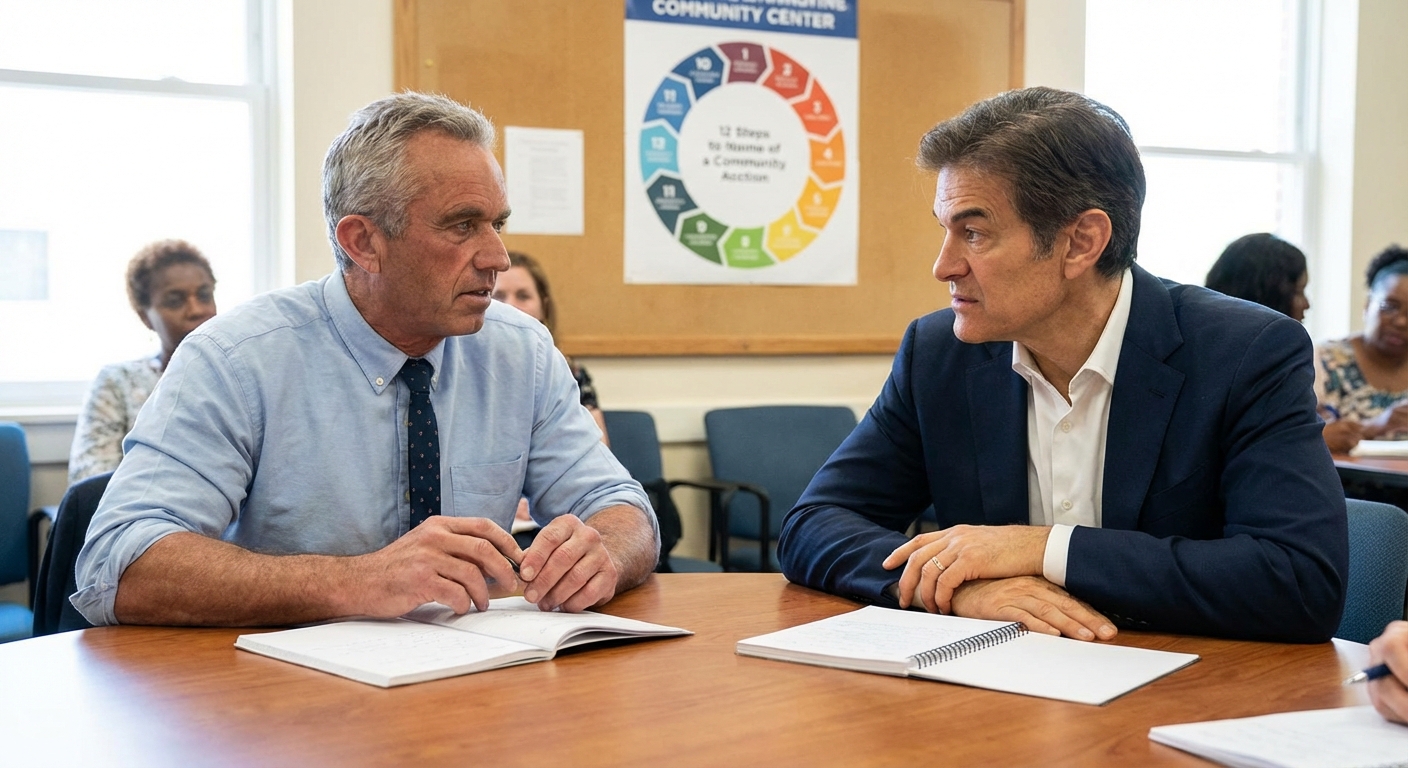
In March 2026, Washington finally admitted what many of us have known for decades: we are facing a deep spiritual crisis. When RFK Jr. and Dr. Oz announced the "Action for Progress" initiative, they weren't just talking about policy; they were acknowledging that the addiction epidemic is driven by a nationwide "spiritual malaise."
The Unlikely Architects
For a long time, we tried to treat addiction solely as a biological glitch or a lack of willpower. But the framework that the government is now championing—the 12-step model—didn't come from a lab coat or a government think tank. It came from a desperate conversation in the 1930s between a "hopeless" drunk and one of the world's most famous psychologists.
The origin story is one of my favorite pieces of history because it proves that sometimes, science has to admit when it has hit a wall. In 1931, an American businessman named Rowland Hazard sought help from Carl Jung, the legendary Swiss psychoanalyst. Hazard was a chronic alcoholic who had tried everything money could buy to get sober. He expected Jung to offer a new psychological insight or a medical cure.
Instead, Jung looked him in the eye and told him the hard truth: he was medically hopeless. Jung explained that in his experience, cases as severe as Hazard's could not be fixed by the mind alone. He told Hazard that his only hope was a "vital spiritual experience"—a complete psychic change that could rearrange his motivations on a fundamental level.
Hazard took that advice to heart. He joined the Oxford Group, a Christian evangelical movement popular in the 1920s that focused on four moral absolutes: honesty, purity, unselfishness, and love. It wasn't an addiction program, but its principles of confession and restitution gave Hazard the spiritual jolt Jung had prescribed.
Hazard passed this message to a man named Ebby Thacher, who passed it to a stockbroker named Bill Wilson. Bill W., as he became known, was ruining his life with alcohol. But after hearing the message, he had his own profound spiritual experience in a hospital room. He realized that to keep this new "gift" of sobriety, he had to give it away.
In June 1935, in Akron, Ohio, Bill W. met Dr. Bob Smith, a surgeon who couldn't stop drinking. They talked for hours, not as doctor and patient, but as equals suffering from the same malady. That conversation birthed Alcoholics Anonymous. They took the chaotic, high-intensity tenets of the Oxford Group and distilled them into a practical, 12-step framework that could work for anyone, regardless of their specific religious background.
Why It Still Works
Fast forward to 2026. We have advanced pharmaceuticals, AI-driven therapy apps, and a deeper understanding of neurobiology than Bill W. could have ever dreamed of. Yet, the "Action for Progress" initiative is doubling down on this 90-year-old model. Why?
Because it works. And now, we actually have the data to prove it.
For years, critics called the 12 steps "unscientific." But a massive Cochrane Review released in 2020—considered the gold standard of medical research—analyzed 27 studies involving over 10,000 participants. The results were undeniable. Manualized 12-step facilitation (TSF) was significantly more effective than Cognitive Behavioral Therapy (CBT) for achieving long-term abstinence. Specifically, 42% of AA participants remained abstinent after one year, compared to just 35% of those in other clinical treatments.
The magic isn't just in the steps themselves; it's in the fellowship. Humans are social creatures. We mimic the behaviors of the herd. When your herd is drinking or using drugs, your brain normalizes that behavior. To get sober, you don't just need to stop the chemical intake; you need to fire your old social network and hire a new one.
I remember when I finally quit smoking and vaping. The physical withdrawals were brutal—sweats, irritability, the works. But the hardest part wasn't the nicotine craving itself; it was the loneliness. I realized my entire social life at work and with friends revolved around "stepping outside" for a smoke. That was my break, my community, my moment of connection. I had to build a totally new life where my connections weren't based on a shared vice, and that void was terrifying until I found better ways to fill it.
The 12-step program provides an instant, accountability-based community. It replaces a network that triggers substance use with one that reinforces discipline and sobriety. It turns the "herding instinct" from a liability into an asset.
The Framework in Practice
If you walk into a meeting today, whether it's in a church basement or a high-end treatment center, the core mechanics haven't changed. It is a system designed to dismantle the ego, which is usually the driving force behind addiction.
Step 1: The Surrender
The first step is admitting you are powerless over the addiction and that your life has become unmanageable. This is the hardest hurdle. In our culture, we are taught to be the masters of our destiny. We are told to "manifest" our dreams and control our reality. Step 1 demands the opposite. It requires total defeat. Clinicians now understand this as a critical psychological shift from denial to acceptance. You can't fix a problem you refuse to acknowledge.
Steps 4 & 5: The Inventory
This is where the real work happens. Participants are asked to make a "searching and fearless moral inventory" of themselves and then admit the exact nature of their wrongs to another human being. This is essentially a form of intense cognitive processing. You are digging up past trauma, resentments, and fears—the "shadow" self that Jung spoke about—and exposing them to the light. By vocalizing these things to a sponsor or a priest, you drain them of their power. Shame thrives in secrecy; it dies in the open.
Step 12: The Service
The final piece of the puzzle is the "helper principle." Step 12 is about carrying the message to other addicts. This isn't just altruism; it's a survival strategy for the person already in recovery. Helping someone else keeps your own struggle front and center in your mind, preventing complacency. It gives you a sense of purpose and utility that addiction often steals away.
A Look at the Future
As we move through 2026, the landscape of recovery is shifting. We are seeing a move away from the "either/or" mentality. It is no longer about choosing between medical science and spiritual discipline. The most effective treatment centers—about 74% of them in the U.S. right now—are integrating 12-step models alongside medication-assisted treatment (MAT) and trauma-informed care.
This "whole-person" approach acknowledges a simple truth: You can detox the body with medicine, but you cannot medicate the soul. The "spiritual malaise" that Kennedy and Oz referenced is real. It is a disconnect from purpose, community, and something greater than ourselves.
The 12-step program remains the most potent tool we have for reconnecting those wires. It offers a path to stillness and a way to quiet the noise of the modern world through prayer, confession, and service. It reminds us that we are not the center of the universe, and paradoxically, that is the only thing that can save us.
Whether you are struggling with a substance or just the general chaos of modern existence, the principles laid down by a Swiss doctor and a broke stockbroker almost a century ago still hold water. Admission, inventory, restitution, and service. It’s a simple formula, but it works.