

If you think sitting in a quiet room and imagining yourself winning a gold medal is going to magically put one around your neck, you are going to be disappointed. That is wishful thinking, not training. But if you think mental rehearsal is just a placebo for people who are afraid of hard work, you are ignoring biology.
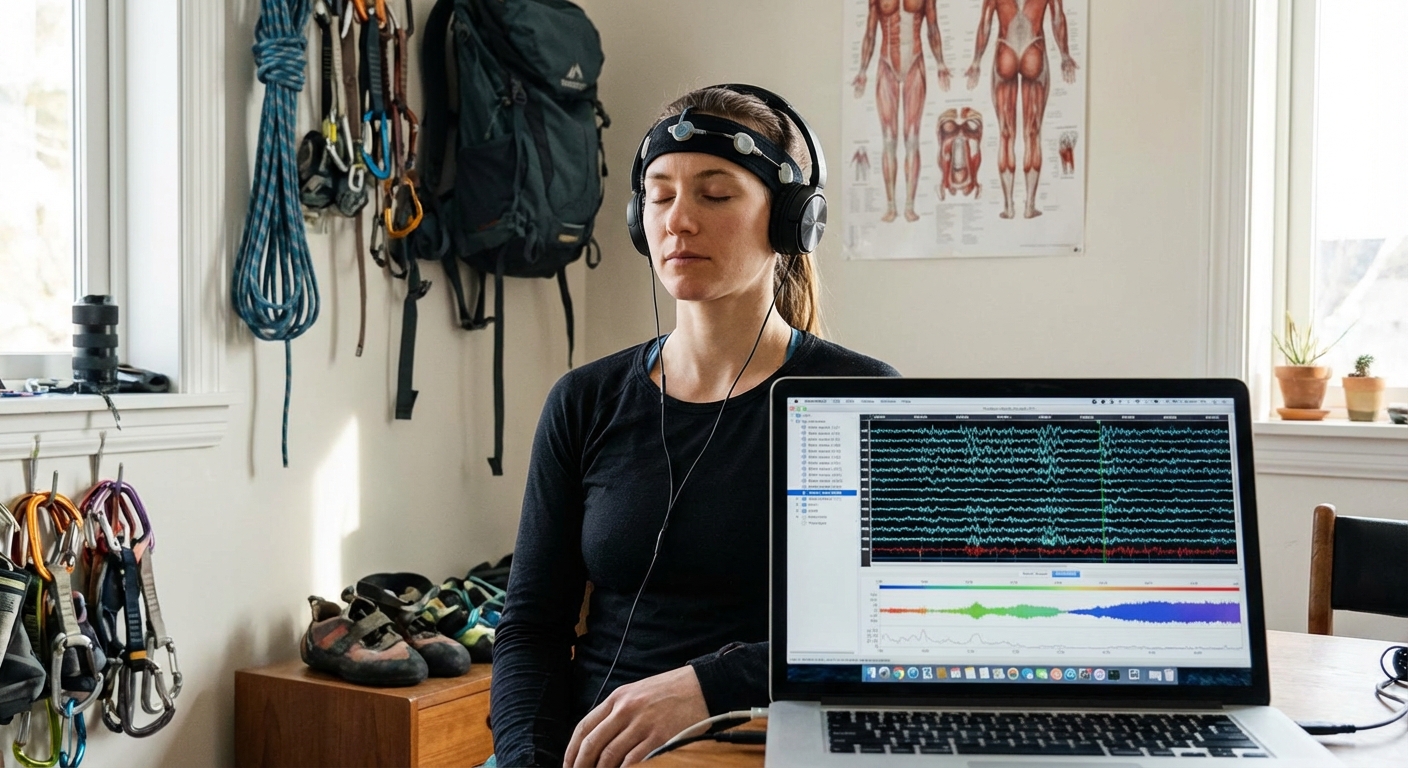
Right now, in March 2026, the "Mind of the Game" summit is happening in Houston. As teams prepare for the World Cup, the top sports psychiatrists and performance coaches aren’t talking about "manifesting" victory. They are looking at fMRI scans. They are treating the brain as a physical muscle that requires as much repetition as a hamstring or a quad. The shift is undeniable: mental conditioning has graduated from a "nice-to-have" bonus to a primary, data-driven necessity for handling high-speed fear and technical precision.
The difference between a champion and a runner-up often isn't the body; it's the software running the body. We need to strip away the fluff and look at the actual wiring under the hood. This isn't about magic; it's about mechanics.
The Brain Doesn't Know the Difference
The core concept you need to understand is called "Functional Equivalence." It sounds complicated, but it’s actually quite simple. It posits that your brain doesn't really distinguish between doing a thing and vividly imagining that same thing.
When you physically lift a heavy weight, your motor cortex lights up to send signals to your muscles. When you sit in a chair and vividly imagine lifting that weight—feeling the cold steel, the tension in your grip, the brace of your core—that same motor cortex lights up again. You are essentially "priming" the pump.
This isn't just a theory. The research backs this up aggressively. A study published just last year, in September 2025 in PNAS, looked at how expert athletes use their brains differently than novices. They found a phenomenon called "Neural Efficiency."
Here is the breakdown:
- Novices: When a beginner visualizes a task, their brain looks like a chaotic storm. It’s lighting up everywhere because it doesn't know what matters.
- Experts: When a pro visualizes, their brain is quiet. It only activates the specific, critical networks needed for that movement. However, when the task gets complex, the expert’s brain scales up its activity, running a high-fidelity simulation that a novice simply cannot generate.
The experts are running a flight simulator that is 99% accurate to reality. The novices are just playing a video game. This specific neural tuning is what we are after. We want your brain to run the code so many times that when you step onto the field or the court, your body is just executing a program it has already run a thousand times perfectly.
The PETTLEP Protocol
So, how do you move from "daydreaming" to "neurological programming"? You need a framework. You can't just close your eyes and hope for the best. The gold standard for this is the PETTLEP model. It stands for Physical, Environment, Task, Timing, Learning, Emotion, and Perspective.
It is a checklist to ensure your mental reps are as "real" as possible. If you want the biological benefit, you have to mimic the biological reality.
Physicality
You cannot do this effectively while lying in bed halfway asleep. You need to replicate the physical sensations. If you are a soccer player, wear your cleats. If you are a fighter, wrap your hands. A study on the PETTLEP approach showed that when athletes adopted the stance of their sport during visualization, the brain activation was significantly higher than when they were relaxed. You need to tell your nervous system, "We are doing this now."
Environment
Your brain relies on cues. The smell of the grass, the hum of the stadium lights, the temperature of the gym. If you visualize in a sterile, silent room, you are training for a sterile, silent event. You need to close your eyes and rebuild the sensory environment. What does the chalk smell like? Is it cold? Is the crowd loud? The more sensory data you include, the more your brain accepts the simulation as reality.
Timing
This is where most people fail. They rush. They imagine a perfect sprint or a perfect lift, but they play it at 2x speed in their head. The research is clear: you must rehearse in real-time. If a 100-meter sprint takes you 11 seconds in real life, your mental rep must take exactly 11 seconds.
Why does this matter? Because you are training firing rates. If you train your brain to execute a movement pattern faster than your body can physically handle, you are building a disconnect that can lead to sloppy form or injury. You have to sync the software clock with the hardware clock.
Dosage
How much is enough? We finally have some concrete numbers on this. Recent meta-analyses from 2025 suggest a specific "dosage" for maximum effect. You don't need to spend hours doing this. The sweet spot appears to be approximately 10 minutes, three times a week.
If you stick to this for a cycle of about 100 days, the performance gains are measurable. It’s just like lifting weights. You don't bench press for six hours once a month and expect results. You show up, do the work for 20 minutes, and come back two days later. Consistency beats intensity every single time.
The Evidence Base
We have moved past the era of anecdotal evidence. We now know specifically why this works on a physiological level. It comes down to three main factors: muscle priming, anxiety reduction, and connectivity.
Muscle Priming
When you visualize correctly, your brain sends sub-threshold electrical signals to your muscles. These signals aren't strong enough to cause your arm to move, but they are strong enough to traverse the neural pathways.
I have seen this in my own life recently. I started training Muay Thai a while back to mix up my routine. I am incredibly inconsistent with the physical classes because of my work schedule. But on the days I can't make it to the gym, I spend ten minutes visualizing the combo drills. I stand in my living room, in my stance, and I run the tape. When I finally get back to the gym and hit the pads, the coordination is there. I haven't physically thrown the kick in a week, but my hip turns over correctly because I kept the pathway greased. The research says this can improve coordination by up to 30%, and frankly, it feels like even more than that to me.
Anxiety Reduction
This is perhaps the most pragmatic application for anyone who gets nervous before a big event. Structured outcome visualization can reduce competition anxiety by roughly 38%.
The mechanism here is fascinating. Your brain treats "unknowns" as threats. That is why you get butterflies; your body is preparing for a fight-or-flight scenario against a predator it hasn't seen yet. But if you have visualized the match winning point five hundred times, your brain recognizes the scenario. It treats the "imagined success" as a familiar, safe memory. You aren't walking into the unknown; you are walking into a room you have been in every day for the last three months.
Connectivity
Finally, we have the "fronto-parietal-temporal network." That is a mouthful, but it essentially refers to how different parts of your brain talk to each other. Athletes who use visualization develop a more cohesive network. This allows them to read the game faster.
While the guy who only did physical drills is still processing the position of the ball, the visualizer has already predicted the trajectory and is moving to intercept. It looks like "talent" or "instinct," but it’s actually just better internet speed between the different lobes of the brain.
Moving From Abstract to Concrete
The days of viewing mental training as a soft skill are over. If you are serious about performance—whether that is on a field, in a boardroom, or in a gym—you have to treat your brain with the same discipline you treat your body.
You don't need incense, and you don't need a guru. You need a quiet space, your game-day gear, and a timer.
Start with the PETTLEP model. Check the boxes.
- Are you in the right stance?
- Are you picturing the right environment?
- Are you running the tape in real-time?
Do this for ten minutes, three times a week. That is thirty minutes of work a week that can yield a 30% improvement in coordination and a massive drop in anxiety. That is an ROI that you simply cannot get from physical training alone.
The research is clear. The biology is proven. The only variable left is whether you have the discipline to sit in silence and do the work.

See also in Personal Growth
I Don’t Have a Passion, and Honestly, I’m Kinda Freaked Out
10 Steps to Create a Vision for Your Future
15 Team Building Skills for Success
Why the Most Meaningful Friendships Start After 30
20 Strategies for Overcoming Negative Thinking
The ‘Gottman Method’ Relationship Fix That Takes 6 Seconds