

Yesterday, on March 4, 2026, a magnitude 6.4 earthquake rattled the Rat Islands in Alaska’s Aleutian chain. Almost immediately, my news feed lit up. It wasn’t just the report of the quake itself; it was the ripple effect of anxiety that followed. Suddenly, unverified rumors of seismic activity in Provo, Utah began trending. A minor tremor in Iran and reports of flooding in Brazil got swept up in the narrative.
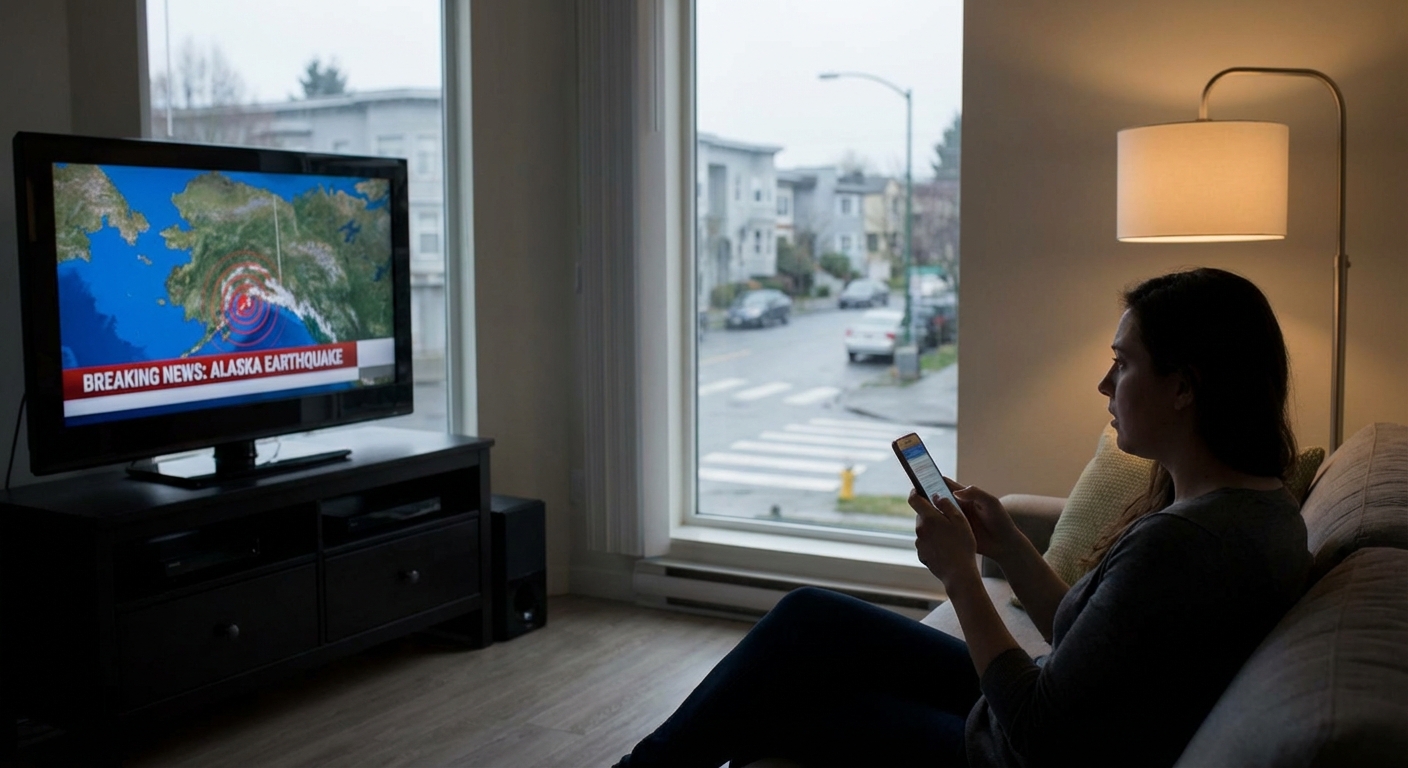
If you spent any time online in the last twenty-four hours, you probably felt a distinct, tightening sensation in your chest. The world feels volatile right now. It feels like the ground beneath our feet is crumbling and the oceans are rising up to meet us.
But here is the cold, hard truth: the statistical probability of you being harmed by a natural disaster today is virtually identical to what it was three days ago. The risk hasn’t changed. Your perception of the risk has.
This is a classic, textbook example of a mental glitch called the availability heuristic. It is the reason why we lie awake at night worrying about catastrophes that will likely never happen, while blithely ignoring the boring, quiet habits that are slowly killing us. We judge the likelihood of an event not by data, but by how easily we can recall an example of it. And right now, thanks to a 24-hour news cycle and a hyper-connected world, examples of disaster are very, very available.
The Science of "Mental Availability"
Your brain is an incredible machine, but it is also essentially a lazy search engine. It wants to save energy. When you are faced with a complex question—like "How safe am I right now?"—your brain doesn't want to run a complex statistical analysis. It doesn't want to pull up actuarial tables or study tectonic plate shifts.
Instead, it substitutes a difficult question for an easier one. It asks, "How easily can I remember a time when things went wrong?"
This cognitive shortcut was first identified by psychologists Daniel Kahneman and Amos Tversky back in 1973. They found that humans rely on the "ease of retrieval" as a proxy for frequency. If you can think of it easily, your brain assumes it happens often.
If you can instantly recall a vivid news report about an earthquake in Alaska, your brain marks "earthquake" as a high-probability event. It prioritizes information that is recent, dramatic, and emotionally charged. The logic operates on a simple, flawed principle: if I can recall it, it must be important.
In the ancestral environment, this kept us alive. If you saw a predator near the river, that memory needed to be vivid and easily accessible so you wouldn't get eaten the next day. But in the modern world, this survival mechanism backfires. We aren't dodging lions anymore; we are navigating a complex world of abstract risks, and our ancient hardware is struggling to keep up with the software of modern society.
The Vividness Trap
The availability heuristic thrives on drama. It loves a story. This is why we fall into what I call the "Vividness Trap."
Consider the way we view transportation. Almost everyone knows someone who is afraid of flying. Maybe you get a little nervous yourself when the turbulence hits. We fear plane crashes because they are horrifyingly vivid. They are catastrophic, rare, and they dominate the news cycle for weeks. The imagery is seared into our minds.
Because those images are so "available" to your memory, you overestimate the danger. Meanwhile, you likely drove your car to the grocery store today without a second thought. You didn't check your tire pressure, and you might have even glanced at a text message while merging.
Yet, statistically, the drive to the airport is the most dangerous part of any trip. Car accidents are mundane. They happen every single day. They are tragic, but they are rarely national news. Because they lack that "dread factor"—the psychological weight of uncontrollability and horror—we underestimate their risk.
Research in the "psychometric paradigm" of risk perception shows that we fear things that feel uncontrollable (like a shark attack or a nuclear leak) far more than we fear voluntary risks (like a poor diet or skipping the gym). If a risk is boring, we ignore it. If it is cinematic, we obsess over it.
This distortion has real consequences. It’s not just about being anxious; it’s about being wrong.
Real-World Consequences
When we let the availability heuristic drive the bus, we make terrible decisions. We allocate our emotional and financial resources toward guarding against lightning strikes while leaving the front door open to heart disease.
I know this firsthand because I lived it for years. I used to be a smoker and a heavy vaper. I knew, intellectually, that it was bad for me. I saw the warnings on the packs. But the damage was slow, invisible, and internal. I couldn't "see" my lungs darkening day by day. It wasn't vivid. It wasn't a headline.
So, I ignored the massive, accumulation of risk in my hand. Yet, at the same time, I would obsess over "sudden" dangers. I’d worry about breaking a bone if I tried a new sport, or I’d get anxious about a strange noise in my car engine. I was hyper-vigilant about the rare stuff and completely blind to the daily poison I was voluntarily inhaling. It wasn't until I finally quit—both the smoking and the vaping—that I realized how skewed my risk assessment had been. I was terrified of the wrong things.
This happens on a national scale, too. We see this in policy errors where billions are spent fighting extremely rare threats because they make for good campaign speeches, while systemic issues like infrastructure maintenance or preventative healthcare get budget cuts. We fixate on the breaking news and ignore the base rates.
We are terrible at math when emotion is involved. We neglect the "base rate"—the actual statistical prevalence of an event—in favor of the story that makes our heart race.
How to Think Statistically
You cannot turn off your brain's tendency to take shortcuts. It is hardwired into you. However, you can build a system to catch yourself when you are falling into the trap. You can move from emotional reaction to analytical response.
Here are three practical frameworks to recalibrate your sense of danger.
Consult Base Rates First
When you feel a spike of fear because of a headline—like the Rat Islands earthquake—stop and engage your logical brain. This is often called "System 2" thinking. It takes effort. You have to manually override the panic.
Ask yourself: "What is the base rate of this event?"
Before you buy a bunker, look up the actual frequency of earthquakes in that region. Look up the statistical probability of the threat affecting you personally. Usually, a five-second Google search for "annual probability of X" is enough to pop the fear bubble. You replace "It feels like this is happening everywhere" with "This happens to 0.0001% of the population."Actively Diversify Your Information
The algorithm is designed to feed you more of what you click on. If you click on one disaster story, you will be served ten more. This creates a false sense of "saturation." It looks like the whole world is burning because your entire feed is on fire.
You must curate your input. Seek out data from sources that track long-term trends rather than minute-by-minute catastrophes. Read books on history or long-form analysis rather than doom-scrolling social media. When you zoom out, the jagged spikes of daily news usually flatten into a much calmer trend line.Consider the Opposite
This is a powerful mental exercise. When you are certain a danger is rising, force your brain to look for evidence to the contrary.
If you think, "The world is getting more violent," deliberately ask yourself, "What evidence exists that the world is becoming safer?"
This forces your brain to retrieve different memories. You might recall that crime rates have historically trended down in many places, or that medical technology is better than ever. By challenging the "ease of retrieval," you break the loop. You force your brain to work for the counter-examples, which balances out your perspective.
Conclusion
The world is not as dangerous as the news makes it feel, nor is it as safe as our bad habits suggest. The truth lies somewhere in the middle, hidden in the quiet, boring data.
The earthquake in Alaska is real, and it is scary for those involved. But it is not a sign of the apocalypse. It is a geological event that happens with statistical regularity.
Your goal shouldn't be to eliminate fear. Fear is useful when a car is swerving into your lane. Your goal is to align your fear with reality. It is about moving from a reactive state, tossed around by the latest vivid headline, to a state of grounded awareness.
Don't let the availability heuristic dictate your peace of mind. Check the numbers. Breath through the panic. And remember that just because a thought is loud, doesn't mean it's true.

See also in Mindset
20 Ways to Enhance Creative Thinking
15 Ways to Practice Strategic Patience
15 Strategies for Mental Stamina
The ‘Sunk Cost Fallacy’ That Keeps You in Bad Relationships
How ‘Moral Licensing’ Makes Good Behavior Give You Permission to Be Bad
The Surprising Way Gratitude Physically Changes Your Brain