

On March 3, 2026, the streets of Birmingham, UK, witnessed a nightmare scenario. In broad daylight, near a primary school, a man began attacking people. It is the kind of situation that freezes the blood in your veins. It’s the moment we all hope we never face, and the moment we all secretly wonder if we could handle.
In the middle of that chaos, one person didn’t freeze. A bystander saw the danger, made a split-second calculation, and drove his vehicle toward the attacker to stop the assault. He then jumped out to help, putting his own safety on the line to protect strangers.
This coincides with the 55th annual National Safety Day, which emphasizes a simple, powerful truth: safety is a shared responsibility. But when we hear stories like the one in Birmingham, we usually think of the hero as someone different from us. We assume they are wired differently, born with courage the rest of us lack.
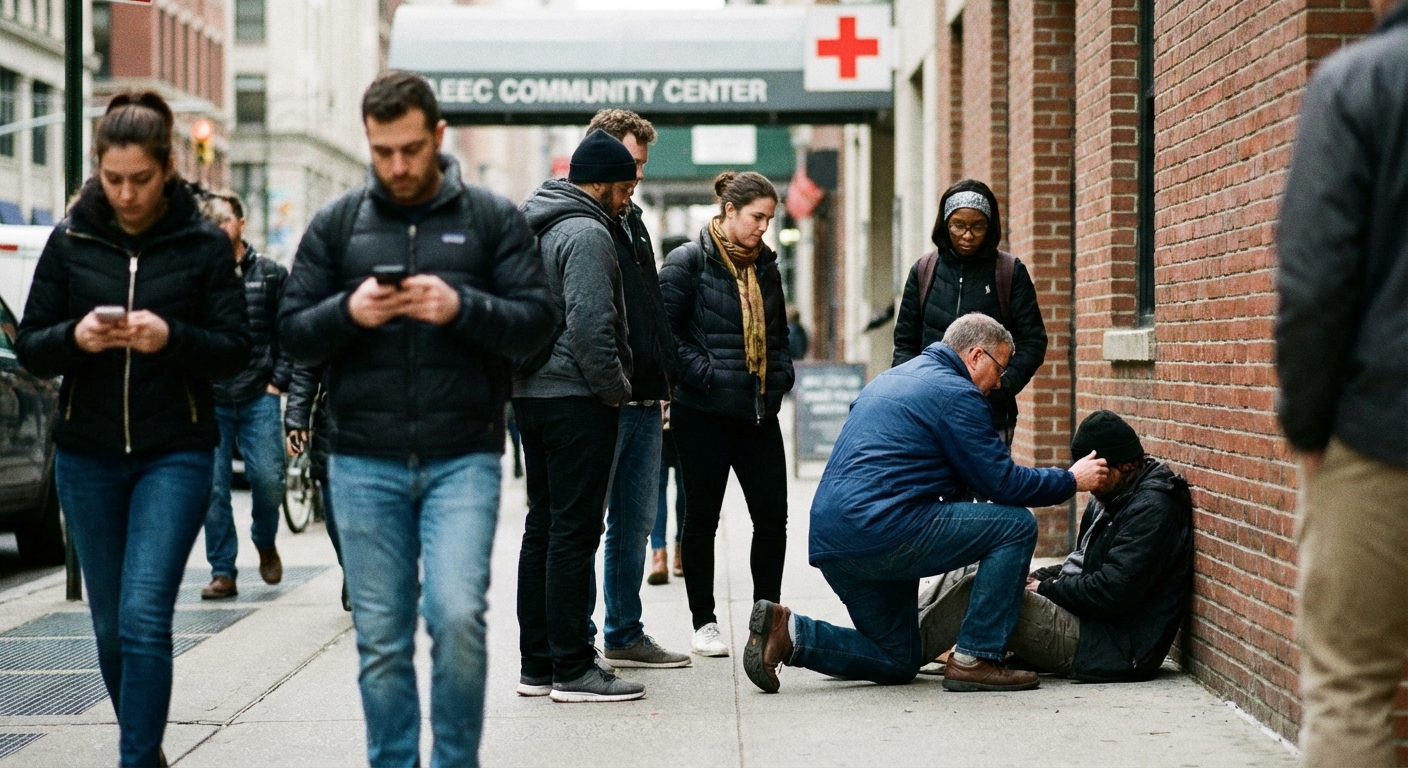
The truth is much more complicated. Most people want to help. Most people are good. But when an emergency happens in a crowd, a strange psychological short-circuit occurs. We don’t act. We wait. We look around. And often, we do nothing.
This isn’t about cowardice. It is about a biological and psychological trap known as the Bystander Effect. If you want to be the person who acts—the person who keeps your community safe—you have to understand how your brain works against you, and you need a plan to override it.
The Science of Silence
We like to think that having more people around makes us safer. Logic suggests that if someone collapses on a busy subway platform, they will get help faster than if they collapse on a lonely street. There are more eyes, more hands, and more phones to call for help.
Psychology tells us the exact opposite is true.
The core of this problem is a phenomenon called "diffusion of responsibility." When you are the only person witnessing an emergency, the burden of action falls 100% on your shoulders. There is no one else to blame if things go wrong, and no one else to save the day. Your brain’s "CEO" recognizes that you are the only variable in the equation, so it pushes you to act.
However, as soon as you add other people to the mix, that sense of personal responsibility dilutes. If there are ten people watching, you might subconsciously feel only 10% responsible. You assume someone else is already calling the police. You assume the guy in the suit is a doctor, or the woman in the gym clothes is an off-duty cop. You tell yourself, "Someone else has this handled."
The statistics on this are staggering. Classic research by Darley and Latané revealed that when people believe they are the sole witness to a crisis, 85% of them intervene. But when they believe just four other people are present, that number plummets to 31%.
The crowd doesn’t empower you; it sedates you.
This is compounded by "pluralistic ignorance." When an emergency starts, it’s rarely clear immediately. Is that couple fighting, or just loud? Is that man sleeping on the bench, or is he unconscious? To figure it out, we look at other people. We want to see how they are reacting.
Here is the trap: everyone else is looking at you to see how you are reacting.
If everyone looks calm because they are trying to figure out what is going on, the group collectively decides that nothing is wrong. We signal to each other that it’s not an emergency, effectively gaslighting the entire crowd into silence. We freeze because we don’t want to be the one person who panics when everyone else seems fine.
The 5-Step Path to Action
Overcoming this requires more than just good intentions. It requires a rewiring of your default instincts. You have to train yourself to recognize the freeze response and break through it.
I started training Muay Thai recently—I’m still inconsistent with it, and I’m definitely not a pro, but it has taught me something profound about the freeze response. The first time I sparred, I saw a punch coming and my brain just stopped. I knew what I should do. I knew the mechanics of a block or a slip. But the sheer reality of a fist coming at my face made me statue-still. I had to learn, through repetition and discipline, to move even when my brain wanted to lock up.
The Bystander Effect is a mental punch. You have to train your reaction before the fight starts.
Psychologists have identified a specific 5-step model that a person must go through to move from an observer to an "upstander."
First, you have to Notice the event. This sounds obvious, but in our world of noise-canceling headphones and endless scrolling, we are often oblivious to our surroundings. You cannot fix what you do not see.
Second, you must Interpret it as an emergency. This is where you have to stop looking at the crowd for confirmation. If your gut says something is wrong, trust it. Ignore the blank faces of the people around you. They are just as confused as you are.
Third, and this is the big one, you must Take Responsibility. You have to consciously tell yourself, "If I don't do something, no one will." You have to reject the comfort of the crowd.
Fourth, you must Decide how to help. This doesn't always mean jumping into a physical altercation. In fact, that is often the wrong move.
Fifth, you must Act.
The gap between step four and step five is where fear lives. But if you have a toolkit—a set of pre-planned moves—you can bridge that gap much faster.
Practical Tools for Intervention
You do not need to be a martial artist or a paramedic to save a life. You just need a framework. In safety circles, we use the "4 Ds" of intervention. These are four different ways to help, ensuring that you can do something useful regardless of your physical size or skill level.
1. Direct
This is the most confrontational approach, but it is also the most effective for breaking the diffusion of responsibility. If you are safe to do so, you can verbally intervene. A simple "Hey, is everything okay here?" or "Leave them alone" can be enough to snap an aggressor out of their momentum.
However, the most powerful "Direct" move is actually asking for help. If you are the victim, or if you are a helper who is overwhelmed, do not yell "Help!" into the void. The crowd will ignore you.
Instead, pick one person. Point at them. Be specific. Say, "You in the blue shirt, call 911 right now."
By isolating one person, you strip away the diffusion of responsibility. You have put the burden solely on them. Suddenly, they are no longer part of the anonymous crowd; they have a job. This almost always works.
2. Distract
If you are worried that a direct confrontation might turn violent, use distraction. Your goal here is to de-escalate the situation by breaking the tension.
You can spill your coffee near the people arguing. You can walk up and ask the aggressor for the time or directions, acting completely oblivious to the conflict. You can drop your keys or make a loud noise.
The goal is to interrupt the attacker’s train of thought. Violence is often fueled by a tunnel-vision focus on the victim. If you can break that focus, even for a few seconds, it gives the victim a chance to get away or for the dynamic to shift.
3. Delegate
You do not have to be the hero. If you see a fight breaking out and you know you cannot handle it physically, look for someone who can.
Find a security guard, a bouncer, or a store manager. If you are on a bus, tell the driver. If you are in a crowd, turn to two or three other people and say, "We need to stop this, come with me."
Remember the statistics: people are less likely to act alone. But if you invite them to join you, you create a new group norm. You are creating a "team" of helpers.
4. Delay
Sometimes, the situation is simply too dangerous. If there is a weapon involved, or if the environment is hostile, jumping in might just create two victims instead of one.
In these cases, "Delay" is your strategy. Wait until the immediate danger has passed, and then check in on the victim. Ask if they are okay. Offer to sit with them. Help them file a report.
Trauma is often compounded by the feeling of being alone. By showing up after the fact, you validate their experience. You tell them, "I saw what happened, it was wrong, and you are not crazy." That is a massive intervention in itself.
The Power of the First Mover
The Birmingham incident reminds us that the world can be dangerous, but it also reminds us that we have agency.
We are social creatures. We look to each other for cues on how to behave. This is why the Bystander Effect is so powerful, but it is also why you are so powerful.
Research into real-life conflicts shows that in over 90% of cases, at least one person eventually intervenes. And here is the key: once that first person moves, others almost always follow. The spell of silence is broken.
When you choose to act—whether you distract, delegate, or intervene directly—you are not just helping the victim. You are giving permission to everyone else in the crowd to be good. You are providing the "social proof" that this is an emergency and that action is required.
Don't wait for permission. Don't wait for the person in the suit or the person in the uniform. When the moment comes, take a breath, trust your gut, and be the first one to move.

See also in Personal Growth
The One Habit That Will Drastically Improve Your Relationships
12 Tips for Overcoming Fear of Failure
The Dunbar Number Explains Why You Can Only Maintain 150 Friendships
Why Talking to Strangers Is the Key to a Happier Life
15 Ways to Develop a Lifelong Learning Habit
The One Skill That Predicts Career Success Better Than IQ