

You’re scrolling through your phone, nodding along to every post you see. The news articles make perfect sense. The opinions align exactly with what you’ve always suspected. The people arguing against your worldview look increasingly irrational, misinformed, or downright dangerous. It feels good to be right. It feels safe. But there is a massive, invisible problem lurking behind that feeling of certainty. You aren’t seeing the world as it is; you are seeing a mirror reflecting your own desires back at you.
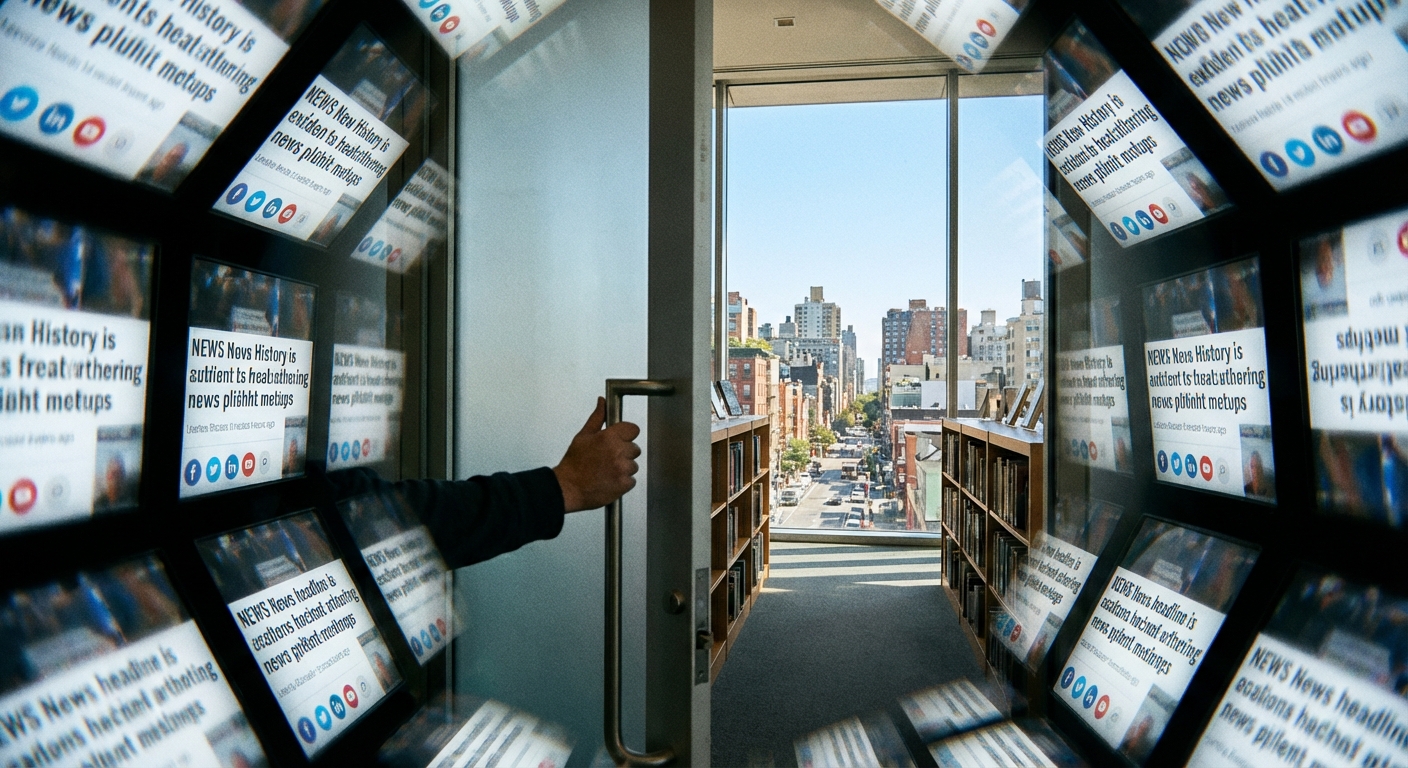
We like to imagine ourselves as independent thinkers, rationally evaluating facts before coming to a logical conclusion. We view our minds as impartial courtrooms where evidence is weighed by a fair judge. But recent data suggests our internal courtroom is rigged. A landmark study published in February 2026 in the journal Nature shattered the illusion of our independence. Researchers found that when users on the platform X (formerly Twitter) were switched from a chronological feed to an algorithmic one, their political opinions shifted significantly toward more extreme positions in just seven weeks.
Think about that time frame. It didn't take years of indoctrination. It took less than two months for a piece of software to fundamentally alter how human beings processed reality. This is the power of confirmation bias when it is weaponized by modern technology. It is the invisible hand guiding your logic, selecting the evidence that proves you right and quietly hiding everything that might prove you wrong.
The Architecture of Certainty
To understand why we fall for this trap, we have to look at the machinery of the human brain. Your brain is not designed for truth; it is designed for survival and efficiency. Processing new, conflicting information burns a tremendous amount of metabolic energy. It creates a psychological friction known as cognitive dissonance—the mental discomfort you feel when you hold two contradictory beliefs at the same time.
When you encounter facts that challenge your identity or your worldview, your brain treats it almost like a physical threat. To protect you from this pain, your mind engages in "motivated reasoning." This is where the courtroom analogy breaks down. Your brain isn’t the judge seeking the truth; your brain is the defense attorney for your existing beliefs. Its only job is to win the case, discredit the opposition, and make you feel secure again.
I know this mechanism intimately because I spent years mastering the art of self-deception. Before I lost 110 pounds and finally got my health under control, I was a grandmaster of motivated reasoning. If I read an article that said sugar wasn't the only cause of obesity, my brain immediately filed that as evidence that my binge eating was fine. I would ignore ten doctors telling me to change my life and fixate on one obscure study that suggested genetics played a role. I wasn't looking for the truth about my health; I was looking for permission to keep eating. I was using confirmation bias to build a fortress around my bad habits, protecting them from the painful reality that I was killing myself.
This "wishful thinking" creates a self-fulfilling prophecy. We seek consistency because consistency feels safe. We prioritize cognitive ease over factual accuracy because admitting we are wrong is exhausting. It requires us to dismantle the mental structures we’ve built and start over. Most of us would rather be comfortably wrong than painfully right.
The Digital Feedback Loop
If confirmation bias were just a quirk of human psychology, it would be a manageable problem. We could just discipline ourselves to be better listeners. But in 2026, this internal bias is being industrialized by external systems. We are living in the age of the algorithmic echo chamber, and it is destroying our ability to find common ground.
The recent study on X’s algorithm highlights a terrifying reality: our confirmation bias is being engineered. Social media platforms do not optimize for truth. They optimize for engagement. And nothing drives engagement quite like validation and outrage. If the algorithm notices you pause for a second on a post criticizing a specific political figure, it will feed you ten more posts just like it. It insulates you from opposing points of view, creating a "filter bubble" where your version of reality is constantly reinforced.
This creates a digital feedback loop that is incredibly difficult to break. You aren't just deciding what to believe anymore; the system is pre-confirming your worldviews before you even form an opinion. It demotes nuanced, traditional reporting in favor of polarizing content that triggers your dopamine receptors.
By the time you put your phone down, you feel more certain than ever that you understand how the world works. But you haven't actually learned anything new. You've just been patted on the back by a machine designed to keep you scrolling. This is why you can show someone irrefutable data that contradicts their opinion, and they will stare at you blankly or get angry. Their digital environment has spent months innoculating them against that data.
Practical Mitigation Strategies
So, how do we escape a mental trap that is built into our biology and reinforced by our technology? It requires more than just good intentions. It requires a systematic approach to thinking. We have to actively disrupt the feedback loop. Here are four frameworks to help you regain your intellectual independence.
1. Implement "Thinking Gray"
Most of us treat opinions like a race. We want to get to the finish line—the conclusion—as fast as possible. Once we cross that line and form an opinion, we stop thinking and start defending.
To counter this, you need to practice "Thinking Gray." This is the discipline of deliberately delaying your decision. When you hear a piece of news or a compelling argument, force yourself to remain in the "gray area" for as long as possible. Don't form a hypothesis. Don't take a side. Tell yourself, "I don't have enough information yet."
By delaying the moment of decision, you prevent your brain from locking into a bias. Once you pick a side, your brain switches into "lawyer mode" and starts filtering evidence to support that side. If you stay neutral longer, you can evaluate facts more objectively.
2. Actively Induce Bias Awareness
It sounds too simple to work, but merely reminding yourself that confirmation bias exists is a potent tool. A 2024 study involving over 1,400 participants found that when people were given targeted information about how confirmation bias works, they became significantly better at spotting misinformation.
You don't need a PhD to do this. You just need a daily reminder. Before you engage with the news or a difficult conversation, take ten seconds of silence. Remind yourself: "My brain wants to be right, not accurate." This brief moment of stillness can be enough to disengage the autopilot and bring your executive function back online.
3. Engage in "Devil's Advocacy"
We often say we want to hear both sides, but we rarely mean it. We usually listen to the other side just to find holes in their argument. To break the cycle of self-reinforcement, you must deliberately seek out people who disagree with you—not to debate them, but to understand them.
This is the practice of Devil's Advocacy. When you are about to make a major decision or form a strong opinion, find someone reputable who holds the opposing view. Read their best arguments. Try to argue their case to yourself as if you believed it. This forces you to confront the weaknesses in your own logic. If your opinion is truly robust, it will survive this stress test. If it crumbles, you have saved yourself from being wrong.
4. Use Structured Cognitive Training
Changing how you think is a skill, just like lifting weights or learning a language. It requires reps. Recent research from the University of Queensland in 2025 demonstrated that "erroneous thinking" can be reversed through systematic training.
You can create your own training loop. When you make a prediction or hold a strong belief, write it down. Write down why you believe it. Then, revisit it later. Did things turn out the way you thought? If not, why? This rapid, clear feedback on your own decision-making process is crucial. It turns life into a laboratory where you are constantly refining your instruments, rather than a stage where you are just performing your certainty.
The Value of Intellectual Humility
Confirmation bias is a cognitive shortcut. It allows us to process a noisy world quickly. But in an age of information overload, these shortcuts are leading us off a cliff. We are becoming more certain, more polarized, and less connected to reality.
The antidote is not more data. The antidote is intellectual humility. It is the willingness to say, "I might be wrong about this." It is the courage to let go of the comfort of certainty and embrace the messiness of truth.
Adopting a scientific approach to your own life means you stop trying to prove yourself right. Instead, you seek to disprove your own hypotheses. You look for the evidence that breaks your theory, not the evidence that supports it. It is uncomfortable. It takes discipline. But it is the only way to ensure that the opinions you hold are actually yours, and not just a reflection of what an algorithm wants you to believe.

See also in Mindset
The Autopilot Behaviors That Keep You Stuck Without Knowing
Why Perfectionism Is Actually a Form of Self-Abuse
20 Strategies to Overcome Self-Doubt
Calming Strategies for Holiday Overwhelm
20 Strategies for Attitude Strength
10 Techniques for Building Self-Reliance