You open a drawer to grab a pen, but you find three dead batteries, a tangled charger, and a taco sauce packet from 2022. It’s time to stop the chaos without spending a fortune.
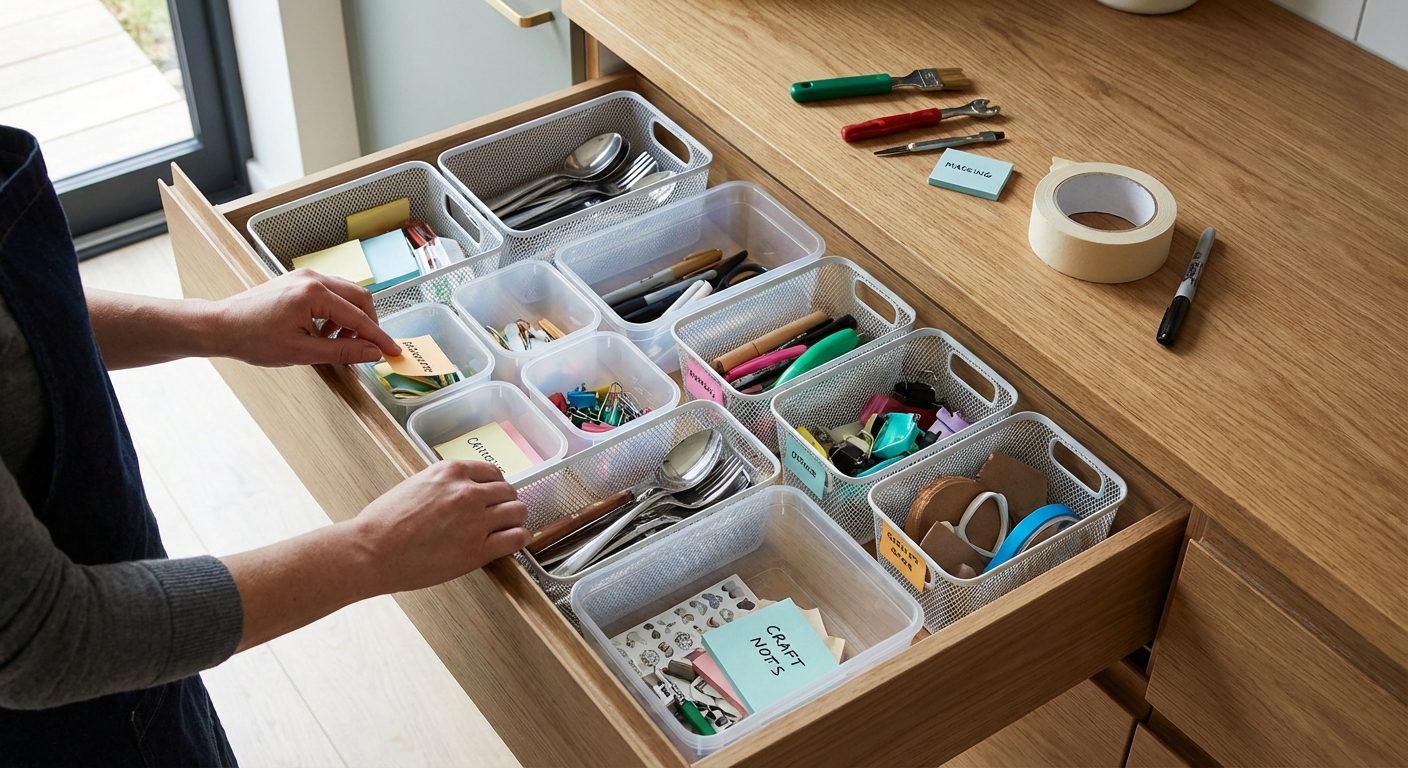
The Myth of the Expensive Organizer
We have been sold a lie that organized living requires a second mortgage. You scroll through social media and see pantries and offices that look like art galleries, usually tagged with high-end brand names that charge twenty dollars for a single plastic bin. It is easy to look at that and think, "Well, I can't afford a thousand-dollar closet renovation, so I guess I'll just live with this mess."
But here is the reality: organization is about physics and geometry, not brand names. A plastic bin from a high-end retailer holds a stapler exactly the same way a plastic bin from the dollar store does. The only difference is the logo and the marketing budget.
As we move through the spring cleaning season of 2026, the trend has shifted. We are moving away from hyper-consumption and toward "proactive cleaning"—finding sustainable, budget-friendly ways to reset our homes. We don't need more stuff; we need better systems. The goal isn't to buy a lifestyle; it's to build a tool that serves you.
Professional-grade organization is accessible for under ten dollars if you know how to shop. The trick isn't finding the store; it's walking into that store with a plan so foolproof that you cannot make a mistake.
The "Road Map" Hack
The biggest mistake I used to make was "eyeballing it." I would stand in the middle of the aisle, holding a mesh basket, squinting at it, and thinking, "Yeah, that looks like it’ll fit in the junk drawer."
I was almost always wrong. I would get home, and the bin would be a quarter-inch too wide, or too tall to close the drawer, or just small enough that it slid around every time I opened the cabinet. I wasted money on solutions that became new problems.
The most effective strategy to stop this cycle is the "Road Map." It is a simple, physical template that eliminates guesswork.
Here is how you do it:
- Empty the drawer you want to organize.
- Take a roll of wrapping paper, craft paper, or even taped-together printer paper.
- Press the paper into the bottom of the drawer and crease it along the edges to get the exact dimensions of the interior space.
- Cut the paper out.
You now have a 1:1 scale model of your drawer floor. This is your map. When you go to the store, you take this sheet of paper with you. You place it on the floor of the aisle or in your cart, and you arrange the bins directly onto the paper.
You can play "Tetris" right there in the store. You will know immediately if you have wasted space, if the bins are too long, or if you can fit one more narrow tray for paperclips. You do not buy a single thing until the puzzle is solved on your paper map. This creates a custom, grid-like system that feels built-in, purely because you did the math before you spent the money.
Step-by-Step Implementation
Once you have your roadmap and you are in the store, you need to execute the plan. There is a specific way to approach the shelves to ensure you get that "luxury" look rather than a mishmash of cheap plastic.
1. Selection of Modular Bins
Avoid the neon colors. If you want your drawer to look professional and calming, stick to the clear acrylics or the neutral-toned lines that are popular right now. Visual transparency is key. When you open a drawer, your brain has to process everything it sees. If you have opaque bins, your brain has to ask, "What is in there?" Clear bins reduce that cognitive load. You see exactly what you have instantly. Look for the "plus section" stacking containers if you have deep drawers; verticality doubles your storage space.
2. The Purge
Before you put the new bins in, you have to be ruthless with the current contents. If a pen doesn't write, it is trash. If you have duplicate charging cables for phones you haven't owned in five years, they are gone. We are not organizing trash; we are organizing tools.
3. Secure the Layout
This is the step most people miss, and it is why their systems fail after a week. When you put smooth plastic bins in a smooth wooden drawer, they slide. Every time you yank the drawer open, the bins slam to the back. This creates noise and disorder.
You need friction. Pick up a roll of shelf liner or a pack of adhesive Velcro dots. I prefer the shelf liner because it protects the wood, but a small dot of Velcro on the bottom corners of your bins will lock them in place. When the bins don't move, the system feels permanent and high-quality.
4. DIY Reinforcement
Sometimes the dollar store fabric bins can feel a bit flimsy. If you are using these for clothes or deeper storage, they can collapse in on themselves, looking sloppy. There is a fix for this. Cut a piece of cardboard from an old shipping box to the exact size of the bin's inner wall. Slide it between the fabric layers or just place it inside against the wall. It acts as a stiffener, giving the cheap fabric the rigid structure of a much more expensive product.
Beyond Basic Bins
If you want to take this to the next level, you have to look outside the storage aisle. Some of the best organizers aren't sold as organizers.
The Spice Jar Hack
Go to the kitchen section and look for those uniform glass jars with bamboo or metal lids. These are perfect for the office drawer. instead of leaving paperclips, rubber bands, and pushpins in their ugly cardboard retail packaging, pour them into these matching jars. When you open your desk drawer and see a row of matching glass jars, it signals order and precision. It turns office supplies into decor.
The Frame Divider
For shallow drawers, like a vanity or a desk lap drawer, standard bins are often too tall. Head to the frame section. Buy a few 4×6 or 5×7 photo frames. Discard the glass and the backing. You can use the frame itself as a low-profile divider. Or, turn the frame face down (glass included) to create a tray for makeup brushes or jewelry. The rim of the frame keeps items from rolling away, and the glass bottom makes it easy to wipe clean.
The Science of the Sorted Drawer
You might be thinking, "It’s just a drawer. Why does it matter so much?"
It matters because your environment dictates your internal state. Visual clutter creates "visual noise." When your eyes gaze upon a chaotic pile of miscellaneous items, your brain has to work harder to filter out the unnecessary data. It is a constant, low-level drain on your energy.
Studies have shown that clutter increases cortisol—the stress hormone. When your cortisol is high, your anxiety spikes, and your ability to focus plummets. Conversely, when you organize a space, you get a hit of dopamine. It provides a tangible sense of mastery. You controlled your environment, which makes you feel capable of controlling your day.
I work as a web developer and marketer, often juggling three or four massive projects at once. There are days when the pressure is immense. A few years ago, my desk was a disaster zone—stacks of papers, tangled wires, random sticky notes. I noticed that when I hit a difficult coding problem, I would look away from the screen and immediately feel overwhelmed by the mess around me. It was like I couldn't breathe. I spent a Saturday doing this exact dollar store overhaul on my desk drawers. Now, when I hit a wall in my work, I open my drawer. I see neat rows. I see order. It sounds small, but that visual silence gives my brain a moment to reset. It wasn't just about cleaning; it was about protecting my focus.
When you use the Road Map method, you are doing more than tidying up. You are building a system that reduces friction in your life. You are saving yourself the three minutes of frustration looking for a battery. You are saving the mental energy of looking at a mess and feeling guilty.
Conclusion
You do not need to organize your entire house in a weekend. That is a recipe for burnout. Start with one drawer. Just one.
Make your paper template. Go to the store. Spend the six dollars. Come home and fit the puzzle pieces together. The satisfaction of dropping that final bin into place and seeing it fit perfectly is worth the effort.
We often wait for motivation to strike before we take action, but action actually produces motivation. Fix the junk drawer, and you might just find you have the energy to tackle the rest of the room. Keep it simple, keep it cheap, and keep moving forward.