

If you are reading this, you are probably fighting a losing battle against your own attention span. It is 2026, and the world has become a relentless machine of notifications, pings, and urgent demands that actually aren’t urgent at all. We are living in an era where the boundary between "home" and "work" has dissolved almost completely.
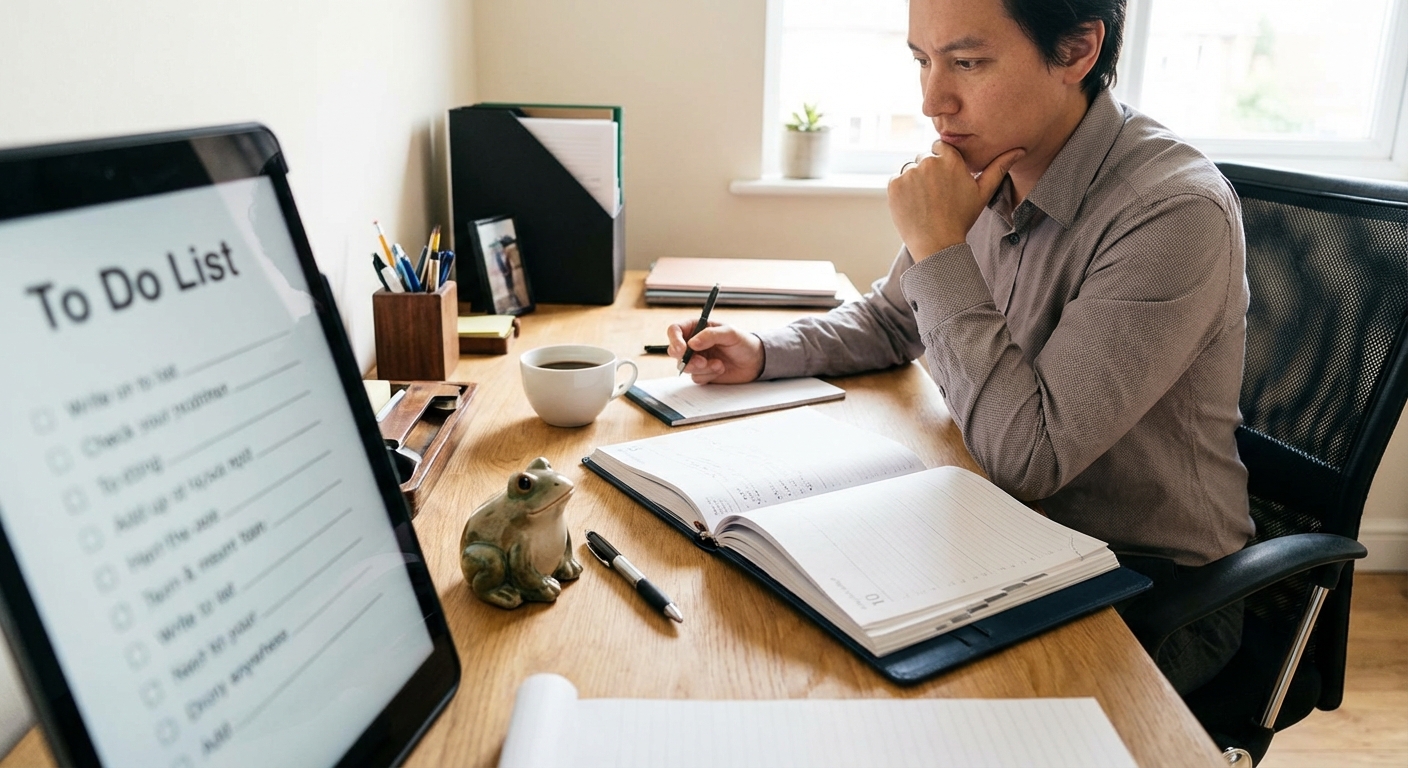
Recently, the Victorian government in Australia made headlines by moving to enshrine the "right to work from home" into legislation. It is a massive shift, signaling a global standard where the office is wherever you open your laptop. But with that freedom comes a dangerous trap. Without a boss breathing down your neck or the physical structure of a cubicle, your productivity is entirely up to your own internal discipline. And the data suggests we are failing.
In this new era of decentralized work, the average office worker is currently achieving only 2 hours and 53 minutes of focused work per 8-hour shift. That is less than three hours of actual value creation in a standard workday. The rest is lost to what we call "productivity theater"—shuffling papers, checking emails, and sitting in meetings that could have been memos.
If you want to reclaim those lost hours and actually build a life of substance, you don't need a new app or a complex filing system. You need to learn how to Eat the Frog.
The Frog Principle: One Choice Changes Everything
The core philosophy here is deceptively simple, but don't mistake simplicity for ease. The concept is rooted in a famous quote often attributed to Mark Twain: "If it's your job to eat a frog, it's best to do it first thing in the morning. And If it's your job to eat two frogs, it's best to eat the biggest one first."
Productivity consultant Brian Tracy popularized this into a method that cuts through the noise of modern life. Your "frog" is your biggest, ugliest, most important task. It is the one task you are most likely to procrastinate on because it requires high cognitive load, emotional labor, or complex problem-solving. It is also the task that, if completed, would have the greatest positive impact on your life and career.
We all have frogs. It might be that difficult client email you have been avoiding for three days. It might be drafting the proposal for a new business. It might be the heavy lifting in the gym that you keep skipping in favor of "light cardio."
The problem is that most of us spend our days clearing away "tadpoles" instead. We answer easy emails, we tidy our desks, we organize files. We tell ourselves we are "warming up" or "getting organized." But this is a lie. This is avoidance dressed up as work.
I know this chaos intimately. As a web developer and marketer constantly juggling client projects, I used to let my inbox dictate my day. I would spend hours putting out small fires, only to realize at 5:00 PM that I hadn't touched the actual code or strategy work that paid the bills. It wasn't until I started using deep-work bursts to tackle my biggest project first thing in the morning that I actually started moving the needle.
When you eat the frog first, you flip the script. You take the 20% of your work that provides 80% of the value and you execute it before the world has a chance to distract you. You stop managing your time and start managing your priorities.
The Psychological Engine
Why does this method work so well? It isn't magic; it is biology. Our brains are not designed to handle the constant, low-level stress of unfinished business.
The Zeigarnik Effect
There is a psychological phenomenon known as the Zeigarnik Effect, which states that people remember uncompleted or interrupted tasks better than completed ones. In practical terms, this means unfinished tasks create "cognitive load." They are like open tabs in your brain's browser, constantly using up RAM even when you aren't looking at them.
Every time you look at your to-do list and skip over that big, scary project, your brain registers a micro-dose of stress. That stress accumulates throughout the day, draining your energy. By the time you finally decide to tackle the big task at 4:00 PM, you are exhausted—not from work, but from the act of avoidance.
When you eat the frog first thing in the morning, you close that loop immediately. You eliminate the mental baggage. The rest of the day feels lighter because the heaviest thing is already behind you.
Ego Depletion and Decision Fatigue
You also have to respect the limits of your own biology. Your willpower is not an infinite resource; it is a battery that drains with every decision you make. Psychologists call this "ego depletion."
From the moment you wake up, you are burning through your decision-making fuel. What to wear? What to eat? Which email to answer? By mid-afternoon, your "CEO brain"—the prefrontal cortex responsible for discipline and complex thought—is tired. That is when you start making bad choices. That is when you skip the gym, eat the junk food, or decide to push the big project to tomorrow.
The morning is sacred because it is usually when your battery is fully charged. You have the mental fortitude to handle the "ugly" task. If you wait, you are trying to lift a heavy weight with tired muscles.
Practical Steps for Implementation
Knowing the theory is useless if you don't execute. This is not about feeling good; it is about doing the work. Here is a four-step framework to implement this immediately.
Identify Your Frog the Night Before
You cannot wake up and ask, "What should I do today?" If you do that, you have already lost. The decision-making friction will be too high, and you will default to checking email.
At the end of your workday, take five minutes to look at tomorrow. Write down the one single task that must happen. That is your frog. Lay out the materials you need. If it’s a document, have it open on your screen. If it’s a workout, have your clothes on the floor. Remove every barrier between you and the work.Break the Frog into Chunks
Sometimes we procrastinate because the frog is simply too big. "Write Book" is not a task; it is a project. You cannot eat a whale in one bite, and you cannot tackle a massive project in one sitting.
If your frog looks overwhelming, slice it up. Instead of "Write Quarterly Report," your frog is "Draft the Introduction and Financial Summary." This should take between one to four hours. If it takes longer than four hours, it is too big for one session. Break it down until it feels manageable.Protect Your Peak Hours
Statistics show that 50% of workplace meetings are scheduled between 9:00 AM and 11:00 AM. This is a tragedy. These are the "Golden Hours" for human cognition. This is when your brain is sharpest, your focus is tightest, and your energy is highest.
Do not give this time away to people who just want to talk. Block this time on your calendar. Treat it with the same reverence you would a doctor's appointment. Turn off your phone. Close your email client. Disconnect the Wi-Fi if you have to. This is your time to eat the frog.Create a Dopamine Loop
When you finish that big task, take a moment to acknowledge it. Crossing that item off your list releases dopamine—the brain’s reward chemical. This isn't just about feeling good; it's about training your brain.
By consistently succeeding at the hard thing first, you build a positive feedback loop. Your brain starts to associate the "pain" of the hard task with the "pleasure" of the accomplishment. Over time, the resistance fades, and the discipline takes over. You start to crave the feeling of having the hard work done.
Conclusion: Scaling the Habit
We often look for complex solutions to our problems because it makes us feel sophisticated. We think we need a new organizational app, a better desk setup, or a different job. But usually, the problem is staring us right in the face. We are avoiding the hard work because it is uncomfortable.
The "Eat the Frog" method forces you to confront that discomfort. It strips away the excuses and the busy work. It demands that you look at your day, identify the thing that matters most, and attack it with everything you have.
This is how you build a career. This is how you build a life of quiet confidence. You don't get there by clearing your inbox or attending every meeting. You get there by doing the heavy lifting while everyone else is still deciding what to do.
Tomorrow morning, don't check your phone. Don't scroll through the news. Don't look for an easy win. Look for the frog. And eat it.

See also in Productivity
10 Ways to Reduce Workplace Burnout
10 Steps for Effective Workflow
10 Strategies for Time Audit Success
10 Techniques for Prioritizing Tasks Well
The ‘Cathedral Thinking’ Mindset for Long-Term Goals That Outlive You
10 Steps to Perfect Project Planning