

You pull up to the drive-thru window, order a standard dinner for the family, and stare at the digital readout in disbelief. The total is noticeably higher than it was just a few months ago. If it feels like the price of convenience is outpacing your paycheck, you aren't imagining things.
We are currently living through a unique economic moment in 2026. The gap between what it costs to cook at home and what it costs to have someone else cook for you has widened into a chasm. According to the USDA’s latest outlook, restaurant prices are climbing at a rate of 3.7% this year, significantly outpacing grocery inflation.
That gap—that 1.2% spread between dining out and eating in—is your opportunity. It is the specific financial lever we can pull to save serious money.
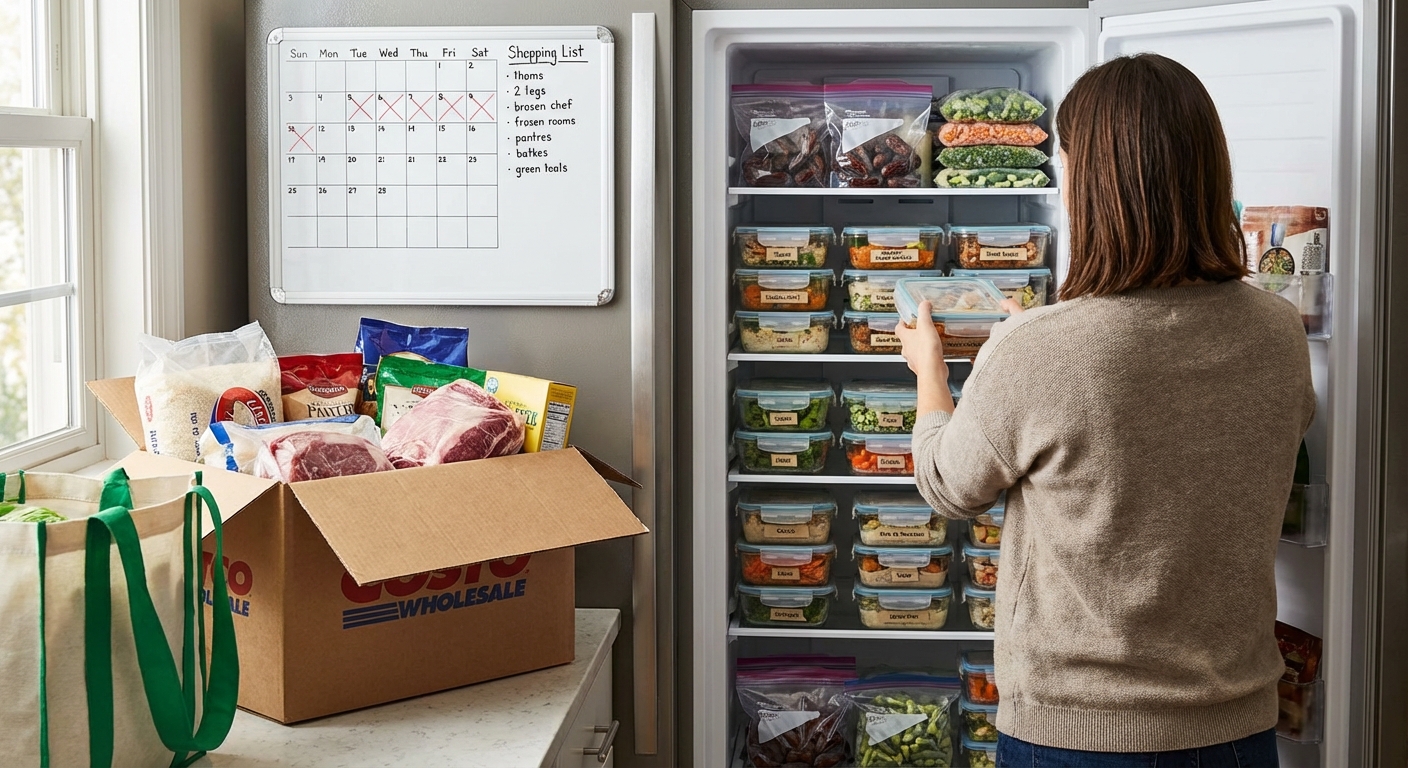
Most people look at their freezer and see a graveyard for half-eaten pints of ice cream or a bag of peas covered in frost. I want you to stop seeing a cold storage box and start seeing a savings account. By treating your freezer as a primary asset rather than a backup plan, you can save upwards of $300 a month. It doesn’t require being a master chef, and it certainly doesn't require spending your entire Sunday in the kitchen. It just requires a strategy.
The Strategic Pivot
For years, the freezer was the place where good intentions went to die. You would buy fresh produce, let it rot in the crisper drawer, and rely on a frozen pizza for emergencies.
But in 2026, the "emergency" is the budget itself. With beef prices projected to rise between 5.5% and 9.4% this year, the old way of shopping—buying exactly what you want, when you want it—is a fast track to financial stress.
We have to pivot. We need to move from "reactive eating" to "proactive inventory."
Data from early this year suggests that 77% of shoppers are already figuring this out, moving frozen foods from the sidelines to the center of the plate. Why? Because the math is undeniable. Recent breakdowns show that you can produce over 100 prepped freezer meals for roughly $228. That breaks down to about $2.22 per meal.
Compare that to your local takeout spot. You are likely spending $15 to $25 per person for a single meal once you factor in delivery fees and tips. That is a markup of nearly 1000%.
The pivot here is mental. You stop asking, "What do I feel like eating tonight?" and start asking, "What does my inventory provide?" This shift allows you to exploit that inflation gap. You are essentially engaging in arbitrage—buying assets (food) when they are undervalued (on sale) and storing them until they are needed, rather than paying market rate plus a premium when you are hungry and tired.
Practical Steps to Building Your Asset
You might be thinking this requires a massive chest freezer or a degree in logistics. It doesn't. It just requires three specific tactical changes to how you handle food.
1. Adopt "Lazy Batching"
There is a misconception that "meal prep" means spending eight hours on a Sunday cooking complex, five-course meals and putting them in Tupperware. That is a recipe for burnout.
I used to weigh over 300 pounds. When I lost 110 pounds and stopped binge eating, I learned a hard truth about human nature: relying on willpower is a trap. I knew that if I came home exhausted and had to chop vegetables, I was going to order a pizza. I didn't have the discipline to cook every night, so I outsourced the discipline to my freezer. I didn't cook full meals; I cooked "bases."
This is "Lazy Batching." Instead of making a lasagna, a stir-fry, and a casserole all at once, you focus on ingredients.
- The Protein Base: Buy five pounds of ground beef or turkey. Cook it all at once with basic seasoning (salt, pepper, garlic). Freeze it in one-pound bags.
- The Grain Base: Cook a massive pot of rice or quinoa. Freeze it in two-cup portions.
Now, on a Tuesday night, you aren't "cooking." You are reheating a bag of meat and a bag of rice, throwing in some salsa for taco bowls, or marinara for pasta. You cut the active work time from 40 minutes to 6 minutes.
2. Use Predictive Shopping
In the past, we clipped coupons. Today, we have better tools. The goal is to buy high-value items, specifically proteins, only when they are at their absolute price floor.
With beef prices spiking, you should never pay full retail price for a steak or a roast. Use apps that track local circulars and inventory. When you see a "loss leader" sale—where the store sells meat at a loss just to get you in the door—that is when you strike.
You don't buy one pack for dinner. You buy four packs. You eat one and freeze three. This flattens the inflation curve for your household. You are effectively locking in today's sale price for meals you will eat two months from now.
3. The Quarterly Bulk Cycle
Most families bleed money by shopping for staples weekly. Every time you walk into a grocery store, you are exposed to thousands of marketing cues designed to make you spend impulsively.
Limit your exposure. For shelf-stable items like beans, oats, rice, and frozen vegetables, switch to a quarterly cycle. Go to a warehouse club once every three months and buy these items in bulk.
By purchasing a 25-pound bag of rice instead of twenty 1-pound bags over the course of the year, you reduce the unit cost by 50% to 75%. More importantly, you remove these items from your weekly shopping list, which lowers your weekly bill and reduces the mental load of meal planning.
Why It Works: The $300 Math
It is easy to throw around numbers, but let’s look at exactly where that $300 a month comes from. It isn't magic; it's efficiency.
The Waste Factor
The average American household throws away approximately $1,500 worth of food every year. That is over $125 a month literally going into the trash can.
This usually happens with fresh produce and raw proteins. You buy spinach intending to make salads, life gets busy, and three days later you have a bag of green slime. You buy chicken for Tuesday, you end up working late, and by Friday it smells off.
When you utilize the freezer strategy, you stop the clock on spoilage. Frozen broccoli does not turn into slime in a week. Cooked ground beef in the freezer doesn't spoil. You are immediately reclaiming that $125 a month simply by eating what you buy.
The Restaurant Dependency
The rest of the savings comes from substituting convenience.
Let’s assume your family orders takeout or eats at a restaurant just twice a week. In 2026, for a family of four, that is easily $160 to $200 per week.
If you replace just one of those nights with a "Lazy Batch" meal from your freezer, you are trading an $80 restaurant bill for an $8.88 home-cooked equivalent (4 people x $2.22).
- Savings per week: ~$71
- Savings per month: ~$284
Combine that with the reduction in food waste, and the savings often exceed $300. This is money that can go toward debt, savings, or just breathing room in a tight budget.
Conclusion
We often think of budgeting as a restriction, a way of telling ourselves "no." But this strategy is actually about saying "yes" to stability.
When you look at the rising cost of living, it is easy to feel helpless. But you have control over what happens within the four walls of your kitchen. By utilizing your freezer, you are building a buffer against the outside world.
You are securing your food supply at a lower cost, reducing the chaos of daily decision-making, and keeping your hard-earned money in your own pocket. It requires a little bit of upfront effort, but the peace of mind—and the extra cash—is worth every second.
