

You probably know the feeling. It starts as a tightness in your chest or a shallow rhythm in your breath. You are sitting at your desk, staring at a screen that seems to be demanding more from you than you have to give. Your phone buzzes. An email pings. Your calendar notifies you of a meeting in ten minutes. The modern world is a marvel of connectivity, but it is also a relentless engine of stress.
We spend our days in climate-controlled boxes, bathed in blue light, completely disconnected from the biological reality our bodies were designed for. We try to hack our way out of it. We buy expensive supplements, track our sleep with watches, and optimize our morning routines down to the second. But sometimes, the solution isn’t more technology or more complexity. Sometimes, the solution is simply to step outside and shut up.
In 2026, we are seeing a massive shift away from "over-optimization" and back toward what works. We are seeing a return to the forest. There is a Japanese practice called Shinrin-Yoku, or "Forest Bathing," that is gaining traction not as a mystical trend, but as a hard-nosed physiological necessity. It doesn't require a subscription, it doesn't require batteries, and it lowers your stress hormones in just twenty minutes.
The Core Idea: More Than Just a Walk
When I first heard about Shinrin-Yoku, I was skeptical. It sounded like just another way to say "taking a walk." But to dismiss it as mere walking is to miss the point entirely. Walking is often about destination; it’s about getting from Point A to Point B, or perhaps hitting a step count on your fitness tracker. Forest bathing is different. It is about immersion.
Developed in Japan during the 1980s, this practice was a direct response to a public health crisis caused by high-stress work environments. The government realized that their workforce was burning out, hearts were failing, and immune systems were crashing. They didn't prescribe more medication; they prescribed nature.
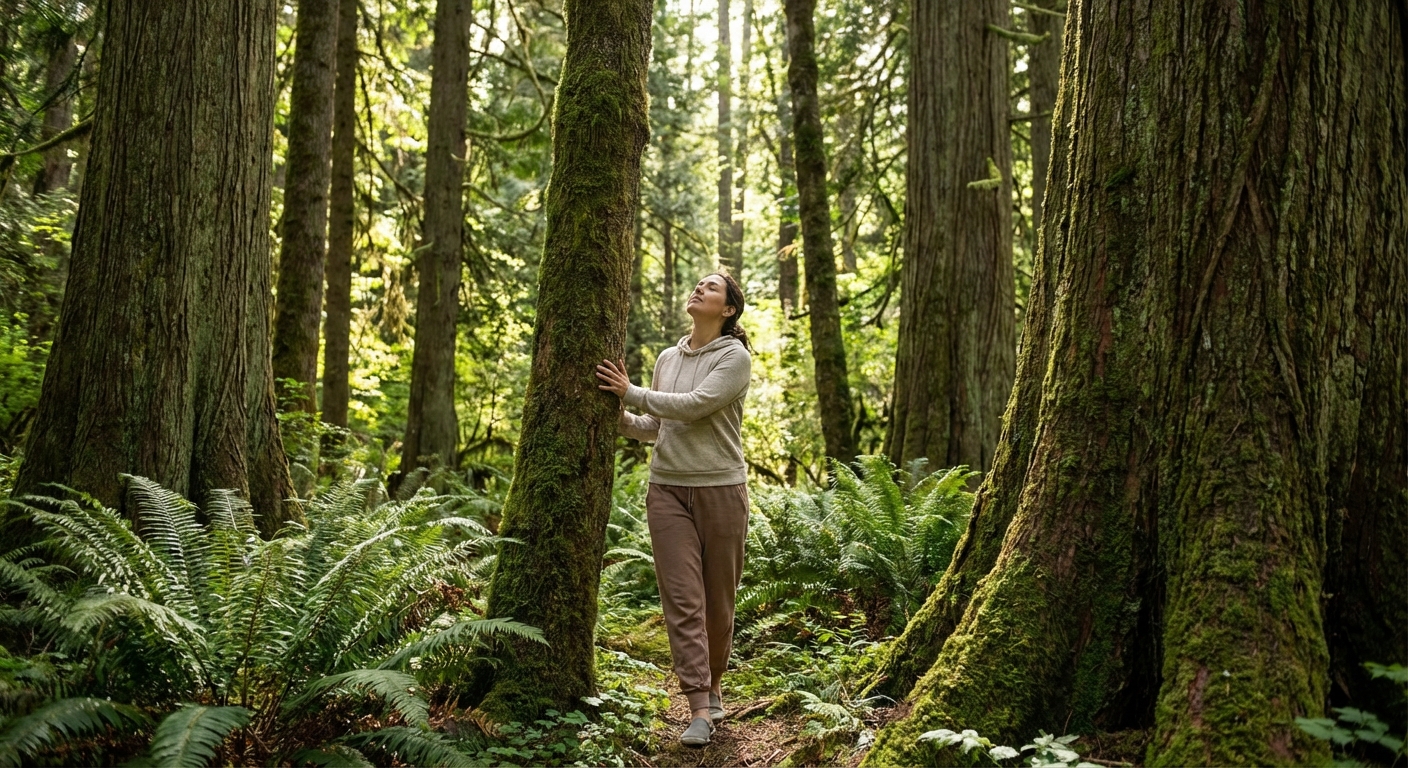
The concept is simple: you enter a forest or a heavily wooded area, and you let the environment in. You don't hike to the top of a peak to conquer it. You don't jog to get your cardio up. You move slowly, aimlessly, and you let your senses take over. You listen to the wind in the leaves. You touch the rough bark of a pine tree. You smell the damp earth.
As of March 2026, global health experts are highlighting Shinrin-Yoku as one of the 7 Japanese secrets for longevity and resilient health, moving it beyond a "trend" into a fundamental pillar of preventative medicine. This isn't about feeling good emotionally; it is about changing your blood chemistry. It is the antithesis of the modern grind. It is the practice of deliberate slowness in a world addicted to speed.
The Biological Reset: Why Trees Are Medicine
You might think that feeling calmer in the woods is just a placebo effect. You like trees, so you feel good. But the science goes much deeper than that. This is a biological reset for your endocrine system.
When you are stressed, your body floods with cortisol. This is the primary stress hormone. In short bursts, cortisol is great—it helps you run from a tiger or meet a tight deadline. But when cortisol levels stay high for days, weeks, or months, it becomes a poison. It destroys your sleep, packs fat around your midsection, and weakens your immune system.
Forest bathing attacks this problem through two main avenues: the nervous system and the immune system.
First, there is the shift in your autonomic nervous system. Most of us live in a state of sympathetic dominance—the "fight or flight" mode. We are constantly scanning for threats (emails, bills, traffic). Being in nature, specifically focusing on the sights and sounds of the forest, forces the body to switch to the parasympathetic system—the "rest and digest" mode. Your heart rate drops. Your blood pressure lowers. Your muscles unclench.
Second, and perhaps more fascinating, is the role of phytoncides. These are antimicrobial volatile organic compounds derived from plants—essentially, the natural oils that trees release to protect themselves from insects and rotting. When you walk through a forest, you are breathing these compounds in.
Research has shown that inhaling phytoncides significantly increases the activity of Natural Killer (NK) cells in the human body. These are the cells responsible for hunting down and killing tumor-infected or virus-infected cells. By simply breathing the air in a forest, you are not just relaxing; you are upgrading your immune defense system.
The 20-Minute Rule: Efficiency in Nature
I am a pragmatist. I don't have hours to spend wandering the woods every single day, and I bet you don't either. The good news is that you don't need to spend a weekend camping to get these benefits.
We often think that more is better. If 20 minutes is good, two hours must be better. While longer stays in nature certainly have their perks, researchers have identified a specific "dose" that provides the most bang for your buck. It’s called the "Nature Pill."
A landmark study established that the most efficient drop in stress markers happens within the first 20 to 30 minutes of nature immersion. The research found that a nature experience produced a 21.3% per hour drop in cortisol levels, but the efficiency curve flattens out after that initial window.
This is a game-changer for busy people. It means you don't need to wait for a vacation. You can fit this into a lunch break. You can do this before you pick the kids up from school. 20 minutes is the clinical "sweet spot." It is enough time for your brain to realize it is no longer in danger and for your body to begin the repair process.
How to Practice: A Tactical Guide
Knowing the science is useful, but execution is everything. You can't just walk outside, check your email, and expect your cortisol to drop. You need a protocol. Here is a practical, step-by-step guide to a 20-minute session using the "Five Senses Method."
1. Leave the Technology Behind
This is the hardest rule, but it is non-negotiable. You cannot forest bathe with a podcast playing. You cannot do it while checking your step count. You certainly cannot do it while scrolling social media.
I work as a web developer and marketer, constantly juggling projects and putting out fires. There are days when my brain feels like a browser with too many tabs open—music playing in one, a video frozen in another, and I can’t find the source of the noise. I found that if I took my phone with me into the woods, even in my pocket, I remained in that "browser" mode. I had to leave it in the car. The silence was uncomfortable at first, but it was the only way to close the tabs.
2. Slow Your Pace
This is not exercise. I repeat: this is not exercise. If you are breathing hard or breaking a sweat, you are doing it wrong. The goal is to shift your nervous system, not train your cardiovascular system.
Ideally, you should walk aimlessly. Let your body drift. If you find a spot that looks interesting, stop. Stand there. Look around. The experts suggest that you should move so slowly that it would take you two hours to walk 5 kilometers. That is a snail's pace. It feels unnatural at first because we are trained to hustle, but that discomfort is just your "fight or flight" system fighting for control. Let it go.
3. Engage the Five Senses
Once you have slowed down, you need to anchor your attention. The mind will want to wander back to your to-do list. To prevent this, use your senses as a tether.
- Sight: Look at the small details. Notice the way the light filters through the leaves. Look for fractal patterns in the ferns or the bark. These patterns are naturally soothing to the human brain.
- Sound: Listen to the birds. Listen to the wind. Listen to the crunch of leaves under your feet. Try to identify the furthest sound you can hear, and then the closest.
- Smell: Take deep breaths. Hunt for the scent of pine, damp soil, or rotting wood. This is where you get your dose of phytoncides.
- Touch: Don't just look; interact. Place your hand on a tree trunk. Feel the texture of a rock. Dip your fingers in a stream. The sensation of texture grounds you in the physical reality of the moment.
- Taste: Taste the air. Notice how it feels different on your tongue than the air in your office or your car.
4. Find a "Sit Spot"
Spend at least part of your 20 minutes in total stillness. Find a log, a rock, or a patch of dry grass. Sit down. Don't do anything. Just exist.
This stillness allows your awareness to expand. When you stop moving, the forest around you starts to move. Birds come closer. Squirrels ignore you. You become part of the landscape rather than a tourist passing through it. This helps improve your heart rate variability, a key marker of stress resilience.
Conclusion
We live in an era where we try to solve high-tech problems with high-tech solutions. We build apps to help us sleep and wear rings to tell us if we are stressed. But we are biological organisms, not machines. We were not evolved to live in concrete boxes or stare at glowing rectangles for twelve hours a day.
Shinrin-Yoku is a reminder that the best way to move forward is sometimes to look back. It is a return to the baseline of human existence. It is not magic. It is simple biology.
So, the next time you feel the walls closing in, don't reach for another cup of coffee. Don't doom-scroll for an hour. Find a patch of trees. Leave your phone behind. Give yourself twenty minutes of silence, breath control, and sensory immersion. Your inbox will still be there when you get back, but you will be better equipped to handle it.

See also in Self-Improvement
10 Ways to Cultivate Winter Inner Peace
20 Lessons You Can Learn from Failure
Birthday Journal Prompts for Reflection
How Vitamin D Deficiency Is Clinically Linked to Seasonal Depression
12 Ways to Stop Self-Sabotage
10 Self-Improvement Challenges for Fall