

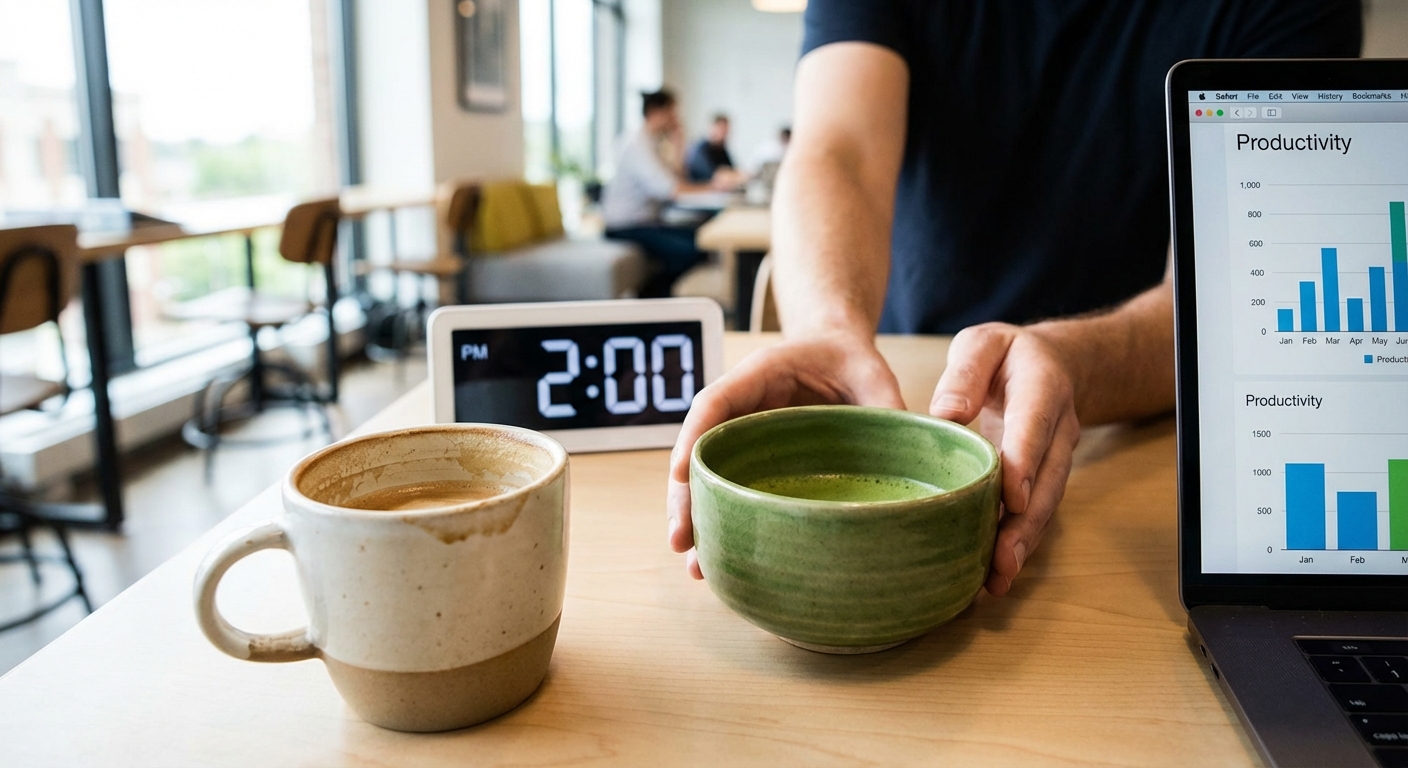
You love the initial jolt, but you dread the 2:00 PM slump where your brain feels like it's wading through molasses. It’s the cycle most of us live in, renting energy from tomorrow to pay for today, but there is a way to stop paying that interest.
The Problem With Your Default Fuel
We need to talk about your morning routine. For years, I treated my morning coffee like a religion. It was the only way I knew how to jumpstart the engine. You wake up groggy, you brew the dark roast, and you down it. Ten minutes later, the world sharpens. You feel invincible.
But that feeling is a loan, not a gift.
By the time the afternoon rolls around, the debt collector shows up. You get the jitters, the sudden fatigue, or that irritability that makes you snap at a coworker for no reason. This is the "coffee crash," and in the high-stakes environment of 2026, it is a productivity killer we can no longer afford.
The issue isn't the caffeine itself; it's the delivery system. Coffee hits your bloodstream like a freight train. It triggers an immediate spike in cortisol and adrenaline. It puts your body into "fight or flight" mode when all you actually wanted was to clear your inbox. This spikes your insulin, drops your blood sugar later, and leaves you hunting for a sugary snack or another cup just to survive until 5:00 PM.
The market is waking up to this. We are seeing a massive shift where consumers are moving away from high-octane jitter juice toward "mind balance" beverages. We are looking for sustained focus, not a heart attack in a mug.
The Green Contender: Enter Matcha
If coffee is a sledgehammer, Matcha is a scalpel.
Matcha is a powdered green tea used in traditional Japanese ceremonies, but don't let the ancient history fool you. It is a modern bio-hack for anyone who needs to get things done. Unlike standard green tea, where you steep the leaves and throw them away, with Matcha, you consume the entire leaf. You are drinking a suspension of high-density nutrients, chlorophyll, and a very specific chemical stack that re-engineers how your brain processes energy.
I was skeptical at first. I didn't want to drink "grass water." But the difference in how I felt was undeniable. It wasn't just about being awake; it was about being present.
The secret weapon here is a unique amino acid called L-theanine. This compound is rare in the modern diet, but it is abundant in shaded green tea leaves. L-theanine is the reason Matcha doesn't make you jittery. It crosses the blood-brain barrier and increases alpha-wave activity. Alpha waves are the brain state associated with "relaxed alertness."
Think about the last time you were totally in the zone. You weren't frantic. You weren't stressed. You were calm, but you were incredibly sharp. That is the alpha state. That is what L-theanine offers.
The Science of "Calm Alert"
When you mix caffeine with L-theanine, you get a synergistic effect that outperforms either compound on its own. It is the biological equivalent of having a turbocharger (caffeine) and a precision steering system (L-theanine) working in tandem.
Caffeine is the accelerator. It blocks adenosine, the chemical that makes you feel tired. But without a brake, an accelerator is dangerous. L-theanine is the brake. It smooths out the rough edges of the caffeine molecule. It prevents the blood pressure spike and the anxiety that often comes with a double shot of espresso.
As a web developer and marketer juggling multiple projects, I know the desperation of needing deep-work bursts to keep focus. I used to rely on high-dose caffeine to power through coding marathons, only to crash hard and stare blankly at my screen for hours. Switching to a source of energy that offered sustained clarity allowed me to maintain that deep work state for four or five hours straight, without the frantic energy that leads to mistakes.
The science backs this up. A 2025 double-blind crossover study confirmed that the L-theanine/caffeine combination significantly improved "hit rate" and target-distractor discriminability more effectively than caffeine alone, essentially reducing "mind-wandering."
This means you aren't just awake; you are accurate. You are less likely to get distracted by a notification on your phone and more likely to finish the task in front of you.
Practical Preparation: The Master’s Ritual
If you treat Matcha like instant coffee, you will hate it. It will taste bitter, grassy, and chalky. To unlock the benefits and the flavor, you need to respect the process. It requires a small amount of discipline, but the result is worth it.
Here is the protocol for the perfect performance brew:
- The Sift: This is non-negotiable. Matcha powder clumps together due to static electricity. If you don't sift it, you will drink lumps of bitter powder. Take 1–2 teaspoons of ceremonial grade powder and push it through a fine-mesh strainer into your bowl or mug.
- The Temperature: This is where most people fail. Do not use boiling water. Boiling water (212°F) scorches the delicate leaves, destroys the L-theanine and EGCG antioxidants, and releases tannins that make the drink incredibly bitter. You want your water at exactly 80°C (176°F). If you don't have a temperature-controlled kettle, boil the water and let it sit with the lid off for five minutes before pouring.
- The Aeration: You cannot stir Matcha with a spoon. It won't mix. You need to whisk it. Traditionally, a bamboo whisk (Chasen) is used. Pour a small amount of water (about 2oz) onto the powder to create a paste, then add another 2-3oz of water. Whisk vigorously in a "W" or "M" motion, not a circle. You want to introduce air into the mixture. Do this for 30–60 seconds until a thick, bright green froth forms on top. This aeration enhances the creaminess and flavor profile.
Once you have your base shot of Matcha, you can dilute it with more hot water (for an Americano style) or steamed milk (for a latte). Just avoid adding too much sugar, as that defeats the purpose of the metabolic stability we are aiming for.
Why It Outperforms the Competition
Let's look at the hard data comparing your morning options. When you stack Matcha against coffee and other alternatives like Yerba Mate, the winner for sustained productivity is clear.
Metabolic Stability
Coffee gives you a 1-2 hour peak followed by a valley. Matcha provides a "time-release" energy. Because the caffeine in Matcha binds to the catechins (antioxidants), it enters your bloodstream at a slower rate. You get a steady lift that lasts 4–6 hours. There is no sudden drop-off. You simply gently land back at your baseline energy levels in the late afternoon.
Antioxidant Load
We all know antioxidants are good for us, but the scale here is ridiculous. Matcha provides up to 137 times more EGCG antioxidants than standard steeped green tea. This is significantly more than roasted coffee beans. Roasting coffee at high temperatures kills off many of the beneficial polyphenols. Since Matcha is stone-ground and unheated until you brew it, you are getting the raw, potent defense system of the plant.
Alkaline vs. Acidic
This is a major factor for anyone with a sensitive stomach.
- Coffee: Highly acidic (pH ~5.0). It stimulates hyper-secretion of gastric acid, which can lead to heartburn, acid reflux, and general digestive upset.
- Matcha: Alkalizing. It is much gentler on the digestive tract. It supports gut health rather than attacking it. If you often feel "sour" in the stomach after your morning cup of joe, this switch alone can change your quality of life.
A Note on Yerba Mate
If you are someone who truly needs a massive caffeine hit—maybe you are a shift worker or an endurance athlete—and Matcha feels too gentle, Yerba Mate is your secondary contender. It contains a bioactive stack of three stimulants: caffeine, theobromine, and theophylline. It provides a more robust "kick" than Matcha but still avoids the worst of the coffee jitters. However, for the average knowledge worker looking for focus over raw power, Matcha remains the king.
Reclaiming Your Morning Focus
We live in an attention economy. Your ability to focus is your most valuable asset. If you are sabotaging that asset every morning with a drink that makes you jittery, anxious, and prone to crashing, you are fighting with one hand tied behind your back.
Switching to Matcha isn't just about being trendy. It is a pragmatic decision to fuel your body with a substance that promotes stillness and clarity rather than chaos. It is about respecting your physiology enough to give it clean energy.
Try it for one week. Put the coffee maker away. Buy a tin of ceremonial grade Matcha and a bamboo whisk. Commit to the ritual. Watch how your afternoon productivity changes. You might find that you didn't need more energy after all; you just needed a better source.

See also in Self-Improvement
10 Ways to Enhance Your Problem-Solving Skills
How to Be More Mature: 8 Simple Steps
The Endorphin Rush from Exercise Is More Complex Than Runner’s High
How ‘Kintsukuroi’ the Japanese Art of Repairing Broken Pottery Applies to Personal Healing
The Proven Link Between Regular Sauna Use and Reduced Cardiovascular Risk
12 Ways to Build Mental Strength