You’ve likely never questioned the rectangular slab of wood sitting in the center of your living room. It’s just "what you do." You buy a sofa, you buy a rug, and you immediately buy a coffee table to fill the gap. But in 2026, a growing movement of pragmatic minimalists is dragging that table to the curb, and the result is a home that finally feels like it can breathe.
The Core Idea: Banning the "Shin-Buster"
We need to have a serious talk about the default settings of our homes. For decades, interior design has followed a rigid script. We treat the living room like a stage set where every piece of furniture has a mandatory role, regardless of whether it actually serves the people living there. The coffee table is the worst offender.
If you look at the "Quiet Luxury" movement that is currently dominating the design world this March, you will notice a shift. It isn't about buying more expensive things; it is about buying fewer things of higher quality and letting the space itself be the luxury. In this context, the coffee table is increasingly viewed as "visual friction."
Think about your own living room right now. How much of your floor space is dominated by that central table? In many urban apartments, especially in places like the UK where the average living room is barely 4 meters wide, that table is an obstacle course. It blocks the flow of traffic. It forces you to shimmy sideways to get to the couch. It is a magnet for clutter—old magazines, remote controls, and unopened mail that you are avoiding.
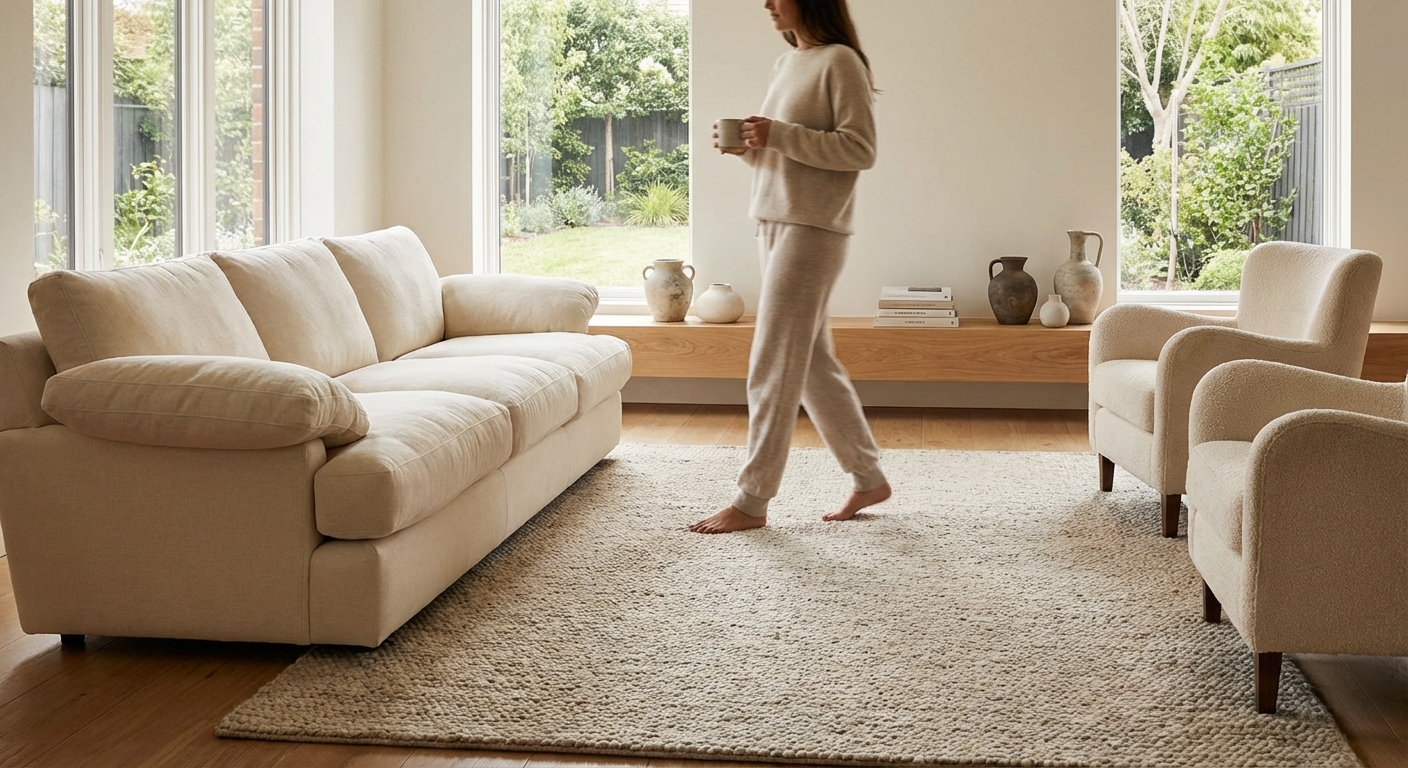
When you remove it, the room immediately opens up. The "flow" creates a sense of stillness that is hard to manufacture with decor. By eliminating the center obstacle, you aren't just gaining square footage; you are removing a subtle, constant source of low-grade annoyance.
The Shift to Conversation Pits
There is a deeper psychological reason why the coffee table is disappearing in 2026. For the last twenty years, our living rooms have been shrines to the television. The furniture layout was essentially a movie theater: everything pointing in one direction, with a table in the middle to hold the popcorn.
But the "Warm Minimalism" we are seeing now is trying to reclaim the home as a place for human connection, not just content consumption. When you remove the barrier between the seating—the coffee table—you change the dynamic of the room. It stops being a row of seats facing a screen and starts becoming a circle of interest.
This is the modern evolution of the "conversation pit." We aren't digging holes in our floors like architects did in the 1970s, but we are creating the same effect. By opening up the center of the room, you invite people to sit on the floor. You allow children to play without hitting their heads on sharp corners. You create a space where the focus is on the people in the room, not the furniture holding them apart.
I recently started Muay Thai—admittedly, I’ve been a little inconsistent with it lately—but on the days I do train, my body is wrecked and I need serious floor space to stretch out my hips. I used to constantly kick the corner of my heavy oak coffee table or bruise my shin trying to find a patch of carpet. Removing that table didn't just make the room look better; it physically allowed me to move and recover in my own home without fighting my furniture.
Practical Steps to Reclaim Your Floor
I know what you are thinking. "If I get rid of the coffee table, where do I put my drink?" It is a valid question. The goal here is not to live in an empty box where you have to hold your coffee mug for three hours. The goal is "intentional comfort." We want functionality without the footprint.
Here are the best alternatives I have seen that maintain the utility of a table without the spatial cost.
1. The Cocktail Ottoman Swap
If you aren't ready to go fully table-less, this is your bridge. A large, upholstered ottoman serves the same visual purpose as a coffee table but removes the hard edges. It adds texture and warmth to the room, fitting perfectly into the "Warm Minimalism" trend.
You can throw your feet up on it, which creates a more relaxed, lounge-like atmosphere. When you need a hard surface for a drink or a snack, you simply use a wooden tray placed on top. It is versatile, soft, and safer for kids, removing that subconscious fear of banging your knee.
2. The Rise of the C-Table
This is my personal favorite solution. The "C-table" is a slim, often C-shaped table designed to slide over the arm of your sofa or tuck right up against the seat.
This moves the utility from the center of the room to the periphery. You still have a place for your drink, your phone, or your book, but it is right next to you rather than two feet away. This keeps the center of the rug completely open, preserving that feeling of spaciousness while actually bringing your "table" closer to where you are sitting.
3. Nesting Tables for Flexibility
If you host guests frequently, you might worry about not having enough surface area. Nesting tables are the answer. These are sets of two or three small tables that stack underneath one another.
On a normal Tuesday night, they take up the footprint of a single side table. But when you have friends over, you can pull them apart and scatter them around the room as needed. This is the definition of "Quiet Luxury"—having high-quality tools that appear when you need them and disappear when you don't.
Why It Works: The "Frictionless" Home
The reason this design shift is taking hold in 2026 is that we are all exhausted. We are over-stimulated, over-worked, and constantly plugged in. When we come home, we need our environment to facilitate recovery, not add to our cognitive load.
Every object in your home requires a tiny micro-payment of attention from your brain. You have to look at it, walk around it, clean it, or organize the junk on top of it. A large, flat surface in the middle of a room is practically begging to be covered in clutter. It is a law of the universe: if there is a flat surface, junk will expand to fill it.
By removing the coffee table, you are removing a "clutter magnet." You are forcing yourself to be more intentional. If there is no table to dump your mail on, you deal with the mail immediately. If there is no table to leave empty cups on, you take them to the kitchen.
Furthermore, we invest heavily in these beautiful, textured area rugs—wool, jute, linen—only to cover sixty percent of them with a piece of wood. Why? In the "Quiet Luxury" philosophy, the texture of the floor covering is a major part of the aesthetic. By exposing the rug, you soften the acoustics of the room and make the space feel larger and more inviting.
Conclusion
Redefining what is "essential" is the hardest part of minimalism. We are conditioned to believe that a complete living room requires a specific checklist of items. But true comfort comes from questioning those checklists.
You don't need a coffee table just because a furniture catalog told you so. You need a home that serves your life. You need a space that allows you to stretch, to breathe, and to walk from the hallway to the window without banging your shin.
Try it for a week. You don't even have to sell your table yet. Just push it into another room or slide it against the wall. Live with that open space for seven days. Notice how the room feels bigger. Notice how your movement changes. You might find that the empty space in the middle of the room isn't empty at all—it’s filled with possibilities.