If you’re staring at a cluttered home and feeling that familiar rising tide of panic, you aren’t alone. Most of us want the result—a peaceful, organized home—but we get completely paralyzed by the process.
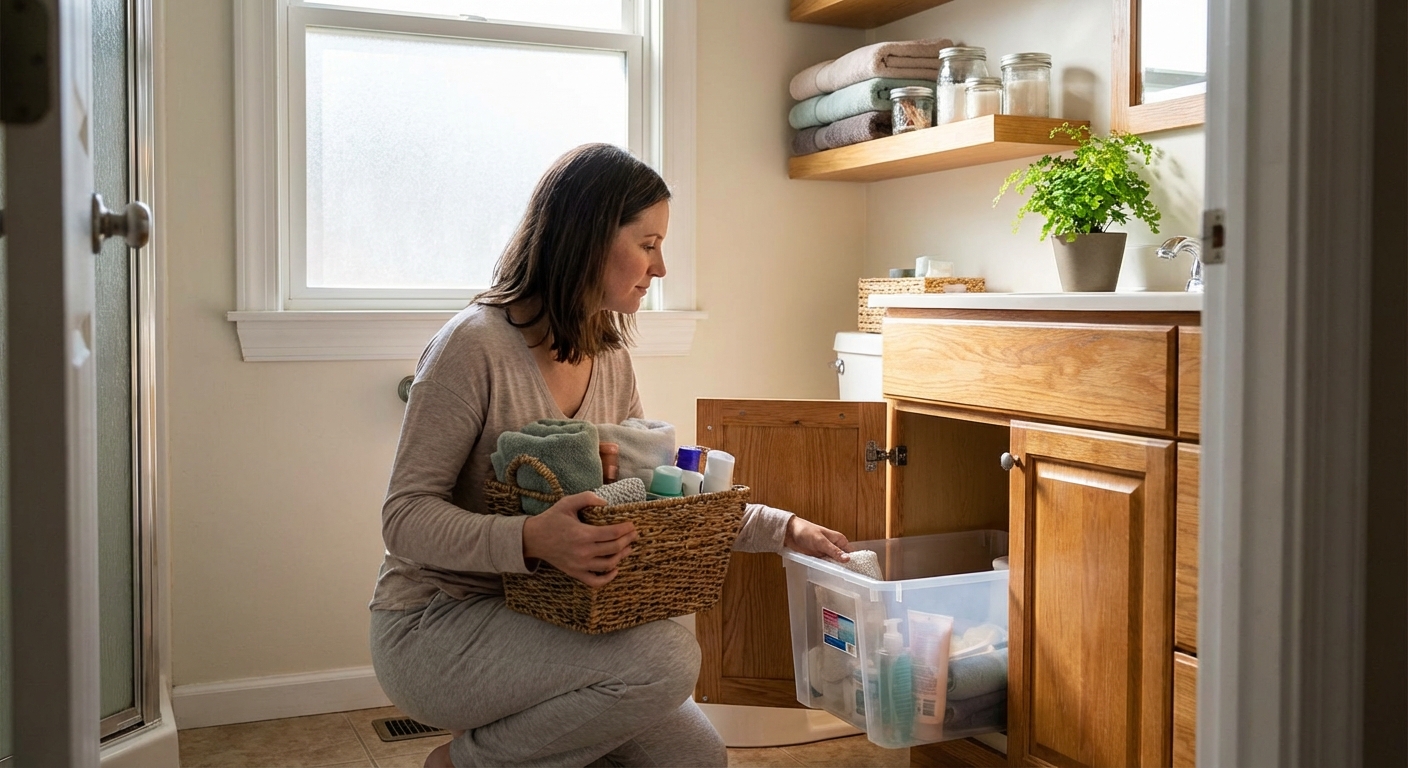
You look at the garage packed with boxes, or the kitchen counter covered in mail and appliances, and your brain just shuts down. It’s too much. It feels impossible. So, you do what any rational person does when overwhelmed: you do nothing. You walk away and promise yourself you’ll tackle it "next weekend."
But "next weekend" has come and gone for months now.
The problem isn’t your lack of discipline or desire. The problem is your starting point. In the world of productivity and home organization, where you start determines if you finish. If you try to lift the heaviest weight first, you’re going to get injured. You have to build the muscle first.
Experts and professional organizers have zeroed in on the absolute best place to start building that muscle. It isn’t the garage, the basement, or even the kitchen. It’s the bathroom.
The Core Idea: Why the "Where" Matters
We tend to think of decluttering as a purely physical act. We think it’s just about moving objects from Point A to Point B. But if you have ever sat on the floor of your bedroom surrounded by old photos, crying over a ticket stub from 2014, you know that’s not true. Decluttering is emotional.
This is why the "where" matters so much. If you start in a room filled with sentimental landmines—like your bedroom or the living room—you are setting yourself up for what psychologists call decision fatigue. Your brain has a limited amount of fuel for making choices. Every time you pick up an item and ask, "Do I keep this?" you burn a little bit of that fuel.
When the item is emotionally charged, you burn a lot of fuel. You stall out. You get exhausted. And you quit.
To succeed, you need a "quick win." You need a space that offers high impact with low emotional drag. You need a space where the decisions are black and white, not gray.
The Expert Choice: The Bathroom
Why is the bathroom the ultimate training ground for your decluttering skills? It comes down to simple math and psychology.
First, it is usually the smallest room in the house. You can physically see the finish line from the starting line. That matters. When you can see the corners of the room, your brain registers the task as "doable" rather than "endless."
Second, and most importantly, the bathroom is the home of binary decisions.
In your closet, a shirt might be "too tight but maybe I'll fit into it one day," or "it was a gift from my aunt." That is emotional baggage. In the bathroom, things are functional. A bottle of shampoo is either empty or full. Medication is either expired or current. A towel is either threadbare or usable.
There is very little sentimentality attached to a dried-out tube of mascara or a razor that has gone dull. This allows you to make rapid-fire decisions without the emotional weight. You are training your brain to decide "stay" or "go" without the guilt.
The Science of the "Quick Win"
There is a physiological reason why this approach works. When you successfully clear a space, your brain releases dopamine. It feels good. It feels like progress. That chemical reward is what fuels you to tackle the next, harder task.
Conversely, living in clutter spikes your cortisol—the stress hormone. Women, in particular, show higher levels of cortisol when they perceive their homes as messy or unfinished.
Think about your daily routine. The bathroom is likely the first room you enter in the morning and the last one you leave at night. It is the bookend to your day.
If you walk into that space first thing in the morning and see a counter covered in half-empty bottles, hair ties, and mystery products, you are micro-dosing stress before you’ve even brushed your teeth. You are starting your day in a deficit.
However, if that space is clear, functional, and organized, you start your day with a sense of control. You are creating a pocket of stillness in a chaotic world.
I know this dynamic well from my own life, though in a different context. Years ago, I lost 110 pounds. When I was at my heaviest, the idea of "getting healthy" felt impossible because I was looking at the whole mountain. I thought I had to change everything—my diet, my sleep, my gym routine—all at once. I failed every time I tried that.
I finally succeeded when I stopped looking at the mountain and just looked at my feet. I focused on one small, binary choice at a time. I didn't worry about next year; I worried about the next meal. I built momentum through small, undeniable wins. The confidence I gained from losing the first five pounds is what gave me the strength to lose the next hundred.
The bathroom is your "first five pounds." It proves to you that you can change your environment.
The 3-Step "Momentum" Protocol
So, how do you actually execute this? Do not tear the whole room apart at once. That creates a bigger mess and leads to panic. Instead, follow this simple protocol designed to build momentum.
1. The Binary Purge
Your first pass is not about organizing; it is about elimination. You are looking for trash and expiration dates. Do not worry about where to put things yet. Grab a trash bag and look for the obvious:
- Expired Medicine: Check the dates. If it’s expired, it goes. (Dispose of medication responsibly according to local guidelines, but get it out of the cabinet).
- Empty Bottles: If there is a tiny amount of product left that you have been saving for a "rainy day" but haven't touched in three months, toss it.
- The "Gross" Factor: Old loofahs, rusted razors, and makeup sponges that have seen better days.
This step requires zero emotional labor. It is purely logical. You are clearing the decks.
2. The 15-Minute Window
In 2026, we are seeing a shift away from marathon cleaning sessions toward "micro-habits." Set a timer for 15 minutes. Tell yourself you only have to work until the timer goes off.
This tricks your brain. "I can do anything for 15 minutes," you tell yourself. Usually, once you start and the dopamine hits, you won’t want to stop. But if you do stop, that’s fine. You did your 15 minutes. You kept the promise to yourself. That builds trust.
3. Immediate Removal
This is the new golden rule of decluttering. The job isn’t done when the bag is full; the job is done when the bag is out of the house.
"Clutter creep" happens when we fill a bag for donation or trash and then leave it in the hallway or the trunk of the car for three weeks. It becomes a new piece of furniture that you trip over.
Take the trash to the outside bin immediately. Put the donation box in your car immediately (and schedule the drop-off). Complete the cycle.
The "Reverse Decluttering" Mindset
As we move deeper into this year, there is a trend gaining traction called "Reverse Decluttering." It sounds counter-intuitive, but it’s brilliant for those of us who struggle with letting go.
Instead of looking at a drawer and asking, "What should I throw away?" empty the drawer completely. Then, ask, "What do I need to put back?"
This shifts your mindset from loss to selection. You aren't "losing" an old comb; you are choosing not to invite it back into your clean space. You only put back the items you use daily and that are currently functional. Everything left on the counter is the excess.
This works exceptionally well in the bathroom because the "keep" pile is usually very clear. You need your toothbrush. You need your daily face wash. You probably don’t need the three hotel shampoos you stole in 2019.
Conclusion: Scaling Your Success
Once you conquer the bathroom, something shifts. You walk in the next morning, and there is space on the counter. You find your toothpaste instantly. You feel a moment of quiet gratitude.
That feeling is addictive. You realize that you aren't a "messy person"; you just lacked a system. You realize that peace is possible.
You can then take that confidence and move to the next level—maybe the linen closet or the junk drawer. You keep the sentimental heavyweights—the photos, the letters, the heirlooms—for last. By the time you get to them, your decision-making muscle will be strong, and you will have a track record of success behind you.
Start small. Start where it’s easy. Go tackle the bathroom, and watch the rest of your home follow suit.