

You’re standing in the grocery store aisle, staring at twenty-seven different types of pasta sauce. It’s a Tuesday night. You are exhausted. All you want is dinner, but instead of grabbing a jar and walking away, you freeze. Is the garlic and herb better than the roasted tomato? Is the organic brand worth the extra two dollars? What if you pick the wrong one and ruin the meal?
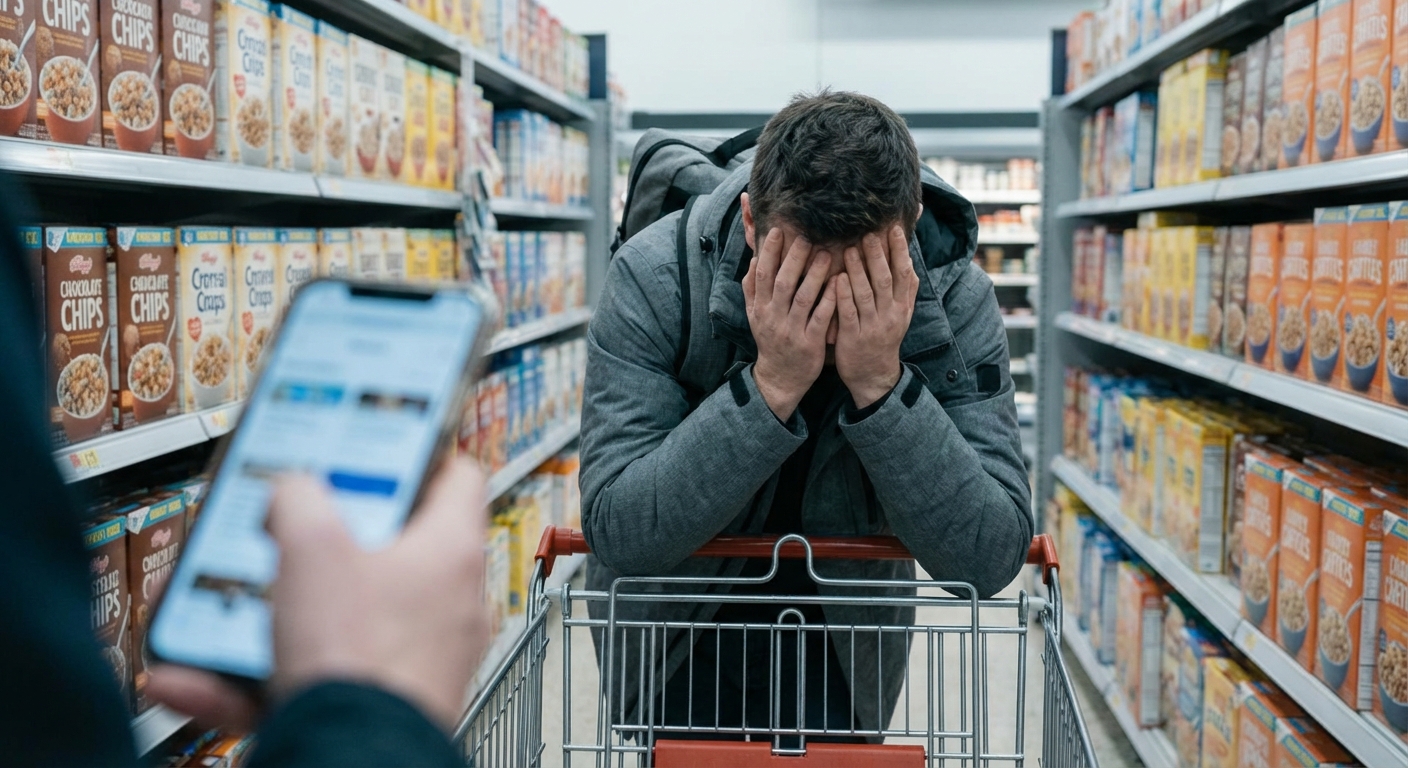
This isn't just about pasta. It’s about the fifty tabs open on your browser, the thousands of movies on your streaming watchlist, and the endless investment options shouting for your attention. We are told that freedom is the highest good and that choice is the definition of freedom. Therefore, more choice should mean more freedom and more happiness.
But if you look at your own life, you know that isn't true.
Recent research from March 2026 confirms what many of us have felt for years: the explosion of fragmented information—specifically in high-stakes markets like cryptocurrency—has created a peak in "information overload." It is causing significant cognitive strain. We are drowning in options, and instead of feeling liberated, we feel paralyzed. This is the Paradox of Choice.
The Cognitive Wall
The premise of the Paradox of Choice, introduced by psychologist Barry Schwartz, is counterintuitive but undeniably real. While having zero choices is oppressive, having too many choices is suffocating. There is a threshold where abundance stops being a luxury and starts being a burden.
Think of your brain like a muscle. Specifically, think of your prefrontal cortex—the CEO of your brain responsible for decision-making—as a battery with a limited charge. Every time you have to evaluate an option, compare features, or predict an outcome, you drain a little bit of that battery.
When you are bombarded with hundreds of micro-choices before you even finish your morning coffee, you hit a state called "decision fatigue." By the time you need to make a decision that actually matters—like how to handle a difficult client or how to discipline your child—your battery is dead. You simply don't have the mental energy left to care.
This is why you see successful people often wearing the same clothes every day or eating the same lunch. They aren't boring; they are protecting their energy. They are refusing to waste their limited cognitive fuel on things that don't matter so they can spend it on things that do.
In the current landscape of 2026, this fatigue is reshaping how we work and live. We are seeing a rise in leaders who are deferring decisions, not because they are incompetent, but because the sheer volume of data required to make a "perfect" choice is humanly impossible to process. We have built a world that demands more processing power than our biology can supply.
The Mechanics of Misery
Why exactly does having more options make us feel worse? You would think that having 100 options increases the statistical likelihood of finding the "perfect" fit. But the psychological mechanism doesn't work that way.
The problem lies in the distinction between two types of people: Maximizers and Satisficers.
A Maximizer is someone who needs to be assured that every purchase or decision was the best that could be made. They need to check every price, read every review, and imagine every scenario. If a Maximizer buys a sweater, they are haunted by the possibility that there was a softer, cheaper, or better-looking sweater at the store next door.
A Satisficer is someone who has criteria, and once those criteria are met, they stop looking. If they want a blue sweater under $50, they buy the first one they find and go home happy.
Maximizers are statistically more likely to experience regret, depression, and lower life satisfaction. The reason is "opportunity cost." When you choose one path, you are rejecting a thousand others. In a world of infinite choice, the "what ifs" are endless. You aren't just enjoying what you picked; you are mourning the phantom value of everything you didn't pick.
I know this trap intimately. There was a period in my life where I decided to quit gaming and doom-scrolling because I realized it was destroying my ability to focus. But before I quit, I lived in a state of constant, low-grade anxiety. I would sit down at my computer with two hours of free time. I had hundreds of games in my library and access to every movie ever made. I would spend forty-five minutes just deciding what to play or watch. By the time I picked something, I was already annoyed. I’d play for ten minutes, wonder if I should be playing the other game, and then switch. I was chasing the "perfect" entertainment experience and ending up with nothing but frustration. I wasn't relaxing; I was working.
This is happening on a global scale. As of early 2026, "Streaming Fatigue" is a documented phenomenon. Reports show that nearly 89% of Americans fail to finish the videos they start. The friction of selection is so high that the joy of consumption is lost. We spend more time scrolling through thumbnails than we do watching the content.
Reclaiming Your Sanity
You cannot wait for the world to offer you fewer choices. The algorithm is designed to feed you more, not less. You have to build your own walls. You need to cultivate discipline and stillness in a noisy world. Here is how you can stop the bleeding and reclaim your mental energy.
Adopt the "Good Enough" Mindset
You must ruthlessly eliminate the desire to be a Maximizer. "Good enough" is not an insult; it is a strategy for survival. When you are looking for a solution—whether it's a plumber, a pair of shoes, or a hotel for vacation—set your criteria before you look. What are the three non-negotiables? The moment you find an option that meets those three standards, take it. Do not look at the next page of results. Close the tab. The "perfect" choice is a myth that costs you your peace of mind.Arbitrarily Limit Your Options
If you are at a restaurant with a six-page menu, do not read the whole thing. Limit yourself to one section, or ask the server for their two favorites and pick one. If you are shopping online, filter by "Best Rated" and only look at the top three items. By artificially narrowing the field, you reduce the cognitive load. You are simulating a simpler world so your brain can actually function.Set Hard Deadlines
Open-ended decision-making creates "analysis paralysis." If you have to make a minor decision, give yourself a strict time limit. Give yourself five minutes to pick a movie. Give yourself ten minutes to pick a restaurant. If the timer goes off and you haven't chosen, you must pick the one your mouse is hovering over. This forces you to trust your gut rather than getting lost in the data. Action is almost always better than stagnation.Practice Intentional Consumption
Stop letting the world shove choices in your face. Do not open social media or news feeds without a specific purpose. If you are looking for information, go find it, get it, and get out. Move toward purpose-driven media. Instead of letting an algorithm autoplay the next video, decide in advance what you are going to watch. This shifts you from a passive victim of choice overload to an active participant in your own life.
Conclusion
The ultimate irony of the Paradox of Choice is that by striving for the best, we guarantee we will feel the worst. We think we are optimizing our lives, but we are actually hollowing them out.
Embracing constraints is not about settling. It is an act of spiritual and mental self-defense. It is about recognizing that your attention is a finite resource, one that is too valuable to waste on agonizing over cereal brands or streaming queues.
When you learn to accept "good enough," you silence the nagging voice of regret. You free up that battery in your brain to focus on the things that actually build a good existence: connection, work you believe in, and the quiet contemplation required to know who you really are. Stop trying to maximize your choices. Start maximizing your peace.
