Social media is currently full of advice evangelizing the physical and mental health benefits of saunas. You have probably seen the clips: people stepping out of steam-filled wooden rooms, looking red-faced but strangely serene, claiming it changed their lives.
Usually, when the internet explodes with a new health trend, my skepticism radar goes off. I’ve seen enough fads come and go to know that most "miracle cures" are just good marketing wrapped in bad science.
But this is different.
We aren't talking about a new supplement or a trendy gadget. We are talking about heat. And we aren't relying on anecdotes from influencers; we are looking at hard data from one of the most robust long-term studies in medical history.
For centuries, the Finns have treated the sauna not as a luxury spa treatment, but as a daily necessity. It turns out they were right all along. As we move through March 2026, clinical science is finally catching up to ancient wisdom, validating that regular sauna bathing is a profound intervention for the human heart.
It is time to stop viewing the sauna as a place to just relax or sweat out a hangover. You need to start viewing it as a gym for your cardiovascular system.
The Core Idea: It’s a Workout Without Moving
If I told you that you could get many of the heart-health benefits of a moderate jog while sitting perfectly still, you would probably call me a liar. It sounds like a late-night infomercial pitch for a weight loss pill.
But that is exactly what heat therapy does. Scientists call this "exercise mimicry," and the mechanism behind it is fascinatingly simple.
When you step into a sauna heated to traditional Finnish standards—somewhere between 170°F and 190°F—your body immediately recognizes a threat. This is a concept called hormesis. It is the principle that brief, controlled exposure to stress triggers your body’s repair and strengthening mechanisms.
Your body doesn't know you are safe in a wooden room; it just knows it is hot, and it needs to cool you down to keep you alive.
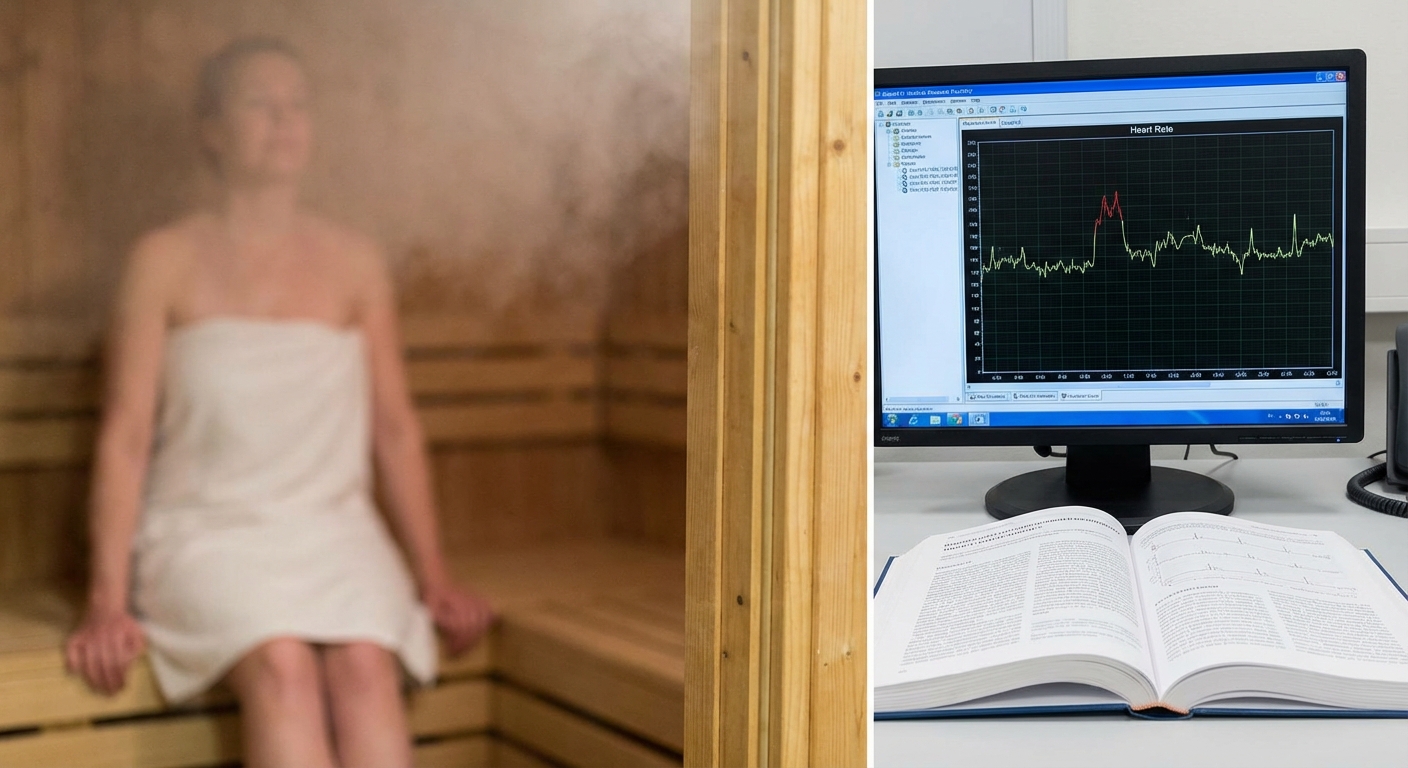
To do this, your physiological systems kick into overdrive. Your heart rate spikes. In a hot sauna, your pulse can easily rise to 120 or even 150 beats per minute. That is the same heart rate you might hit during a brisk run or a moderate session on the rowing machine.
While your heart is pumping faster, something else is happening to your plumbing. Your blood vessels undergo vasodilation. This is a fancy way of saying your pipes get wider. The heat causes your blood vessels to expand to help move blood to the surface of your skin for cooling.
This expansion reduces peripheral resistance. Think of it like a traffic jam. If you have thousands of cars trying to squeeze through two lanes, traffic stops, and pressure builds. If you suddenly open up two more lanes, the traffic flows smoothly, and the pressure drops.
That is what heat does to your arteries. It lowers your blood pressure and improves endothelial function—the health of the inner lining of your blood vessels. This lining is crucial. When it is healthy and elastic, you are resilient. When it gets stiff and inflamed, you are on the fast track to atherosclerosis and heart disease.
I have lately been inconsistent with my Muay Thai training, but I know the feeling of that intense cardiovascular demand—the way your chest heaves and your pulse throbs in your ears during a sparring round. It is shocking to realize that sitting in silence on a wooden bench can replicate a significant portion of that cardiac workload. You are sweating, your heart is working, and your blood is flowing, but your joints are resting. It is passive cardio.
The Numbers Don't Lie
It is easy to get lost in the theory of biological mechanisms. Theories are nice, but I prefer proof. I want to know if this actually keeps people alive longer.
This brings us to the Kuopio Ischaemic Heart Disease Study. This isn't a small survey of 20 people over a weekend. This is the landmark evidence that changed how cardiologists look at heat.
Researchers followed 2,315 middle-aged men in eastern Finland for over 20 years. They tracked everything about their lives, including how often they sat in a sauna. The results were not just statistically significant; they were staggering.
The study found a direct link between sauna frequency and survival.
- The Baseline: They compared men who used the sauna once a week (which is considered low in Finland) to those who used it more often.
- The Reduction: Men who used the sauna 4 to 7 times per week had a 63% lower risk of sudden cardiac death.
- The Disease Factor: Those frequent bathers also had a 48% lower risk of fatal coronary heart disease.
Let those numbers sink in for a second.
In the world of medicine and nutrition, we usually get excited about risk reductions of 10% or 15%. A 63% reduction in sudden cardiac death is unheard of. It suggests that heat therapy isn't just a minor "healthy habit" like taking a multivitamin; it is a powerful shield against the leading killer of men.
The study also showed a clear "dose-response" relationship. This means the benefits didn't plateau immediately. The more frequently the men used the sauna, the lower their risk dropped. It implies that consistency is key. You can't just go once a month and expect to bulletproof your heart. You have to treat it like a discipline.
How to Do It (The Finnish Protocol)
Knowing the science is useless if you don't know how to apply it. You can't just walk into a warm room for five minutes and expect to live forever. To get the results seen in the study, you have to mimic the protocols used by the people in the study.
We call this the "Finnish Protocol." It is distinct from the way many Americans use saunas at their local gym.
Here is the blueprint for integrating this into your life for maximum heart health.
1. The Temperature Must Be High
Most gym saunas in the United States are kept lukewarm, often around 150°F or lower, because of liability concerns or poor maintenance. That is not enough. To trigger the hormetic stress response and the vasodilation we talked about, you need real heat.
- Target: Aim for 176°F to 194°F (80°C to 90°C).
- Type: This refers to a traditional dry sauna (electric or wood-burning heater with rocks). Infrared saunas have their place, but the long-term data on cardiac death comes specifically from traditional high-heat saunas.
2. Duration Matters
You need to stay in long enough to raise your core body temperature. If you don't break a sweat, you haven't started the clock.
- Target: 11 to 20 minutes per session.
- The Sweet Spot: The study indicated that sessions lasting longer than 19 minutes provided the most substantial risk reduction. However, listen to your body. If you feel dizzy or lightheaded, get out immediately. You are trying to stress the system, not crash it.
3. Frequency is Everything
This is the hardest part for most people. The magic happens with repetition.
- Target: 4 to 7 sessions per week.
- Reality Check: If you can't do daily, aim for consistency. Even 2 or 3 times a week is significantly better than zero. But if you have access to a sauna at home or your gym, try to make it a daily ritual.
4. The Cool Down and Safety
The transition from hot to cold is part of the therapy, but safety is paramount.
- Hydration: You are going to lose a massive amount of water and electrolytes. You must hydrate aggressively before and after every session.
- Substance Avoidance: Never combine sauna use with alcohol. Alcohol dehydrates you and messes with your blood pressure regulation. Mixing booze and high heat is a recipe for fainting, arrhythmia, or worse.
- The Cool Down: In Finland, they might jump in a frozen lake or roll in the snow. You don't have to be that extreme, but a cool shower after your session helps close the pores and normalize your body temperature.
Conclusion
We live in a time where we are constantly looking for the next bio-hack or pharmaceutical breakthrough to save us from our sedentary lifestyles. Yet, one of the most potent tools we have has been sitting in Northern Europe for thousands of years.
The sauna is a unique bridge between relaxation and hard work. It requires discipline to sit in the heat when your brain is telling you to leave. It requires a commitment to silence and stillness in a world that is constantly screaming for your attention.
But the payoff is undeniable.
By integrating this practice into your weekly routine, you aren't just pampering yourself. You are training your heart. You are opening up your vascular system, reducing the load on your cardiac muscle, and statistically increasing your odds of living a longer, healthier life.
Don't wait for a doctor to prescribe it. Find the heat, respect the protocol, and sweat your way to a stronger heart.