

It is March 2, 2026. If you are like millions of other people right now, you might be staring at a notification on your phone that says your tax refund has arrived. Maybe you’ve already done the mental math. This year, the average refund is estimated to be about $800 higher than last year. It feels like a windfall. It feels like "found money."
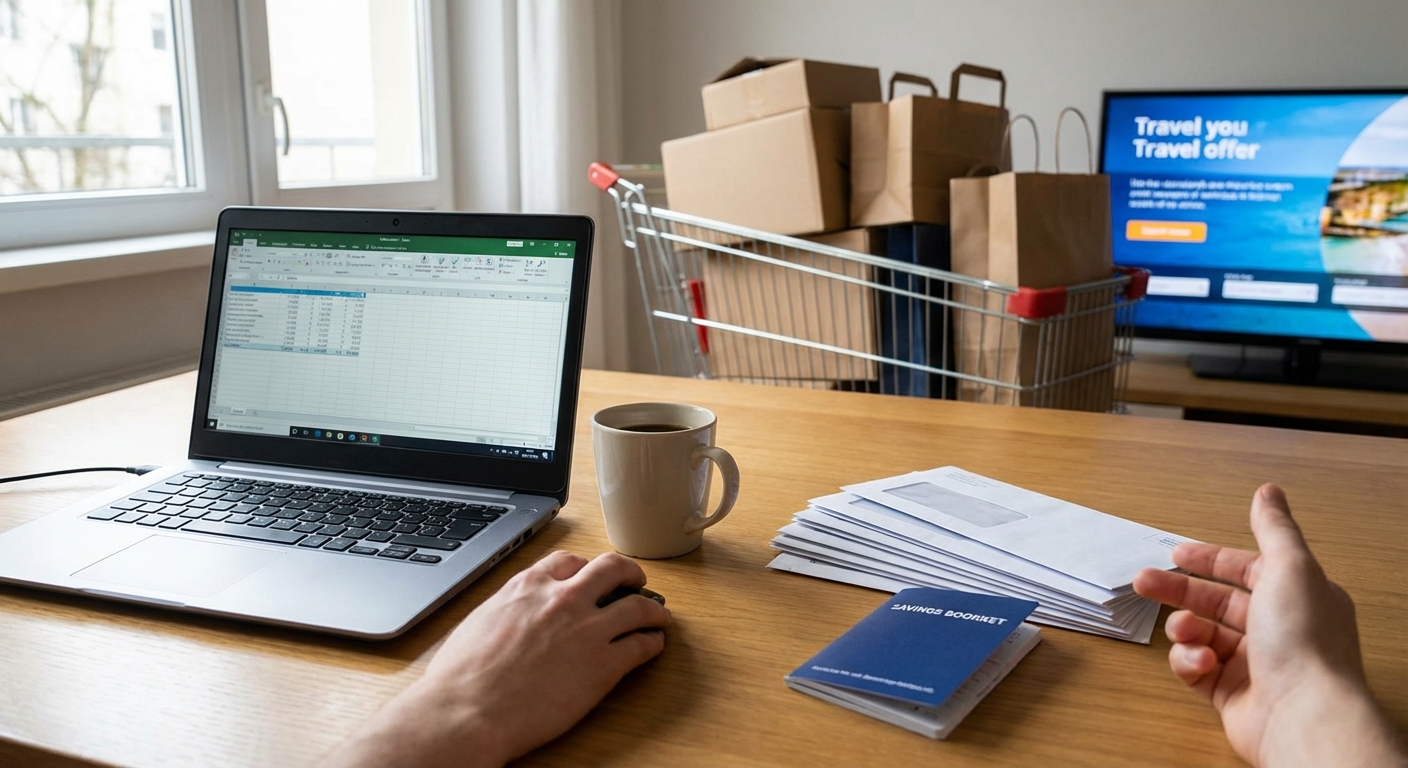
And that is exactly why you are in the danger zone.
Right now, economists are tracking a strange phenomenon. Despite record levels of household debt—hitting $1.277 trillion recently—people are spending that refund money faster than ever. We are seeing a "K-shaped" dynamic where debt is rising, yet consumption is skyrocketing. Why? Because when your brain labels money as a "bonus" rather than "income," your guard drops. You aren't thinking about paying down the high-interest credit card balance you’ve been carrying for a year. You are thinking about the upgrade. The treat. The reward.
You are about to buy something you don't need, and I am going to tell you exactly why it happens, why your brain is conspiring against your bank account, and how you can actually stop it. This isn't about being cheap. It is about understanding the machinery under the hood of your own psychology so you don't get taken for a ride.
The Spiral of Unity (The Diderot Effect)
The most insidious trap in consumerism isn't the first purchase; it is the second, third, and fourth one that the first one demands. This is known as the Diderot Effect.
It is named after the French philosopher Denis Diderot. The story goes that he lived a humble life until he was gifted a beautiful, expensive scarlet robe. It was a magnificent piece of clothing. But when he put it on and sat in his study, he noticed a problem. The robe was so elegant that his old desk looked like trash in comparison. So, he bought a new desk. Then, the rugged carpet looked out of place beneath the new desk, so he upgraded the carpet. Eventually, he replaced everything in the room to match the robe. He ended up in debt, famously writing, "I was absolute master of my old dressing gown, but I have become a slave to my new one."
You see this in your own life all the time. You don't just buy a new smartphone. Suddenly, your old headphones aren't compatible, or they look beat up next to the sleek new glass screen. You need the new case. Then you need the magnetic charger.
This happens because human beings have a deep psychological need for "unity" or consistency in their identity and environment. When you introduce a new, higher-quality item into your life, it creates immediate dissonance. It creates a mismatch. Your brain hates that mismatch. It interprets that tension as stress. To relieve the stress, you unknowingly start spiraling, buying more things not because you need them, but to make the picture look "right" again.
In 2026, this is weaponized against you. Online retailers use algorithms specifically designed to trigger the Diderot Effect. They don't just show you a couch; they show you the "bundle" with the lamp and the rug that makes the couch look perfect. They are selling you the resolution to the tension they just created.
The Neurological High
Let’s get real about what is happening chemically. You aren't addicted to the products. You are addicted to the hunt.
There is a massive misconception that the pleasure of shopping comes from owning the item. If that were true, you would feel a sustained sense of joy every time you looked at that gadget you bought three months ago. But you don't, do you? In fact, you probably hardly notice it anymore.
The pleasure comes from anticipation. When you are browsing, scrolling, and hovering over the "add to cart" button, your brain is flooding with dopamine. This is your brain’s reward system kicking into overdrive. It is simulating the future. It is telling you, "If you get this, your life will be better. You will be happier. You will be complete."
The dopamine spike peaks right before you execute the purchase. Once the transaction is done, the chemical levels drop off a cliff. This is why "buyer's remorse" or post-purchase dissonance is so common. You chased the high, you caught it, and now it’s gone.
This cycle creates a loop. You feel a drop in mood (the dopamine crash), so you instinctively reach for your phone to start browsing again to get that level back up. It is a physiological response, not a moral failing. But if you don't recognize it, you will keep trying to fill a bucket that has a hole in the bottom.
The Rationality Gap
We like to think we are rational actors. We think we look at our budget, look at the price, and make a logical calculation. That is rarely the case.
Your brain has a CEO. It’s the prefrontal cortex, the part of your brain responsible for long-term planning, impulse control, and logic. But your brain also has a toddler. That’s the limbic system, the ancient emotional center that wants what it wants, and it wants it now.
Under normal circumstances, the CEO can tell the toddler to settle down. But the CEO gets tired. When you are stressed, exhausted, or emotional, the prefrontal cortex essentially goes offline. This is the "Rationality Gap."
I know this dynamic intimately. Years ago, I was a smoker and a vaper. I knew logically that it was destroying my lungs and draining my wallet. My "CEO" brain had all the facts. But the moment I hit a wall of stress with work or felt a pang of anxiety, logic didn't matter. The "itch" took over. My brain convinced me that the only way to survive the next hour was to take a drag. It wasn't about the nicotine; it was about immediate emotional regulation. I see the exact same pattern in how people spend money.
When you are in a state of H.A.L.T.—Hungry, Angry, Lonely, or Tired—you are physiologically incapable of making good financial decisions. You are buying to soothe a feeling, not to acquire a utility.
If you are lonely, you buy things to feel connected or to project an image. If you are tired, you buy convenience (takeout, gadgets) to save energy. If you are angry or stressed, you buy to feel a sense of control. The "found money" from a tax refund hits your account, and if you are in a H.A.L.T. state, that money is gone before your rational brain even wakes up.
Identity Markers and the Fantasy Self
We also buy things to bridge the gap between who we are and who we wish we were. This is identity-based consumption.
You might buy a high-end stand mixer not because you bake every weekend, but because you want to be the kind of person who bakes. You want that identity. You might buy expensive running gear not because you run, but because you want to be a "runner."
You are purchasing a costume for your "Fantasy Self."
The problem is that the object doesn't confer the character trait. Buying the mixer doesn't give you the discipline to bake. Buying the gear doesn't give you the cardio. The purchase is a shortcut. It feels like you made progress toward that identity, which tricks your brain into feeling satisfied, causing you to actually put in less effort toward the real goal.
Practical Steps to Reclaim Your Budget
So, how do we fight back? We don't do it with willpower. Willpower is a finite resource, and it breaks. We do it with systems and friction. We need to put speed bumps between the impulse and the action.
The 72-Hour Rule:
Never buy anything non-essential immediately. If you see something you want, wait 72 hours. This isn't just an arbitrary number. It takes time for the dopamine fog to clear and for your prefrontal cortex to come back online. If you still want it after three days, and you have checked your budget, then you can consider it. You will find that 90% of the time, the urge evaporates completely.Strategic Friction:
You need to make it annoying to spend money. Retailers have spent billions making it "frictionless" (one-click ordering, saved cards, Apple Pay). You need to add the friction back. Delete the shopping apps from your phone. Do not save your credit card information in your browser. Force yourself to get up, find your wallet, and type in the 16 digits every single time. That two minutes of effort is often enough time for your brain to ask, "Do I actually need this?"The Buy One, Give One Rule:
To combat the Diderot Effect, implement a strict policy: for every new item that comes into your house, an old one must leave. If you buy a new shirt, an old one gets donated. If you buy a new gadget, the old one gets sold or recycled. This forces you to evaluate the real value of the new item. Is this new thing really worth more to me than the thing I already have? If the answer is no, you don't buy it.Practice Stillness:
This sounds abstract, but it is the most practical tool you have. The urge to consume often comes from a lack of peace. We are bored, anxious, or restless, so we scroll. Learning to sit in silence, without a screen, and just be is the antidote to the constant desire for "more." It builds the discipline necessary to tell yourself "no."
Conclusion
We are living in a time where the pressure to consume is higher than ever, and the barriers to doing so are lower than ever. The tax refund in your account looks like freedom, but if you aren't careful, it becomes chains.
You are not fighting a fair fight. You are up against neurochemistry, algorithms, and your own emotional triggers. But you can win. By understanding the Diderot Effect, recognizing the dopamine trap, and respecting your own emotional state, you can step off the treadmill.
You don't need the upgrade. You don't need the bundle. You need the peace of mind that comes from knowing you are in control of your life, not your impulses. Keep your money. Keep your freedom.

See also in Mindset
Neuroscientists Reveal the #1 Reason You Can’t Focus
20 Tips for Developing Mental Agility
What To Do When You Dont Know What To Do
20 Strategies for Handling Challenges
20 Mental Math Tricks
The Finnish Concept of ‘Sisu’ That Builds Unbreakable Grit