

If you have been following the news lately, you know that traveling right now is a nightmare. It is March 5, 2026, and if you are stuck at a major hub like Houston’s George Bush Intercontinental Airport (IAH), you are likely living through a special kind of hell. Thanks to the partial federal government shutdown affecting TSA staffing, security wait times are exceeding three hours.
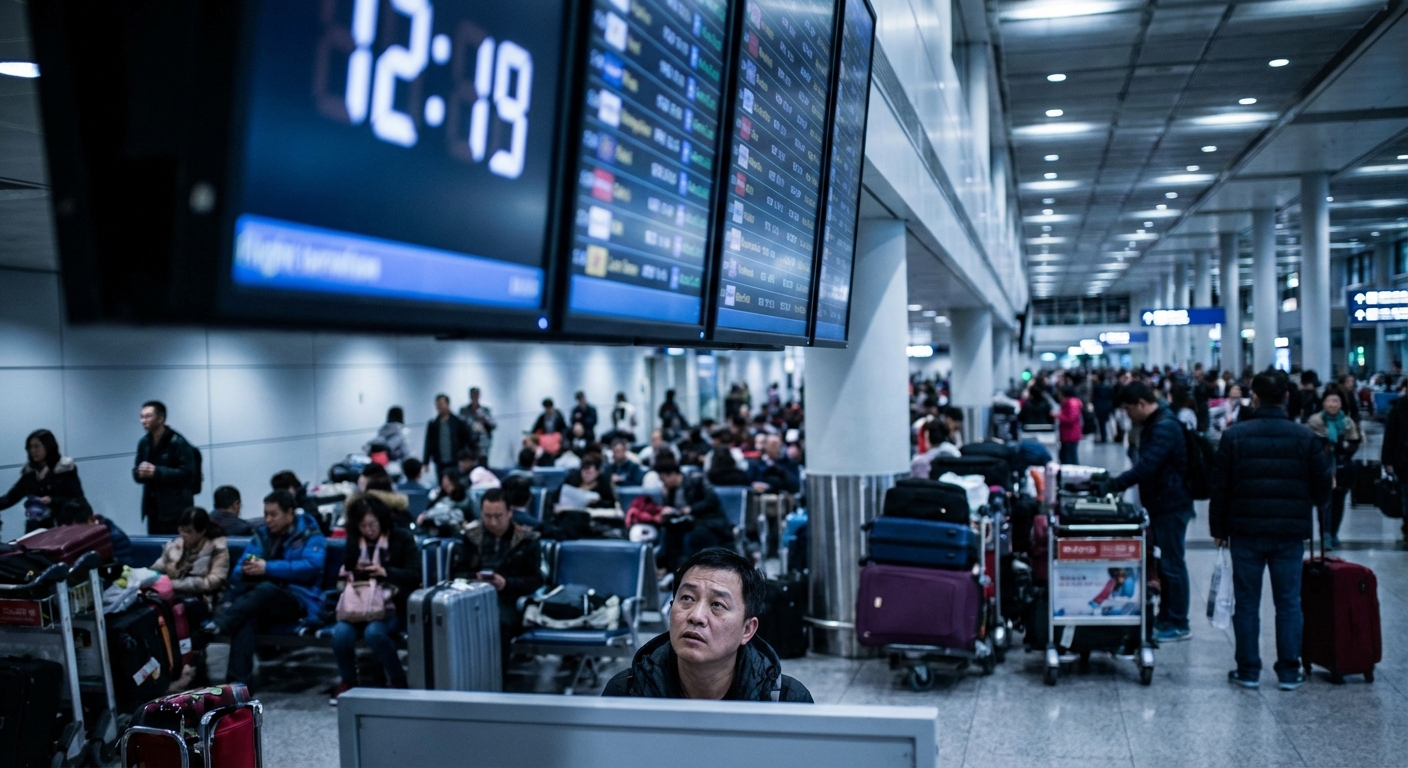
Social media is currently ablaze with the "Airport Theory" trend, where travelers are trying to game the system by arriving at the last possible second to avoid the lines. But experts are warning that this is a failing gamble. The system is too unpredictable right now.
But here is the interesting thing about waiting: the misery isn't just about the clock. It is about how your brain processes that clock. Why does a five-minute wait for a slow barista feel like twenty minutes, while a two-hour movie flies by? The difference isn't time management; it is perception management. We need to stop looking at the minute hand and start looking at what is happening inside our heads while we stand there.
The Houston Airport Strategy
To understand how to hack your perception of time, we have to look at a classic case study that ironically comes from the same city currently making headlines for its travel chaos. Years ago, executives at a Houston airport faced a massive customer service crisis. Passengers were furious about the amount of time they had to wait for their luggage at the baggage carousel.
The airport did the logical thing first. They hired more baggage handlers. They optimized the workflow. They managed to get the average wait time down to just eight minutes. In the world of logistics, eight minutes is incredible.
But the complaints didn't stop. In fact, they barely dipped.
The executives were baffled, so they brought in behavioral psychologists to analyze the passenger experience. They realized that it took passengers about one minute to walk from their arrival gate to the baggage claim area. That meant they spent seven minutes standing idle at the carousel, staring at an empty conveyor belt.
So, they tried a counter-intuitive approach. They didn't speed up the bags; they slowed down the passengers. They moved the arrival gates much further away from the main terminal and routed the bags to the furthest carousel.
The new result? Passengers now had to walk for six minutes to get to baggage claim. When they arrived, they only had to wait two minutes for their bags. The total time from plane to suitcase was exactly the same: eight minutes.
However, the complaints dropped to near zero.
Why? Because occupied time feels significantly shorter than unoccupied time. When people were walking, they were "doing" something. Their brains were engaged in navigation and movement. When they were standing still, they were unoccupied, leaving their brains with nothing to do but measure the passage of every agonizing second.
The Core Principle: Occupied Time
This phenomenon is grounded in the work of David Maister, a former Harvard Business School professor who dedicated his career to the psychology of waiting lines. His formula for satisfaction is simple but profound:
Satisfaction = Perception – Expectation
If you expect a wait to be long and it is short, you are happy. If you expect it to be short and it is long, you are furious. But the most critical variable here is "Perception."
Humans do not have an objective internal clock. We rely on heuristics—mental shortcuts—to guess how much time has passed. When our minds are unoccupied, we become hyper-aware of time itself. Research suggests that when we are idle, we overestimate the duration of a wait by roughly 36%. That means a ten-minute wait feels like nearly fourteen minutes if you are just staring at the wall.
This is where the "Occupied Time" principle saves us. When your brain is focused on a task, it has fewer "attentional resources" to dedicate to monitoring the clock.
I see this in my own professional life constantly. I am a web developer and marketer who often juggles multiple complex projects at once. I rely on deep-work bursts to keep my focus sharp. When I am truly locked into a coding problem or mapping out a campaign strategy, four hours can disappear in what feels like ten minutes. The immersion is total. But, if I am sitting there waiting for a large video file to render or waiting for a client to text me back with an urgent approval? Two minutes feels like an hour. The clock hasn't changed; my brain has just run out of things to do, so it starts counting seconds.
This is why mirrors are placed next to elevators. It isn't just for décor; it is so you can check your tie or fix your hair. That brief moment of vanity occupies your time, making the wait for the elevator feel instantaneous.
Why Uncertainty Is the Enemy
While "occupied time" is the primary factor, there is a secondary demon that makes waiting unbearable: uncertainty.
In the current situation at Houston IAH, the reason people are panicking isn't just that the line is long; it is that they don't know how long it is. Is it three hours? Four? Will they miss the flight?
Uncertainty triggers a stress response. When the outcome is unknown, your body releases cortisol. You enter a state of vigilance. Maister’s research found that "uncertain waits are longer than known, finite waits."
If you walk into a doctor’s office and the receptionist says, " The doctor will see you in twenty minutes," you might be annoyed, but you can settle in. You can open a book. You can mentally budget that time. But if the receptionist says, "The doctor will be with you soon," and twenty minutes pass, you are climbing the walls. "Soon" is a variable. Every minute that passes increases the anxiety that you have been forgotten.
This is why progress bars on computers were invented. Early computer systems didn't have them. You would click "download," and the screen would just freeze. Users hated it because they didn't know if the computer was working or if it had crashed. The progress bar doesn't make the download faster—in fact, the graphical rendering might technically slow it down by a millisecond—but it gives you certainty. It turns an infinite wait into a finite process.
Practical Steps to "Hack" Your Waiting
We cannot always control the speed of the service, the TSA staffing levels, or the traffic on the highway. But we can control how we experience the wait. Whether you are a business owner trying to keep customers happy or just a guy trying not to lose his temper at the post office, here are three ways to apply these principles.
1. Replace Uncertainty with Visibility
If you are running a business, never leave your customer in the dark. If there is a delay, give them a number. Even if the number is bad, a specific "30-minute wait" is psychologically easier to handle than a vague "we're running behind."
If you are the one waiting, seek out certainty. If you are in a long line, ask an employee for a realistic estimate. Once you have a timeframe, your brain can stop scanning for danger and settle into the wait. You can switch from "anxiety mode" to "endurance mode."
2. Pre-Processing: Start Before You Start
One of the most effective tricks is the concept of "pre-processing." This is when a service signals that the transaction has begun, even if the main event hasn't happened yet.
Restaurants do this by handing you a menu while you are still standing in the foyer. Doctors do this by having you fill out intake forms the moment you walk in. By starting a task related to the service, you feel like you have "crossed the threshold." You are no longer waiting to be served; you are being served.
In your personal life, you can simulate this. If you are waiting to meet a friend for a serious conversation and they are late, start outlining your thoughts in a notebook. You are no longer waiting for the talk to start; you are preparing for it. You have begun the process.
3. The "Because" Effect
Psychologically, an unexplained delay feels like an insult. An explained delay feels like a misfortune. When we don't know why we are waiting, we tend to assume incompetence or negligence on the part of the service provider.
However, simply knowing the "why" helps us cognitively reappraise the situation. This is known as the "Because" effect. If the pilot announces, "We are sitting on the tarmac because of a mechanical issue," we might be worried, but we accept the wait as necessary for safety. If they say nothing, we assume they are just incompetent.
If you are stuck in traffic, finding out there is an accident ahead doesn't clear the road, but it often lowers your blood pressure. You shift from "Why is this happening to me?" to "Oh, something happened." It depersonalizes the delay.
Conclusion
We live in a world that is obsessed with speed, yet we spend a staggering amount of our lives waiting. We wait in traffic, we wait for web pages to load, we wait for test results, and yes, we wait in airport security lines.
You cannot always force the world to move faster. The government shutdown affecting the TSA is out of your hands. The number of baggage handlers is not your call. But you have full authority over your own perception.
The next time you find yourself stuck in a line, don't just stand there and let your brain amplify the seconds. Occupy that time. Force your brain into a task. Bring a book, solve a problem, or practice quiet contemplation. If you can fill the void with activity, you rob the wait of its power to frustrate you. Time is elastic; you just have to stretch it in the right direction.

See also in Mindset
20 Mindset Hacks for Holiday Cheer
Why Your Brain Craves Routine More Than You Realize
5 Types of Music to Calm You Down
How the ‘Scarcity Mindset’ Literally Narrows Your Cognitive Bandwidth
20 Techniques for Outlook Changes
Behavioral Scientists Decode Holiday Stress Patterns