

We have all been sold the lie of the "nightcap," the idea that a stiff drink or a glass of red wine is the perfect way to power down after a high-stress day. It feels intuitive because, initially, it works. You take a sip, the noise in your head quiets down, and your body feels heavy. You drift off.
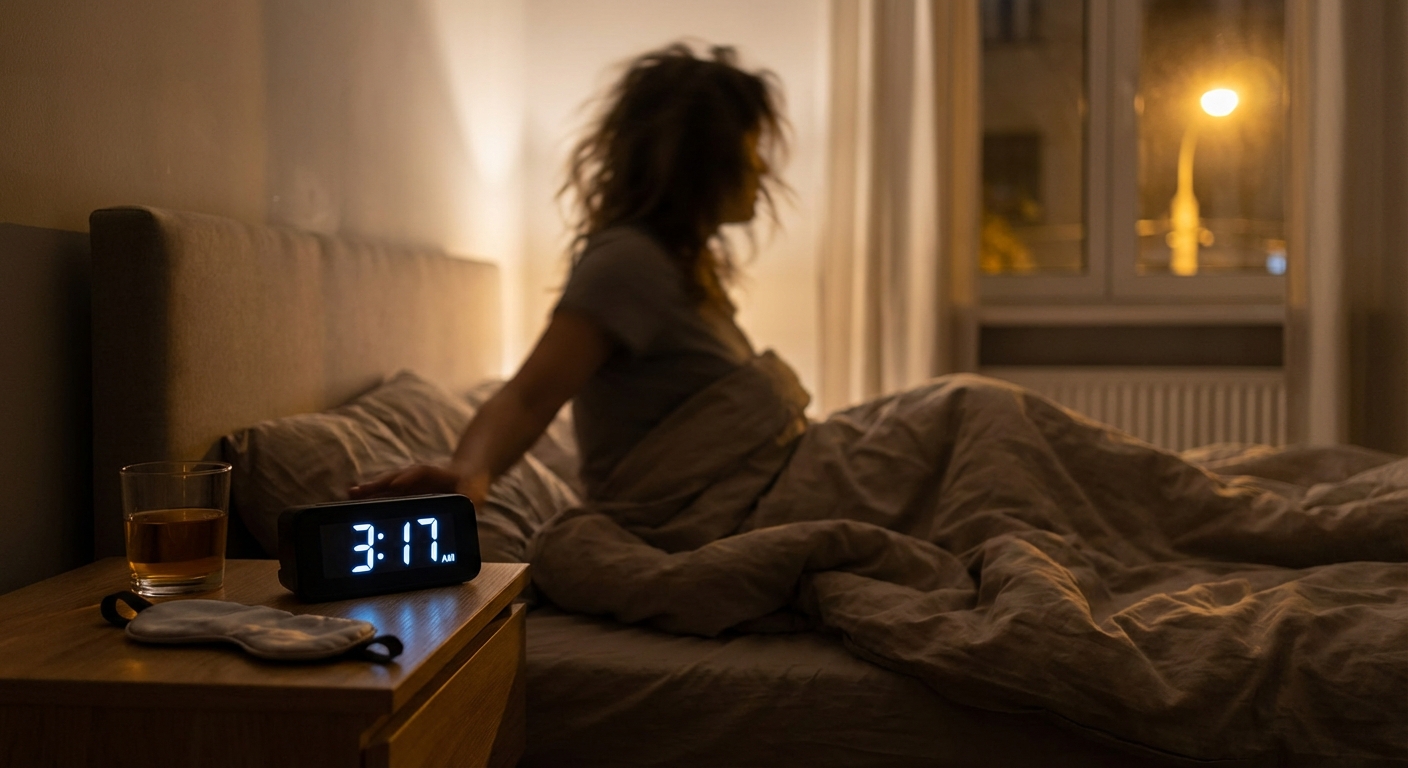
But there is a massive difference between sedation and sleep.
As we move through Sleep Awareness Week in March 2026, the conversation around our nightly rest has fundamentally shifted. We are no longer just talking about "getting eight hours." We are looking at the quality of those hours. Following the major reset of federal nutrition policy earlier this year, the old "one drink for women, two for men" rule has been thrown out. The new guideline is starker, simpler, and based on hard biology: "consume less alcohol for better overall health."
This isn't about morality. It is about mechanics. If you are serious about your performance, your mood, and your longevity, you need to understand exactly what that evening drink is doing to the architecture of your sleep. It is not just dehydrating you; it is actively dismantling your ability to recover.
The Neurochemical Whiplash
To understand why you wake up at 3:00 AM staring at the ceiling with a racing heart, you have to understand the chemical negotiation happening inside your skull. Your brain operates on a delicate balance between excitation and inhibition. It has a gas pedal (Glutamate) and a brake pedal (GABA).
When you drink alcohol, you are artificially slamming on the brakes. Alcohol acts as a GABA agonist, meaning it mimics the body's primary inhibitory neurotransmitter. It sedates you. It slows down neuronal firing. At the same time, it suppresses Glutamate, taking your foot off the gas. This is that initial feeling of relaxation and "unwinding."
But your brain is a master of homeostasis. It wants balance above all else. When it realizes that an outside agent (alcohol) is holding down the brake pedal, it fights back to prevent you from slipping into a coma. The brain responds by furiously pumping out Glutamate (the gas) and downregulating its own GABA receptors to counteract the sedation.
Here is the problem: Alcohol metabolizes relatively quickly. Depending on how much you drank, the ethanol leaves your system within a few hours. But your brain’s counter-measures—that flood of excitatory Glutamate—stick around much longer.
This is the "rebound effect."
Once the alcohol wears off around 2:00 or 3:00 AM, the sedation vanishes, but the brain is still in hyper-drive mode. The brakes are gone, but the gas pedal is floored. This creates a state of neurochemical whiplash. You jolt awake, not because you are rested, but because your brain is vibrating with excitatory chemicals.
This is the physiological root of "hangxiety." It isn't just regret about what you said at dinner; it is a chemical imbalance where your brain is firing unchecked. This rebound effect peaks anywhere from 6 to 24 hours after your last drink, meaning the anxiety and brain fog you feel the next day aren't just dehydration—they are the result of a brain trying desperately to calm itself down.
Fragmented Architecture: A Tale of Two Halves
If you look at a hypnogram—a graph of sleep stages—for a sober night, you see a beautiful, rhythmic wave. You dip into deep sleep, cycle up to REM (Rapid Eye Movement), and repeat this about every 90 minutes.
Alcohol destroys this wave and replaces it with a "night of two halves."
In the first half of the night, while alcohol is still in your system, you experience a massive increase in Slow Wave Sleep (N3). This is the deep, coma-like sleep. It sounds good on paper, but it is artificial. You are skipping the lighter stages that serve as the on-ramp for natural sleep cycles. This acts as a trap door into unconsciousness.
The penalty comes in the second half of the night. As the rebound effect kicks in, your sleep architecture fragments. The most significant casualty is REM sleep.
REM sleep is the stage responsible for emotional regulation, memory consolidation, and creative problem-solving. It is when your brain sorts through the data of the day and decides what to keep and what to discard. Alcohol is a potent REM antagonist. A 2025 meta-analysis confirmed that even low doses—roughly two standard drinks—significantly delay the onset of REM and reduce its total duration.
When you suppress REM, you rob yourself of emotional processing. You wake up feeling brittle and reactive. You might have been "unconscious" for seven hours, but biologically, you have been fighting a war. The second half of the night becomes riddled with micro-awakenings—moments where you wake up for a few seconds and fall back asleep, often without remembering them.
I know this feeling intimately. I balance a lot of roles—juggling complex web development projects and marketing campaigns. I used to think a drink or two helped me switch off the code running through my head. But I noticed a pattern. On the nights I drank, even just a little, my ability to hit those "deep work" bursts the next morning evaporated. I wasn't hungover in the traditional headache-and-nausea sense, but my focus was shattered. I couldn't hold complex logic in my head. I realized that by trying to borrow relaxation from the evening, I was stealing competence from the next morning.
The Heart Under Pressure
We often think of sleep as a time when the body shuts down to repair itself. Your heart rate should drop, your body temperature should cool, and your nervous system should shift into "rest and digest" mode (parasympathetic dominance).
Alcohol forces the opposite to happen. It keeps the sympathetic nervous system—the "fight or flight" mode—active throughout the night.
Data from wearable technology has made this undeniable. In 2025, aggregate data from over 600,000 users showed that on nights with alcohol, the average resting heart rate (RHR) spiked by nearly 10%. That might not sound like much, but over an eight-hour period, that is thousands of extra beats. Your heart is essentially running a light jog while you are lying in bed.
Even more telling is the crash in Heart Rate Variability (HRV). HRV is the gold standard for measuring your body's recovery status and resilience to stress. High HRV means your body is adaptable and recovered; low HRV means you are under strain. The data shows that alcohol causes HRV to plummet by an average of 15.6%.
This explains why you wake up feeling physically exhausted even if you didn't stay up late. Your body was not resting. It was metabolizing a toxin.
This also manifests in temperature regulation. Alcohol is a vasodilator, meaning it widens blood vessels and sends blood to the skin's surface. This disrupts the body's natural cooling process, often leading to night sweats and temperature spikes that further disrupt the sleep cycle. You are asking your body to perform complex maintenance work while simultaneously forcing it to run a fever and a marathon.
Actionable Strategies for Restorative Rest
The goal here isn't to preach total abstinence if that isn't your path. The goal is to be pragmatic. If you choose to drink, you need to treat it like the physiological load that it is and manage it accordingly.
Here are three strategies to reclaim your sleep architecture.
1. The Four-Hour Window
The most effective way to mitigate the damage is to give your body time to process the ethanol before your head hits the pillow. You need a buffer zone.
Aim to finish your last drink 3 to 4 hours before sleep. This allows your liver to metabolize the bulk of the alcohol, meaning the "sedation" phase wears off before you are fully asleep. You might have a harder time falling asleep initially because you don't have the chemical "brakes" helping you, but the sleep you do get will be real. This minimizes the peak of the glutamate rebound during your critical REM cycles in the early morning.
2. Monitor Your Bio-Metrics
Stop guessing and start measuring. If you wear a tracker, look at your RHR and HRV the morning after a drink.
It is easy to lie to ourselves and say, "I feel fine." It is much harder to argue with a resting heart rate that is 12 beats per minute higher than your baseline. Use this data as a feedback loop. When you see the physiological cost of that second glass of wine expressed in hard numbers, it changes your decision-making process. You stop seeing it as a harmless treat and start seeing it as a recovery tax.
3. Prioritize "Sober Weeks"
The new "less is better" framework suggests moving away from daily counting and toward longer periods of recovery. Your brain's neurochemistry needs time to reset.
It takes time for GABA and Glutamate receptors to re-sensitize and return to baseline. Aim for windows of 3 to 4 days—or ideally full weeks—of zero intake. This allows your sleep architecture to stabilize. You will likely notice that by night three or four, your dream recall becomes vivid and intense. That is your brain catching up on the REM sleep it has been starved of.
Conclusion: Reclaiming the Night
We live in a high-pressure world. The desire to turn off the noise is valid. But we have to be honest about the tool we are using. Alcohol doesn't turn off the noise; it just delays it and turns up the volume for the next day.
Real recovery requires stillness and physiological safety, things that alcohol actively destroys. By understanding the mechanics of the glutamate rebound and the strain on your heart, you can stop sabotaging your own recovery.
Sleep is the foundation of your discipline, your mood, and your ability to handle the world. Don't sell it cheap for a moment of sedation. Protect your rest.
