

You drive through an upscale neighborhood, and the houses seem to scream for attention. They are massive, sprawling estates with columns that don't hold anything up and fountains that cost more than a mid-sized sedan to operate. You naturally assume the people living inside have "made it." But if you actually pull back the curtain on the finances of the truly wealthy—the people who have generational freedom rather than just high incomes—you will notice a startling trend.
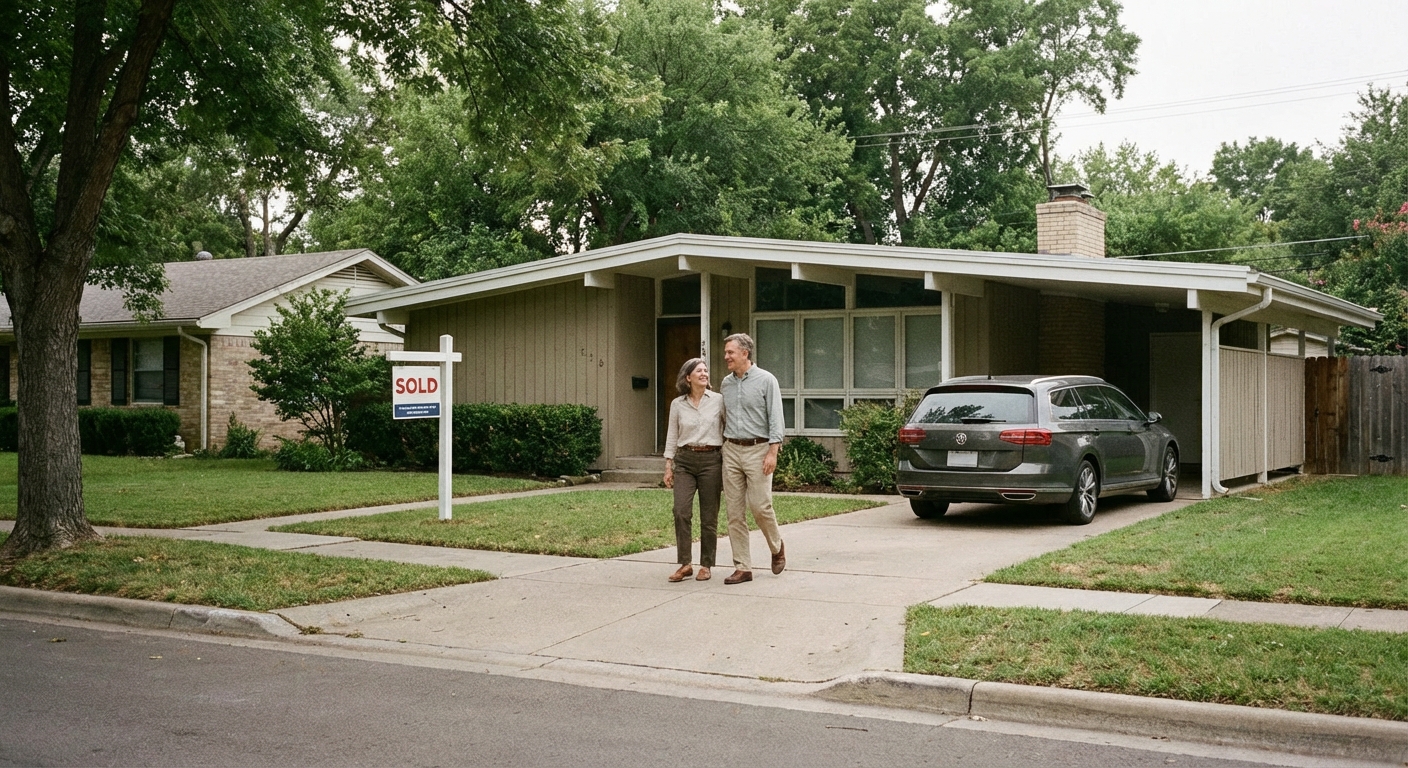
They aren't living in the castles. They are living in the modest, well-built homes down the street.
As we move through 2026, the real estate market has shifted into what experts are calling a "deliberate phase." The era of buying the biggest house you can qualify for is over for the smart money. High-net-worth individuals are increasingly prioritizing capital preservation and intentional living over speculative urgency. They understand something that most aspiring millionaires miss: your primary residence is not an asset; it is a liability that you sleep in.
I have spent years watching how people manage their lives and their money, and I can tell you that the most successful people I know are masters of "Stealth Wealth." They don't use their homes to broadcast their net worth. They use their homes as a quiet platform to build more of it.
The Core Idea: The Strategic Utility of the Modest Home
There is a profound difference between looking rich and being wealthy. Looking rich is expensive. It requires upkeep, staff, and a constant stream of cash flow just to maintain the illusion. Being wealthy, on the other hand, requires discipline and the ability to keep your capital moving.
In the financial landscape of 2026, the defining characteristic of sustainable wealth is "invisibility." Those practicing Stealth Wealth avoid the outward trappings of success to prevent lifestyle creep. Lifestyle creep is the silent killer of financial independence. It’s that subtle phenomenon where your expenses rise to meet your income, leaving you running on a hamster wheel regardless of how much you earn.
The wealthy view housing through the lens of "dead equity." Every dollar tied up in drywall, landscaping, and unused guest bedrooms is a dollar that isn't working in the market. It isn't compounding. It isn't generating dividends. It is sitting there, essentially dead, waiting for a housing market crash or a natural disaster to threaten it.
Consider Warren Buffett. He is the archetype of this principle. He still lives in the Omaha home he purchased in 1958 for roughly $31,500. He famously dubbed the purchase "Buffett's Folly" early on. Why? Because even back then, he did the math. He knew that the capital he tied up in that house could have compounded at a much higher rate if he had deployed it into American businesses. While he loves his home, he understands the opportunity cost. If one of the richest men in history sees a modest home as a luxury he barely justifies, we should probably rethink our obsession with square footage.
Practical Steps: How the Affluent Optimize Their Living Space
The shift we are seeing today is away from "more" and toward "better." The wealthy are optimizing their living spaces for peace, privacy, and efficiency. Here is how they are doing it, and how you can apply the same logic.
1. Prioritize Architectural Silence Over Scale
There is a design philosophy taking over the high-end market called "Architectural Silence." It is the opposite of the McMansion style that dominated the early 2000s. Instead of prestige being measured by sheer square footage or ornate displays, it is measured by intelligence and restraint.
Modern wealthy homeowners are choosing minimalist luxury. This prioritizes mental clarity. A massive house is a massive visual load. Every room you walk past that isn't being used is a mental "open tab" in your brain. It registers as something that needs to be cleaned, heated, cooled, or furnished. By choosing a smaller footprint with higher-quality materials, you create an environment of stillness. You stop "visually shouting" at your neighbors and start creating a sanctuary for yourself.
2. Avoid the Maintenance Trap
This is the most practical reason to downsize your housing ambitions. Large-scale luxury properties are maintenance traps. The costs associated with them—taxes, insurance, and upkeep—are exponential, not linear. A house that is twice as big doesn't cost twice as much to maintain; it often costs three or four times as much because the systems are more complex and the labor required is more specialized.
I learned this lesson regarding focus the hard way. I juggle projects as a web developer and marketer, often requiring deep-work bursts to keep my focus and momentum. There was a time when I let my lifestyle get too complicated, and the mental load of managing "stuff" started eating into my productivity. I realized that if I wanted to build something meaningful, I couldn't spend my Saturday mornings worrying about a massive lawn or a complex home automation system that kept glitching. I needed simplicity. The wealthy understand that time is their most finite resource. They refuse to spend it managing a depreciating asset.
As of 2026, we are seeing a clear shift away from big-ticket renovations. Homeowners are distinguishing between "need-to-have" repairs and "nice-to-have" upgrades. High labor and material costs make large discretionary projects a bad bet. The smart move is to buy a home that functions perfectly as is, rather than buying a project that will drain your bank account and your patience.
3. Design for Privacy and Security
Real wealth values anonymity. For the majority of luxury homebuyers right now, privacy and security are the top concerns. This often leads to choosing homes that look modest from the street.
Flashy new developments attract attention. They attract salespeople, solicitors, and sometimes, bad actors. Established, low-key communities offer a layer of camouflage. If you live in a modest home, you are less of a target. You can come and go without announcing your financial status to the world. It allows you to live a normal life, which, paradoxically, is the one thing money can’t buy if you give it away by living in a glass box.
Why It Works: The Long-Term Wealth Multiplier
You might be thinking, "But real estate is a good investment!" That is the common wisdom, but the math often tells a different story, especially when you factor in the opportunity cost.
The "price-to-rent" ratio is a metric used to evaluate whether it makes more sense to buy or rent. In 2026, these ratios are sitting near 16 in many markets, which is higher than the levels seen during the 2008 bubble. When the ratio is this high, over-investing in a primary residence is often a losing bet compared to the stock market.
The wealthy understand the concept of the "Long-Term Wealth Multiplier." It works like this:
- Scenario A: You buy a $2 million mansion. You put $400,000 down. You pay $15,000 a month in mortgage, taxes, and insurance. You pay another $20,000 a year in maintenance.
- Scenario B: You buy a $500,000 modest home. You put $100,000 down. Your monthly costs are $3,500. You take the difference in down payment ($300,000) and the difference in monthly costs ($11,500/month) and invest it in a diversified portfolio.
Over 20 years, Scenario B destroys Scenario A. The compound interest on the invested capital vastly outperforms the appreciation of the mansion, especially when you factor in the "carry costs" of the large home (taxes, insurance, repairs) which are money you never get back.
Younger affluent generations, particularly Gen X and Millennials, are catching on to this. They view homes as lifestyle platforms rather than trophies. They allocate a larger share of their portfolio to real estate only when it supports day-to-day productivity. They want a home that serves them, not a home that they have to serve.
Conclusion
We have been sold a lie that success looks like a gated estate with a six-car garage. But when you look at the numbers, and more importantly, when you look at the lives of the people inside those estates, the picture changes.
True wealth is about freedom. It is about the ability to do what you want, when you want, without the crushing pressure of monthly overhead. It is about having the stillness of mind to pray, to think, and to be present with your family without worrying about the roof leaking in the west wing.
The reason wealthy people live in surprisingly modest homes isn't because they can't afford more. It's because they can't afford the distraction. They know that wealth is what you don't see. It's the unspent money that grows into freedom. So, the next time you drive past a modest, well-kept house in a quiet neighborhood, don't assume they are just getting by. You might be driving past the richest person in town.
