

You think that when you shut the door, turn off the lights, and sit in a quiet room by yourself, you are giving your brain a break. It feels intuitive. You equate solitude with rest and people with work. But according to groundbreaking neuroscience, you have it completely backward. Your brain does not view being alone as a neutral state of rest; it views isolation as a crisis management situation that requires maximum horsepower to survive.
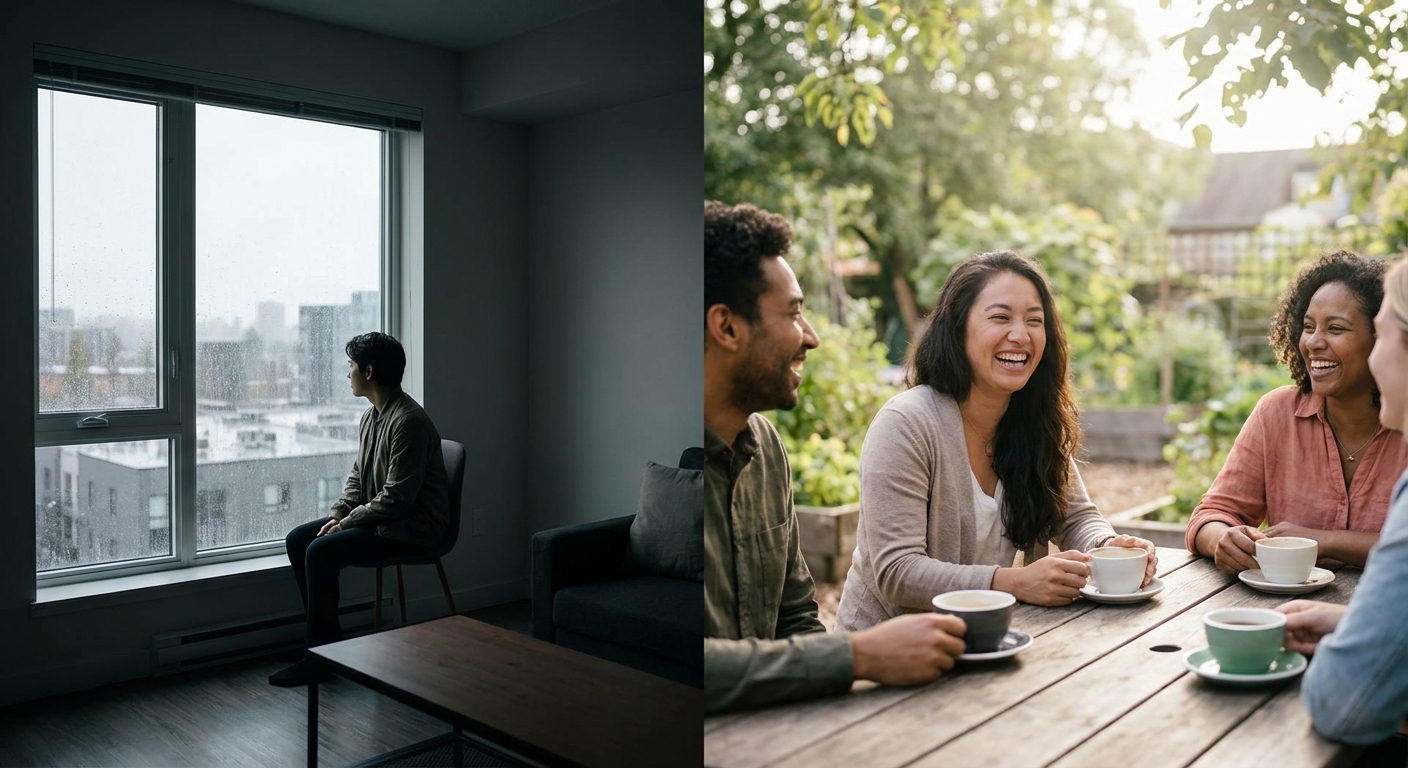
The Default State: Why Your Brain Hates a Room for One
For decades, we have operated under a "myth of independence." We tell ourselves that a healthy adult should be a self-contained fortress, capable of regulating emotions, processing threats, and managing stress entirely on our own. We view social connection as a nice bonus—a luxury we indulge in after the "real work" is done.
However, the data tells a much more alarming story. A massive study involving 350,000 adults from the UK Biobank, released just recently in March 2026, put a hard number on the cost of this independence. The researchers found that objective social isolation is associated with an 8–9% higher risk of developing cancer, particularly in women. This risk exists regardless of whether the person actually felt lonely.
This is the critical distinction: You might enjoy your solitude, but your biology does not.
This aligns perfectly with Social Baseline Theory (SBT), developed by Dr. James Coan at the University of Virginia. Coan’s work flips our understanding of human nature upside down. He argues that the human brain evolved to operate in a social context. The "baseline"—the state in which your brain is most efficient, calm, and energy-conserving—is when you are with other people.
When you are alone, your brain registers this as a deviation from the baseline. It perceives isolation as an "experimental treatment" or a high-risk environment. Without others around to help watch for predators or help solve problems, your brain automatically spins up its vigilance systems. It becomes hyper-aware, scanning for threats and preparing for "fight or flight" at a moment's notice. You might feel like you are relaxing on the couch, but your neural circuitry is idling in high gear, burning through your energy reserves just to maintain a basic sense of safety.
Biological Outsourcing: Sharing the Metabolic Load
To understand why isolation is so expensive, you have to look at your brain as an energy manager. Your brain is a greedy organ; it consumes a massive amount of your body's glucose and oxygen. Its primary job is to budget these resources to keep you alive.
In the wild, survival is incredibly calorie-expensive. You have to regulate your body temperature, scan the horizon for danger, remember where the food sources are, and suppress your fear responses to stay calm enough to act. Doing all of this alone is metabolically exhausting.
Social Baseline Theory suggests that we evolved to "outsource" these tasks. When you are with a trusted partner or a group, you don't have to be the only one watching the door. You don't have to be the only one remembering the path home. You can offload some of that cognitive and emotional labor onto the people around you.
This is called "load sharing." When you share the load, your brain literally slows down its consumption of metabolic resources. It stops dumping stress hormones into your bloodstream because it knows backup is available.
I learned this the hard way back when I was 110 pounds heavier and stuck in a brutal cycle of binge eating. I thought the solution was to isolate myself, white-knuckle through the cravings, and force discipline through sheer will. I treated my struggle like a private war, but that only burned me out faster because my brain was exhausted from constant solo vigilance; it wasn't until I stopped hiding and leaned on a support system that the "noise" in my head finally quieted down enough for me to change.
When we deny ourselves this support, we force our brains to do the work of a whole tribe. We maintain a state of constant, low-grade emergency. Over years, this "metabolic tax" accumulates. It wears down our immune systems, spikes our inflammation markers, and, as the recent UK Biobank data suggests, leaves us vulnerable to severe physical illness.
Perception Shifts: Why Hills Look Steeper When You’re Alone
Here is where the science gets truly wild. The presence of others doesn't just change how you feel; it changes what you see.
Your brain is constantly predicting how much energy it will take to perform an action. If it thinks an action is too "expensive" for your current energy budget, it will discourage you from trying. It does this by altering your visual perception.
Research has shown that when you stand at the bottom of a hill alone, your brain calculates the effort required to climb it based solely on your own biological resources. To conserve your energy, your brain makes the hill look steeper than it actually is. It is a visual trick designed to make you think twice about the exertion.
However, if you stand at the bottom of that exact same hill with a friend, the hill looks flatter. This isn't a metaphor. The participants in these studies visually perceived the slope as less severe. Why? Because your brain factored the "social resources" into its budget. It calculated that if you tripped, someone would catch you. If you got tired, someone would help. With those extra resources available, the cost of the climb went down, and the hill literally looked easier to conquer.
We see the same thing in pain processing. In fMRI studies, when people were threatened with an electric shock while holding a stranger's hand, their brain's threat response dropped slightly. But when they held the hand of a trusted partner, the activity in the regions responsible for processing fear and pain plummeted. The shock was the same, but the brain simply didn't care as much. It didn't need to ring the alarm bells because the "social baseline" was intact.
Actionable Resilience: Leveraging SBT in Modern Life
The reality of modern life is that we cannot always be surrounded by a tribe. Many of us work remotely, live far from family, or navigate seasons of solitude. We face a culture of hyper-individualism that tells us to hustle alone. But knowing that your brain treats isolation as a metabolic tax, you can use specific strategies to trick your biology back into a state of safety.
You don't need to become a social butterfly overnight. You just need to signal to your brain that resources are available. Here is how to apply Social Baseline Theory to your daily routine:
Utilize "Body Doubling" for Deep Work
If you are struggling to focus on a difficult task, stop trying to force yourself to do it in a silent, empty room. Your brain is likely scanning for distractions because it feels unsafe or under-stimulated. Instead, try "body doubling." This is simply working in the physical presence of another person. You don't need to talk to them or collaborate. Just sitting in a coffee shop or a library where other people are working can be enough. The mere presence of other humans signals to your brain that you are part of a group, which down-regulates that limbic alarm system and frees up energy for focus.Build Micro-Interactions into Your Day
You don't need a deep, soul-baring conversation to get a biological benefit. Your brain tracks "social capital" in small increments, too. Make it a point to greet your neighbors, chat briefly with a cashier, or send a quick text to a friend. These "low-stakes" interactions act as safety signals. They tell your nervous system, "I am recognized here. I am not invisible. If I fell, someone would notice." This prevents your brain from slipping into the deep, expensive state of total isolation.Verbalize Your Stress (Shared Risk Assessment)
When you are worried about a problem—finances, health, work—and you keep it to yourself, your brain carries 100% of the threat load. It spins in circles trying to solve it. The moment you articulate that fear to a partner or friend, you engage in "risk distribution." You don't even need them to solve the problem. Just the act of speaking it aloud shifts the burden. Your brain recognizes that the threat is now "shared knowledge," and the activity in your amygdala (the fear center) decreases. You are no longer a solo sentry in the night; you are part of a watch team.
Conclusion
We have spent the last few decades optimizing our lives for privacy and independence. We have built fences, automated our deliveries, and moved our work into home offices. We did this in the name of convenience and freedom. But we forgot to check the owner's manual for the human machine.
Your brain is not designed for the solitary confinement of modern life. It treats independence as an expensive, exhausting emergency state. When you try to do everything alone, you aren't proving your strength; you are just burning through your fuel faster than necessary.
The goal isn't to be dependent or needy. The goal is to be efficient. By acknowledging that we are biological creatures who run better on a social grid, we can stop fighting our own physiology. We can make the hills look a little flatter, the pain feel a little duller, and the daily grind cost a little less. Step out of the quiet room. Your brain is waiting for you to rejoin the tribe.

See also in Personal Growth
Why Mirror Neurons Make You Become Like the 5 People You Spend Time With
The ‘Tiny Experiments’ Approach to Finding What Makes You Happy
How ‘Motivational Interviewing’ Helps People Change Without Pressure
The Actual History of the Enneagram from Ancient Roots to Modern Psychology
25 Ways to Build Influence at Work
15 Steps to Improve Your Decision-Making Skills