

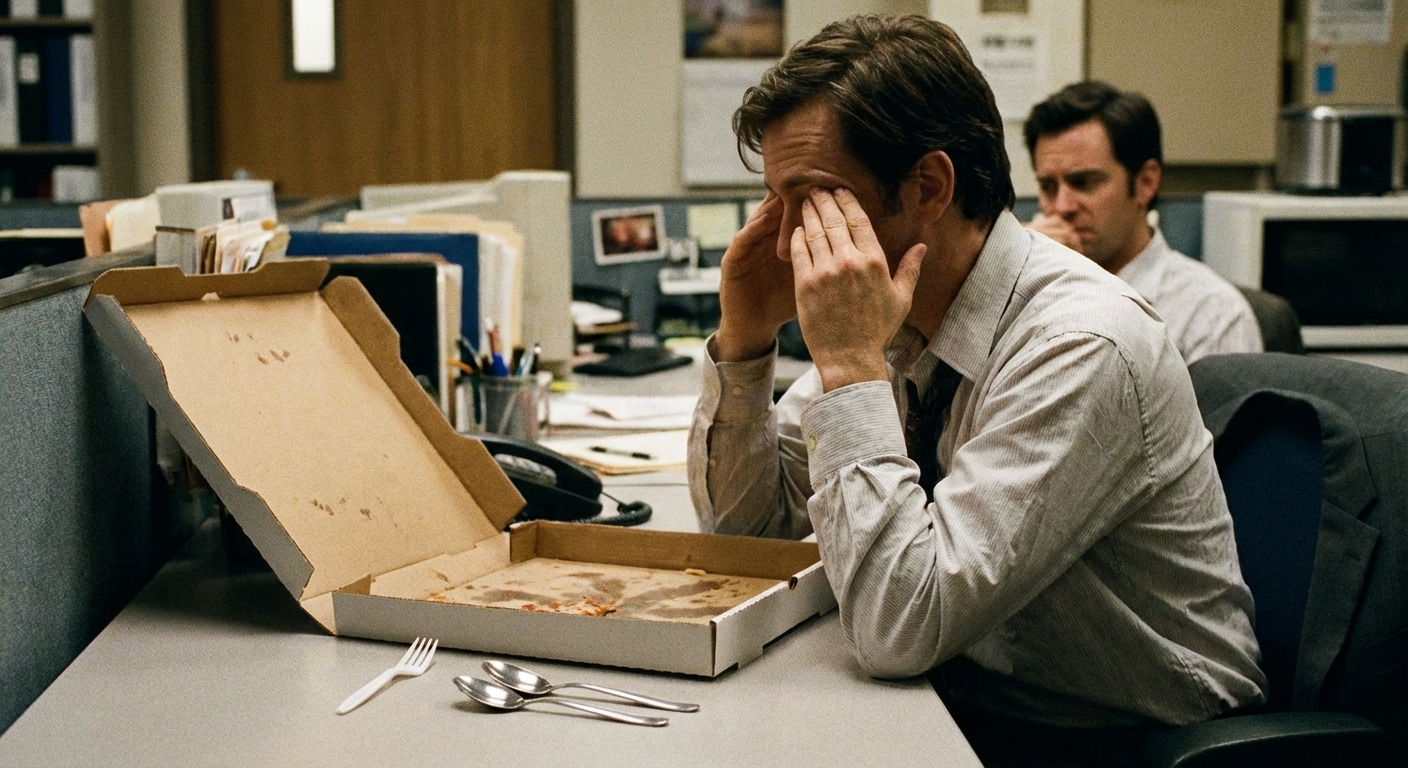
Tomorrow is Employee Appreciation Day. Across the corporate world, managers are likely preparing generic "thank you" emails, ordering pizzas for the break room, or handing out branded water bottles. It is a nice gesture, theoretically. But if you are part of the eighty-three percent of the workforce currently stuck in the cycle of burnout, a slice of pepperoni pizza doesn't fix the problem. It feels like putting a band-aid on a broken leg.
New data hitting my desk suggests a massive disconnect between the people signing the paychecks and the people doing the work. While HR professionals are reporting high levels of engagement, a quarter of the actual workforce feels genuinely undervalued. We call this the "appreciation gap," but I prefer to call it what it really is: a misunderstanding of energy.
For years, we have treated professional stamina as if it were a bottomless well. We assume that if we just drink enough coffee, sleep a little later on Saturday, and "push through," we will find the energy to meet every demand. But for those facing burnout, the problem isn't a lack of willpower. It is a literal, mathematical lack of resources. You are trying to drive a car that has no gas, no oil, and four flat tires, and you are wondering why you can't hit sixty miles per hour on the highway.
To fix this, we need to stop talking about "hustle" and start talking about "spoons."
The Spoon Analogy
The concept of "Spoon Theory" didn't start in a boardroom or a psychology textbook. It started in a diner. In 2003, a woman named Christine Miserandino was trying to explain to a friend what it felt like to live with Lupus, a chronic illness. Her friend couldn't grasp why Christine couldn't just "do things" like a normal person.
In a moment of frustration and clarity, Christine grabbed a handful of spoons from the nearby tables and shoved them into her friend's hands. "Here you go," she said. "You have Lupus."
She explained that healthy people wake up with a nearly unlimited supply of spoons. They don't have to count them. They get up, shower, commute, work, cook dinner, and go to the gym without ever worrying if they will run out of the ability to do so. But people with chronic illness—and, by extension, people suffering from severe burnout—wake up with a limited number. Let’s say twelve spoons.
Everything you do costs a spoon.
Getting out of bed? That’s one spoon.
Taking a shower? Another spoon.
Getting dressed? One more.
Before you have even had your coffee or started your commute, you might be down to nine spoons. If your commute is stressful, that costs you two. Now you have seven spoons left, and you haven't even clocked in for work yet.
This visual metaphor is powerful because it turns energy into currency. It makes the invisible visible. When you are burnt out, you are operating on a budget that is significantly lower than the demands being placed on you. When you run out of spoons, you cannot just "borrow" more from tomorrow without paying a steep penalty. If you push past your limit today, you might wake up tomorrow with only six spoons instead of twelve.
Why Burnout Depletes Your Drawer
I know a thing or two about this kind of depletion. There was a time when I was juggling multiple heavy web development projects while simultaneously trying to run complex marketing campaigns. I was convincing myself that I was just "grinding" and that the fatigue was temporary. I would sit at my desk, staring at a line of code or a simple email, and I physically could not make my brain engage. It wasn't that I didn't want to do the work. It wasn't that I was lazy. It was that I had spent every single unit of mental energy I possessed. I had reached into the drawer for a spoon to deal with a client crisis, and the drawer was empty.
That is the reality of burnout. It is not just being "tired." Tiredness is fixed by a nap. Burnout is a systemic failure of your energy regulation system. The World Health Organization defines it as a syndrome resulting from chronic workplace stress that hasn't been successfully managed. It is characterized by feelings of energy depletion or exhaustion.
The "invisible burden" here is the mental overhead required to just exist when you are burnt out. For a healthy person, answering a text message costs almost zero energy. For a burnt-out person, the anxiety, decision fatigue, and emotional weight of that same text message might cost three spoons.
If you don't understand this math, you will continue to beat yourself up for being "unproductive." You will try to use willpower to overcome a physiological deficit. That is a losing battle. You cannot budget your way out of debt if you don't admit you are broke.
Practical Energy Management
If you are nodding your head right now, realizing you have been running on a spoon deficit for months or years, you need a strategy. You cannot wait for your employer to fix this for you. You have to take control of your own economy.
Here is how you apply the theory to your work life to stop the crash.
Conduct a Brutally Honest Spoon Audit
You need to know what things cost. Most of us underestimate the price of our tasks. We think a thirty-minute meeting costs thirty minutes of time. But if that meeting is with a toxic boss or a difficult client, it might cost you four spoons of emotional energy.
Take a piece of paper and track your day. Assign a "spoon cost" to everything.- Answering emails: 1 spoon.
- Deep creative work: 3 spoons.
- Pretending to be happy in a Zoom meeting: 4 spoons.
- Dealing with a tech issue: 2 spoons.
- Commuting: 2 spoons.
If your daily job requires twenty spoons and you only have twelve, you have identified the root of your burnout. You aren't failing; you are structurally insolvent.
Implement Micro-Goal Setting
When your brain is fried, a large task looks like a mountain. It costs too many spoons up front, so you procrastinate, which causes guilt, which drains even more spoons.
Stop looking at the mountain. Look at the pebble. Break tasks down into tiny, five-minute increments that cost almost nothing.
Don't set a goal to "write the quarterly report." That costs five spoons just to think about. Set a goal to "open the document and name it." That costs half a spoon. Once you start, the momentum often carries you forward with less friction. This is about lowering the entry fee for your productivity.Establish Hard Boundaries Using Shorthand
One of the hardest parts of burnout is communicating it to others without sounding like you are complaining. The Spoon Theory gives you a neutral shorthand.
Instead of saying, "I am emotionally devastated and cannot handle your request right now," which feels vulnerable and risky in a corporate setting, you can use the language of resource management.
"I don't have the bandwidth for that today" is the corporate equivalent of "I have no spoons left."
Learn to say no. If you are out of spoons, you are out. Accepting another task when you are empty means you are borrowing from your physical health. You will pay for it with insomnia, headaches, or illness.Adopt the 3R Model
Recovery isn't passive; it's active. Use the 3R model to structure your days.- Recognize: Watch for the triggers that drain you fastest. Is it multitasking? Is it noise? Is it specific people? Identify the leaks in your tank.
- Reverse: When you feel the drain, prioritize immediate rest. This doesn't mean scrolling social media, which actually costs spoons. It means true stillness. Close your eyes. Practice breath control. Step away from the screen for five minutes of silence.
- Resilience: Build your capacity back up slowly. You cannot go from burnout to peak performance overnight. Set limits on your work hours and stick to them with discipline.
The Psychology of Permission
The reason this theory works—and the reason it has survived for over two decades—is that it shifts your internal narrative.
When we are burnt out, we tend to default to shame. We tell ourselves we are weak, lazy, or incompetent. We look at our colleagues who seem to have infinite energy and wonder what is wrong with us. This shame is a heavy weight that burns through your remaining energy faster than anything else.
Viewing your energy as a finite resource, like money in a bank account, removes the morality from the equation. It is just math. If you have twelve spoons and you spend fourteen, you are going to crash. It is not a character flaw; it is an accounting error.
This shift allows you to make objective decisions. You can look at a request and say, "I cannot afford that right now," just as you would if someone asked you to buy a Ferrari when you have fifty dollars in the bank. It gives you permission to rest without the guilt.
Real recovery from burnout takes time. It isn't fixed in a weekend. It requires a disciplined approach to guarding your resources. It requires saying no to things that don't matter so you can say yes to your own health. It requires accepting that your capacity is not bottomless, and that is okay.
So, tomorrow, when the "Happy Employee Appreciation Day" email lands in your inbox, don't roll your eyes and keep grinding. Take it as a reminder to check your drawer. Count your spoons. And if you're running low, close the drawer and give yourself the rest you actually deserve.

See also in Mindset
Scientists Discover Why Some People Never Get Stressed
Weather Psychology Behind Winter Mood Shifts
How Awe Experiences in Nature Literally Alter Your Perception of Time
Why Being ‘Good Enough’ Is Better Than Being Perfect
8 Ways to Cultivate Inner Peace
How to Start a Morning Routine: 7 Ways for a Productive Day