

The world in 2026 is louder than ever, but the secret to your next big idea isn't in a podcast, a notification, or a playlist—it's in the quiet you are actively avoiding.
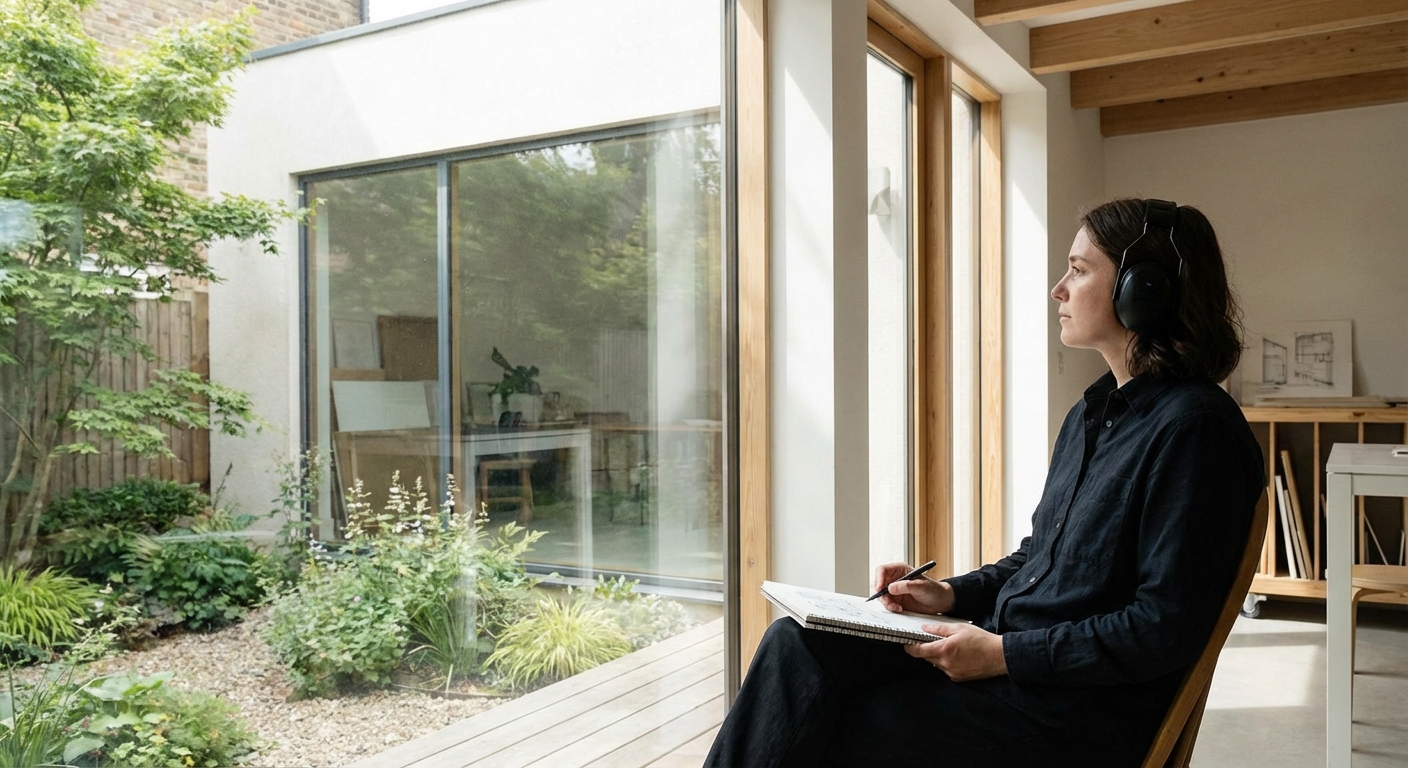
Beyond the Digital Detox
We have spent the last decade obsessed with screens. We counted pixels, tracked hours, and installed apps to block other apps. But as we settle into March 2026, a shift is happening. We are realizing that putting the phone away wasn't enough because we replaced the visual clutter with auditory clutter.
You see it everywhere. The searches for "nature getaways" are up 72% this year. People are desperate to unplug. But the most interesting trend isn't just about going offline; it is about "Audio Fasting." It is the intentional practice of stripping away the podcasts, the background music, and the constant hum of information to reclaim a sense of stillness.
We used to think silence was just empty space. We thought it was what happened when nothing was going on. But new research and a growing cultural movement are proving us wrong. Silence isn't empty. It is a biological trigger, a heavy-lifting tool for your brain, and quite possibly the most potent competitive advantage you have left in a world saturated by AI and noise.
The Biological "Surprise"
If you think silence is passive, you need to look at what is happening under the hood of your skull. For years, we assumed the adult brain couldn't grow new cells. We thought you had a set number of neurons, and once they were gone, they were gone.
Science has since proved that wrong, but the catalyst for that growth is what shocked everyone.
There was a landmark study led by Imke Kirste at Duke University that completely changed how we view quiet. The researchers were looking at how different sounds affected the brains of mice. They played white noise, puppy calls, and Mozart. They included silence essentially as a control variable—a baseline to measure the other sounds against.
But the baseline stole the show.
The study found that when subjects were exposed to two hours of silence daily, they developed new, mature cells in the hippocampus. This is the region of the brain responsible for memory, learning, and emotion. None of the other sounds produced this effect. Not even the "relaxing" music.
Think about that for a second. We spend millions on supplements, nootropics, and brain-training games to stay sharp. Yet, the biological trigger that actually recruits precursor cells and turns them into functioning neurons is simply the absence of noise. Your brain treats stillness not as a break, but as a green light to build.
The DMN Engine
So, why does this matter for your creativity? It comes down to how your brain manages its energy.
Your brain operates in two primary modes. First, there is the "Task Positive Network." This is when you are focused, executing, and getting things done. It’s the mode you are in when you are writing an email, crunching numbers, or following a recipe.
Then, there is the Default Mode Network (DMN). For a long time, scientists thought this was just the brain idling, like a car at a red light. They called it "daydreaming." But we now know the DMN is actually the engine of creativity.
When you enter a state of quiet contemplation, the Task Positive Network shuts down and the DMN lights up. This is your brain’s "creative compost bin." It is where your mind goes to sort through the millions of data points you have absorbed, making distant associations between unrelated concepts. This is where the "aha!" moments come from.
I know this from experience. As a web developer and marketer, I spend a lot of time juggling complex projects. For years, I thought the way to stay productive was to keep the input high. I would listen to business podcasts while I coded or have high-tempo music blasting while I mapped out campaigns. I felt busy, but I wasn't breaking through. It was only when I started using deep-work bursts of total silence that my focus sharpened. The code became cleaner, the strategy became clearer, and the anxiety of "doing enough" quietly evaporated.
If you are constantly feeding your brain auditory input—even "good" input like educational audiobooks—you are keeping yourself locked in the Task Positive Network. You are never giving your brain the silence it needs to switch over to the DMN and actually process what you have learned.
The Cortisol Problem
There is another physiological reason we need to embrace this 2026 trend of "Quiet Living." It’s about stress.
Our modern environments are biologically hostile to deep thought. The typical open-plan office or a busy coffee shop hovers around 65–70 decibels. You might think you can "tune it out," but your body hears it.
Chronic exposure to this level of noise raises cortisol levels. Cortisol is the stress hormone. When it spikes, it impairs your executive function. Your brain’s CEO gets tired, just like you do. This constant auditory "micro-stress" keeps you in a state of low-grade fight-or-flight.
When you remove the noise, you aren't just "relaxing." You are physically lowering the chemical load on your brain, freeing up energy that can be used for problem-solving rather than threat detection.
Practical Steps for Audio Fasting
You don't need to move to a monastery or a cabin in the woods to get these benefits. You just need to be disciplined about how you structure your day. Here is how to implement intermittent silence into a modern routine:
The Two-Hour Silence Sprint
To mirror the biological benefits seen in the neurogenesis research, aim for one solid block of silence. This is the gold standard. Schedule a two-hour window where you engage in deep work with zero auditory input. No lo-fi beats, no white noise, no podcasts.
Companies like Milanote have experimented with this, implementing "quiet hours" where meetings and notifications are banned. They reported a 23% increase in productivity. If you can't do two hours yet, start with one. The key is that it must be unbroken.Utilize "Micro-Pauses"
If a two-hour block is impossible today, use the gaps in your schedule. Instead of checking your feed or putting in earbuds between tasks, sit in silence for two minutes.
Research suggests that these brief silent breaks are more physiologically relaxing and effective at lowering heart rate than listening to "relaxing" music. It acts as a reset button for your nervous system, clearing the cognitive buildup from the previous task so you can tackle the next one with fresh eyes.Commute "Audio Fasting"
This is the lowest-hanging fruit for most people. We are conditioned to think a commute is "wasted time" unless we are consuming content. We try to optimize every second.
Stop optimizing and start incubating. Leave the radio off. Don't play the podcast. Use your transit time for silence. This is the perfect time to activate the Default Mode Network. You aren't trying to solve a problem; you are just letting the silence do the work. You might be surprised by how many solutions pop into your head when you finally stop trying to force them in.
The New Competitive Advantage
We are living in an era where Artificial Intelligence can handle the grunt work. It can summarize data, write code, and generate images. But AI cannot engage in the kind of deep, divergent thinking that comes from the human soul interacting with stillness.
Creativity is becoming the only currency that matters. And creativity requires a substrate to grow in. That substrate is silence.
Intermittent silence is not about being anti-technology or anti-social. It is about discipline. It is about recognizing that your brain is a biological organ that requires specific conditions to thrive. In a world that is screaming for your attention, the ability to sit in quiet contemplation is a superpower.
So, turn off the podcast. Close the music app. Let the silence get uncomfortable for a minute. That discomfort you feel is just your brain waking up.

See also in Self-Improvement
10 Tips for Goal Fine-Tuning
20 Methods to Enhance Self-Efficacy
15 Ways to Practice Gratitude Daily
The 2 Secrets to Motivating Yourself You’ll Ever Need
18 Ways to Boost Your Energy Naturally
15 Steps to Boost Self-Compassion