

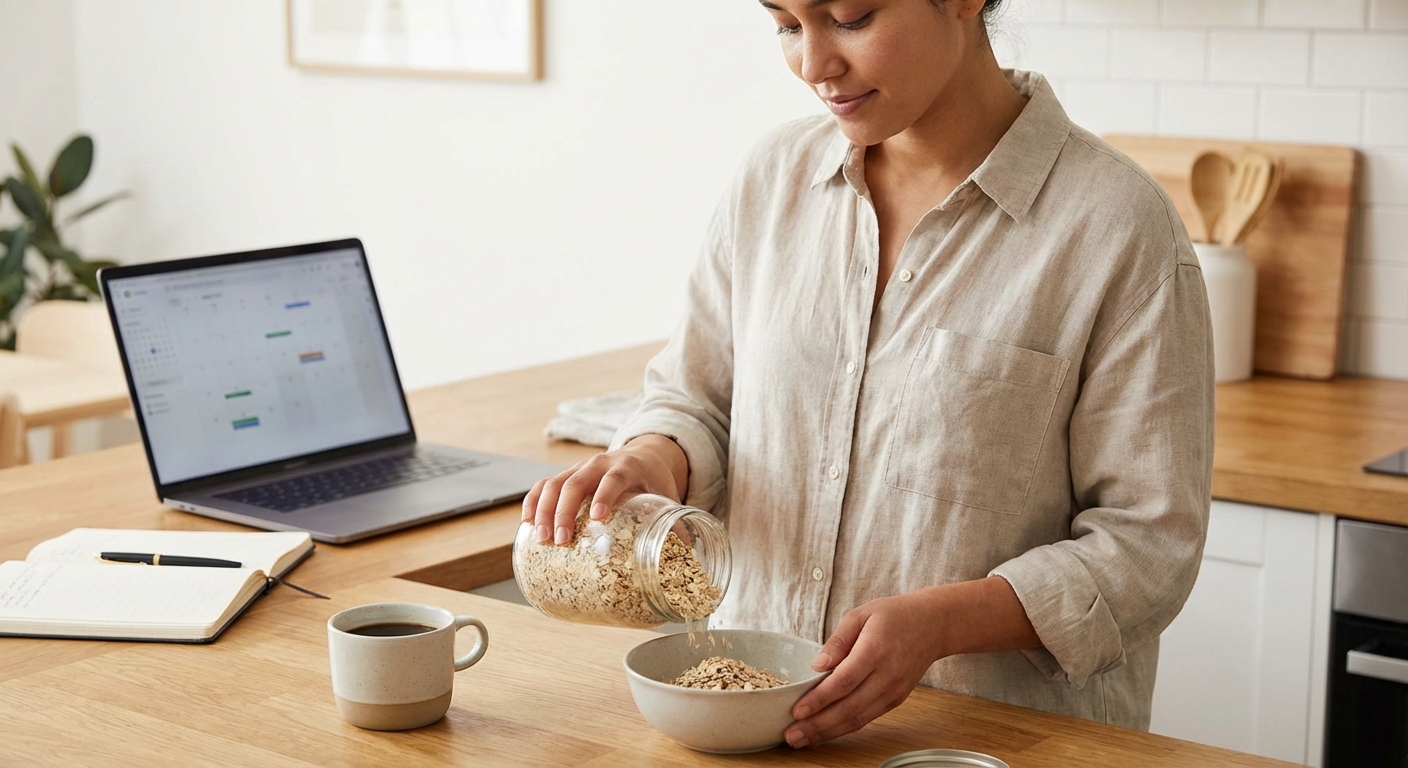
The alarm goes off, and before your feet even hit the floor, the negotiation begins. Should you hit snooze? What shirt should you wear? Check email now or later? And then, the kitchen. Eggs? Toast? Cereal? Maybe just grab a coffee on the way?
By the time you sit down at your desk, you feel like you have already run a mental marathon. That is because, in a very real sense, you have.
We are living through a strange moment in cultural history. As of March 2026, National School Breakfast Week is sparking global conversations about "chrononutrition," and Elon Musk is making headlines for his rigid "steak and eggs" morning routine. While the internet debates the nutritional merits of carnivore diets versus plant-based options, they are missing the point entirely. The power of Musk’s breakfast—or Richard Branson’s muesli, or Mark Zuckerberg’s hoodie—isn't in the ingredients. It is in the repetition.
The most productive people in the world do not treat breakfast as a culinary adventure. They treat it as an automated system. They understand that willpower is a finite resource, and they refuse to waste a single drop of it on a menu. If you want to reclaim your focus, stabilize your energy, and win the morning, it is time to stop asking "what’s for breakfast?" and start sticking to the script.
The Science of Decision Fatigue
There is a psychological concept called "decision fatigue," pioneered by researcher Roy Baumeister, and it is the invisible killer of your productivity. The theory is simple but profound: your brain works like a battery. Every single choice you make, no matter how trivial, drains a little bit of that charge.
Neuroscience tells us that humans make roughly 35,000 decisions every single day. Most of them are unconscious, but the conscious ones—the "forks in the road"—are expensive. Your prefrontal cortex, the CEO of your brain responsible for logic, strategy, and emotional control, gets tired. When it gets tired, two things happen: you either make impulsive, bad decisions (like snapping at a coworker or eating junk food), or you avoid making decisions altogether.
When you stand in front of your refrigerator at 7:00 AM debating between an omelet and a bagel, you are not just choosing food. You are burning through the premium mental fuel you need for that 10:00 AM strategy meeting or that complex coding problem. You are leaking energy before the race has even started.
This is why the concept of "Decision Zero" is so critical. By automating the first hour of your day, you essentially put blinders on your brain, protecting your energy for the things that actually move the needle in your life. You are eliminating the friction of starting the day. You don't have to "gear up" to make a healthy choice if the choice was made for you on Sunday night.
Metabolic Consistency and the Crash
Beyond the psychology of choice, there is the physiology of performance. If decision fatigue is the killer of focus, glucose instability is the killer of endurance.
We have all felt the 11:00 AM slump. You start strong, but suddenly your brain feels like it is wading through molasses. You lose your train of thought. You get irritable. This is often the direct result of a chaotic nutritional strategy. When you vary your breakfast wildly—eating a pastry one day, eggs the next, and nothing the day after—your body is constantly trying to recalibrate its insulin response.
Recent data reinforces this. Studies released this year in 2026 regarding "habitual skippers" show a stark contrast in performance metrics. People who skip breakfast or eat inconsistently have a mean productivity score of 6.2 out of 10, compared to a 7.4 score for those with a routine. That is not a small margin; that is the difference between a promotion and a performance improvement plan.
When you eat the same high-quality meal every morning, you stabilize your blood sugar. You teach your body exactly what to expect. You are providing a steady stream of fuel rather than a rollercoaster of spikes and crashes.
I learned this lesson the hard way. Years ago, I was 110 pounds overweight and trapped in a cycle of binge eating. Every meal was a negotiation, and usually, the loudest craving won. I viewed food as entertainment, as a source of joy to distract me from stress. When I finally committed to losing the weight, I realized I couldn't trust my in-the-moment decision-making. I had to automate it. I started eating the exact same breakfast—and lunch—for months on end. It wasn't exciting. In fact, it was boring. But that boredom set me free. The weight fell off because I stopped treating food like a prize and started treating it like fuel. That discipline bled into every other area of my life.
How to Build Your Standard Script
You do not need to eat steak and eggs like a tech billionaire to get the benefits of this system. You just need a "Standard Script." This is a pre-determined, non-negotiable meal that you execute on autopilot. Here is how to build one that serves your ambition rather than your taste buds.
- Select for Sustained Energy, Not Sugar: The goal is a slow burn. You want a meal that is high in protein and healthy fats, or complex carbohydrates that digest slowly. Think oatmeal with nuts, eggs with avocado, or a high-density protein shake. Avoid sugary cereals or white toast that will spike your insulin and drop you flat on your face two hours later.
- Batch the Logistics: The battle is often lost in the grocery store, not the kitchen. If you decide to eat oatmeal every day, buy the giant tub. If it’s eggs, buy three dozen. Remove the variable of "running out." When I prepare for my week, I make sure the physical environment is set up so that the path of least resistance is the healthy path.
- Embrace the Boredom: This is the part most people struggle with. We are conditioned to seek novelty. We think we "deserve" variety. You need to reframe this. You are not depriving yourself of culinary joy; you are outsourcing your nutrition so you can find joy in your achievements. Save the fancy brunches for Saturday morning. Monday through Friday is for execution.
The Power of the Habit Loop
Once you establish this routine, something magical happens. It stops being a "choice" and becomes a part of your identity. This is the "Habit Loop."
In the beginning, sticking to the same meal requires a little bit of discipline. You might crave a bagel. You might want to hit the drive-thru. But after two or three weeks, the resistance fades. Your body expects the routine. Your brain stops looking for alternatives.
This is where the real productivity gains happen. When you stop thinking about the basics of survival, your mind is free to wander into creative territories. You might find that you have your best ideas while chewing your identical bowl of oats. That isn't a coincidence. It is the result of a quiet mind that isn't being nagged by micro-decisions.
Conclusion
We live in a world that worships variety. We are told that spontaneity is the spice of life. But if you look at the people who are actually changing the world, or even just the people who seem to have it all together, you will find they rely heavily on routine.
Eating the same breakfast every day is a small act of rebellion against a chaotic world. It is a declaration that you prioritize your long-term goals over your short-term impulses. It is a way to guard your mental energy for the battles that actually matter.
So, tomorrow morning, do not ask yourself what you want to eat. Tell yourself what you are going to eat. Remove the choice. Eat the eggs. Eat the oats. Drink the smoothie. Do it again the next day, and the day after that. You might find that by making your morning meal predictable, the rest of your life becomes remarkably extraordinary.

See also in Productivity
5 Things to Do on Sunday for a Better Week
The Yerkes-Dodson Law Shows Exactly How Much Stress You Need to Perform
10 Productivity Myths You Need to Stop Believing
15 Morning Productivity Rituals
20 Productivity Secrets for Thanksgiving Planning
10 Strategies for Effective Time Blocking