

Imagine walking into your doctor’s office with high blood pressure and leaving not with a script for a beta-blocker, but with a free pass to a national park.
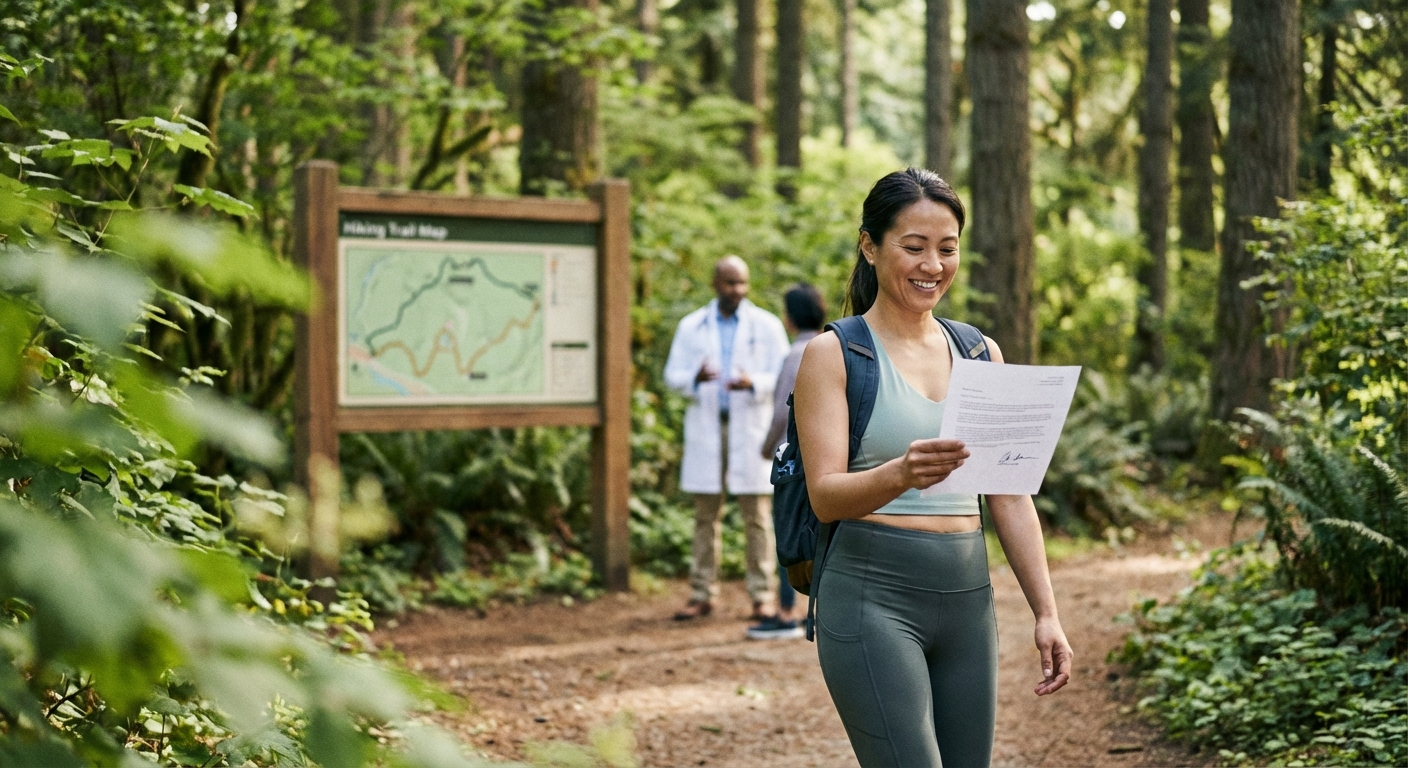
It sounds like a utopian fantasy or something you might hear from a fringe wellness guru, but as of March 2026, this is becoming standard medical procedure. The days of viewing a walk in the woods as merely a "nice thing to do" are over.
Major healthcare systems and insurance giants are now treating the outdoors as a clinically valid pharmaceutical.
Just last month, Manulife became the first life and health insurer in the world to officially back a national nature prescription program.
They aren't doing this out of charity. They are doing it because the data is undeniable.
We have spent decades trying to medicate away the symptoms of a sedentary, indoor life. We built better pills, fancier hospitals, and more complex therapy models. Yet, chronic disease and anxiety rates continued to climb.
Now, the medical establishment is finally admitting that we might have missed the most obvious cure because it was free and sitting right outside our windows.
Nature is no longer just a backdrop for your weekend; it is being formalized as the fourth pillar of health.
The "Green Prescription" Movement
For years, if you told a doctor you were feeling overwhelmed or sluggish, they might have vaguely suggested you "get some fresh air."
It was good advice, but it wasn't medicine. It was a throwaway line that most of us ignored on our way to the pharmacy.
That dynamic has shifted aggressively. We are seeing the rise of "Green Prescriptions," a formalized healthcare model where providers refer patients to non-clinical services to improve health.
This isn't just a suggestion anymore. It is a system.
Organizations like PaRx in Canada and Park Rx America have codified nature into a clinical tool. They have done the hard work of integrating with healthcare networks to ensure that when a doctor tells you to go outside, it carries the same weight as telling you to take an antibiotic.
This shift is crucial because it moves nature from "recreation" to "treatment."
Consider the recent move by Halton Healthcare. They became the first hospital system to fully partner with the PaRx program.
This partnership allows physicians to issue prescriptions that grant patients free visits to regional conservation areas.
This specific detail is vital. It addresses the economic barrier to entry.
It is easy for a wealthy wellness influencer to talk about the healing power of nature when they live on a sprawling estate or can afford weekend trips to the mountains.
But for a single parent working two jobs in a concrete-dense city, access to nature is a logistical and financial hurdle.
By partnering with park foundations to provide tangible access, hospitals are acknowledging that "natural medicine" shouldn't be a luxury good.
It is a public health necessity.
When a doctor hands a patient a pass that waives the entry fee, they are removing the friction between the patient and the cure.
The Clinical Prescription
So, what does this actually look like in practice?
It isn't as simple as telling a patient to "go hug a tree."
Medicine requires precision. You don't take "some" aspirin; you take a specific milligram dosage at specific intervals.
Nature prescriptions are following the same trajectory. We are moving toward a standardized "Nature Dose."
Doctors are looking for a minimum effective dose to achieve measurable health benefits. The current consensus revolves around a specific time commitment.
To be effective, nature prescriptions follow a standardized dose of at least 150 minutes of moderate activity per week or a minimum of two hours spent in nature to improve physical and mental health.
That is the magic number. Two hours a week.
You don't need to move to a cabin in the woods. You don't need to become a survivalist. You just need to clock your 120 to 150 minutes.
The mechanics of this are fascinating.
Registered healthcare providers now receive unique provider codes. When they issue a prescription, it is logged. It can be tracked within a patient’s medical history.
This integration into Electronic Health Records (EHR) is the "preventative integration" that changes everything.
It means your lack of nature exposure is now a visible data point in your medical file, right next to your cholesterol levels and blood pressure.
We are also seeing this integrate into digital health tools.
The "Nature Scripts" trial in Australia, for example, used a structured six-week program. It wasn't a free-for-all. It involved specific activities like nature journaling and bushwalks.
The goal is to take the guesswork out of it.
When you are depressed, anxious, or physically unwell, your executive function is often shot. You don't have the mental energy to plan a hike or figure out where to go.
By formalizing the prescription, the healthcare provider takes the cognitive load off the patient. They provide the plan, the location, and the duration. All the patient has to do is show up.
The Science of Survival
Why is the medical establishment finally buying into this?
Because the results are undeniable, and frankly, they are cheaper than surgery.
We have known about "biophilia" for a long time—the innate human tendency to seek connections with nature. But we often treated it as a poetic concept rather than a biological imperative.
The science proves otherwise.
Our bodies were not designed to sit under fluorescent lights for twelve hours a day, staring at glowing rectangles.
When we do that, our systems go into a low-grade fight-or-flight mode. Cortisol levels spike. Digestion slows down. Anxiety hums in the background like static.
Stepping into nature acts as a physiological reset button.
A 2025 evaluation of the UK's Green Social Prescribing pilots showed incredible results. Participants saw their happiness levels rise from an average of 5.3 to 7.5.
To put that in perspective, that jump surpassed the national average. These weren't just sick people getting slightly better; these were struggling people becoming happier than the general population.
The cardiovascular benefits are just as stark.
Clinical studies have shown that nature-based interventions effectively reduce heart rate and blood pressure.
This hits home for me.
I used to weigh 110 pounds more than I do right now.
My life was a cycle of high stress, binge eating, and sitting in front of a computer screen until my eyes burned.
I wasn't just heavy; I was constantly inflamed and anxious.
The turning point wasn't a gym membership I couldn't afford or a fancy diet pill. It started with walking.
I would force myself to go to a small wooded trail near my apartment.
At first, it was brutal. I was out of breath and uncomfortable.
But the silence of the trees did something that the noise of the gym never could.
It quieted the racing thoughts that usually drove me to eat.
Those walks became my anchor. I didn't know the science then—I didn't know about cortisol reduction or "wellbeing units."
I just knew that when I was in the woods, I wasn't fighting myself.
That simple, rhythmic movement in a quiet place laid the foundation for losing the weight and, more importantly, keeping it off.
It turns out, my experience wasn't unique. It was biology.
The economic impact of this is what truly drives the insurance companies.
Research from the University of Melbourne estimated that the wellbeing improvements from nature prescriptions were equivalent to a value of approximately $19,875 per participant over six months.
That is nearly twenty thousand dollars of value generated essentially out of thin air.
If you could bottle a pill that saved the healthcare system $20k per person and had zero side effects, it would be the best-selling drug in history.
That is what nature is.
We are also seeing massive implications for mental health.
In a University of York study published in April 2025, researchers found that mood and anxiety levels showed significant improvement in as little as 12 weeks of structured nature-based activity.
In a world where anxiety is becoming the default state for millions, having a non-pharmaceutical intervention that actually works is a game-changer.
Conclusion
We are witnessing a fundamental correction in how we view health.
For too long, we have compartmentalized our well-being. We thought health was something you found in a bottle or a gym.
We ignored the environment we evolved to live in.
The formalization of nature prescriptions tells us that nature is not a luxury. It is not a hobby for the weekend.
It is the fourth pillar of health, standing equal alongside diet, sleep, and exercise.
The insurance companies know it. The hospital systems know it. The data proves it.
The prescription is written. The dosage is clear.
Now, you just have to step outside.

See also in Self-Improvement
15 Cold Shower Benefits for Mental Toughness
How to Forgive Others
10 Best Self Help Books for Men: Unlock Personal Growth
20 Tips for Personal Boundary Enforcement
Become the Person You Want to Be
20 Methods to Boost Clarity