

Stop staring at the delivery app and the lingering guilt that comes with it. That sinking feeling isn't just about the money you’re spending; it’s about the dependency you feel. The antidote isn't becoming a professional chef—it's mastering just one thing.
The Core Idea
We are living in a strange time. It is 2026, and the cost of sitting down at a restaurant feels less like a treat and more like a tactical error. We are all feeling the pinch, and the data backs it up. Most of us are cutting back, and nearly half of us feel a distinct sense of shame when we opt for takeout yet again. But this isn't an article about inflation or budgeting. It is about confidence.
There is a profound psychological shift that happens when you move from being a consumer to a creator. When you rely constantly on others to feed you, you are subtly reinforcing a narrative of helplessness. You are telling yourself, "I cannot provide for my own basic needs." Over time, that chips away at your resilience.
The solution is not to go to culinary school. The solution is to develop what psychologists call "culinary self-efficacy," but I just call it getting a win. You need a Signature Dish.
A Signature Dish is not just a recipe you know how to read. It is a meal you have executed so many times that the process lives in your hands, not in a book. It is a specific sequence of movements that you own completely. When you have one dish that you can execute perfectly—whether it’s a roast chicken, a specific pasta carbonara, or a beef stew—you possess a secret weapon against the chaos of modern life.
This mastery creates a ripple effect. When you prove to yourself that you can take raw, disorganized ingredients and turn them into something structured and beautiful, you trigger a behavioral activation. You get a dopamine hit from the completion of a task. You realize that if you can control the heat and the knife, you might be able to control other chaotic variables in your life.
I know this firsthand. Years ago, when I was 110 pounds heavier than I am today, my relationship with food was entirely reactive. I ate what was fast, what was easy, and what numbed the stress. I lost that weight and stopped the binge eating not by starving myself, but by learning to cook. I mastered a simple, high-protein stir-fry. It wasn't fancy, but it was mine. Knowing I could go into the kitchen and build a meal that fueled my body gave me the agency I needed to fix my health. That one dish broke the cycle of dependency.
The Mastery Ripple Effect
Why does one dish matter so much? Because your brain’s CEO gets tired, just like you do. We suffer from decision fatigue. When 6:00 PM rolls around and you are exhausted from work, the idea of "figuring out dinner" feels like climbing a mountain. If you don't have a plan, you default to the path of least resistance: the delivery app.
However, when you have a Signature Dish, you bypass the decision-making process. You don't have to wonder if it will be good. You don't have to stress about the outcome. You already know. This lowers the barrier to entry for healthy living.
This concept creates a "gateway effect." Once you understand the mechanics of searing meat or balancing acidity in a sauce for your dish, those skills quietly transfer to everything else. You stop being afraid of the kitchen. You realize that a recipe is just a suggestion, not a rigid set of laws.
Furthermore, this kind of discipline builds mental resilience. We live in an era of digital fatigue. We spend our days manipulating pixels and emails—intangible things that disappear when the power goes out. Cooking is tangible. It is real. You chop the onion, the onion is chopped. You apply heat, the protein changes color. There is a deep, primal satisfaction in seeing the immediate result of your labor. It grounds you in reality in a way that a spreadsheet never will.
Practical Steps to Your Signature Plate
So, how do you find this elusive dish? You do not find it by scrolling through endless 15-second videos of viral food trends. You build it through intention and repetition.
Find Your Niche
Do not pick a dish because it looks good on social media. Pick a dish that speaks to your palate and your history. Think about the flavors that actually comfort you. Is it the spice profile of a curry? The slow-cooked depth of a ragu? The crisp freshness of a specific salad? Choose a dish that reflects your heritage or a specific global flavor profile you genuinely love. If you hate cooking it, you will never master it.Tell a Story
Your Signature Dish should be biographical. It needs to have a "why." Maybe you are recreating a stew your grandmother made, but you are updating it with better ingredients. Maybe it is a dish you had on a trip that changed your perspective. When you attach a narrative to the food, you are no longer just heating up nutrients; you are preserving a memory. This emotional connection is what keeps you coming back to the stove when you are tired.The Iteration Phase
This is where most people fail. They cook a recipe once, it comes out "okay," and they move on to the next shiny thing. Mastery requires repetition. You must shift from experimentation to practice.You need to cook this specific dish ten times in a row.
The first time, you are reading the instructions. By the fifth time, you are anticipating the steps. By the tenth time, you are not looking at the recipe at all. You are listening to the sound of the sear; you are smelling when the garlic is ready. This creates muscle memory. This is when the magic happens. You stop thinking about the mechanics and start focusing on the soul of the dish.
The Science of the Shared Table
There is a deeper reason why this matters, and it goes beyond your own self-esteem. It is about your connection to other human beings.
In 2026, we are seeing a resurgence of "social hosting." The bar scene is expensive and loud. People are craving authentic connection. The "Cook Book Club" and the dinner party are replacing the night out. But you cannot host with confidence if you are terrified of ruining the meal.
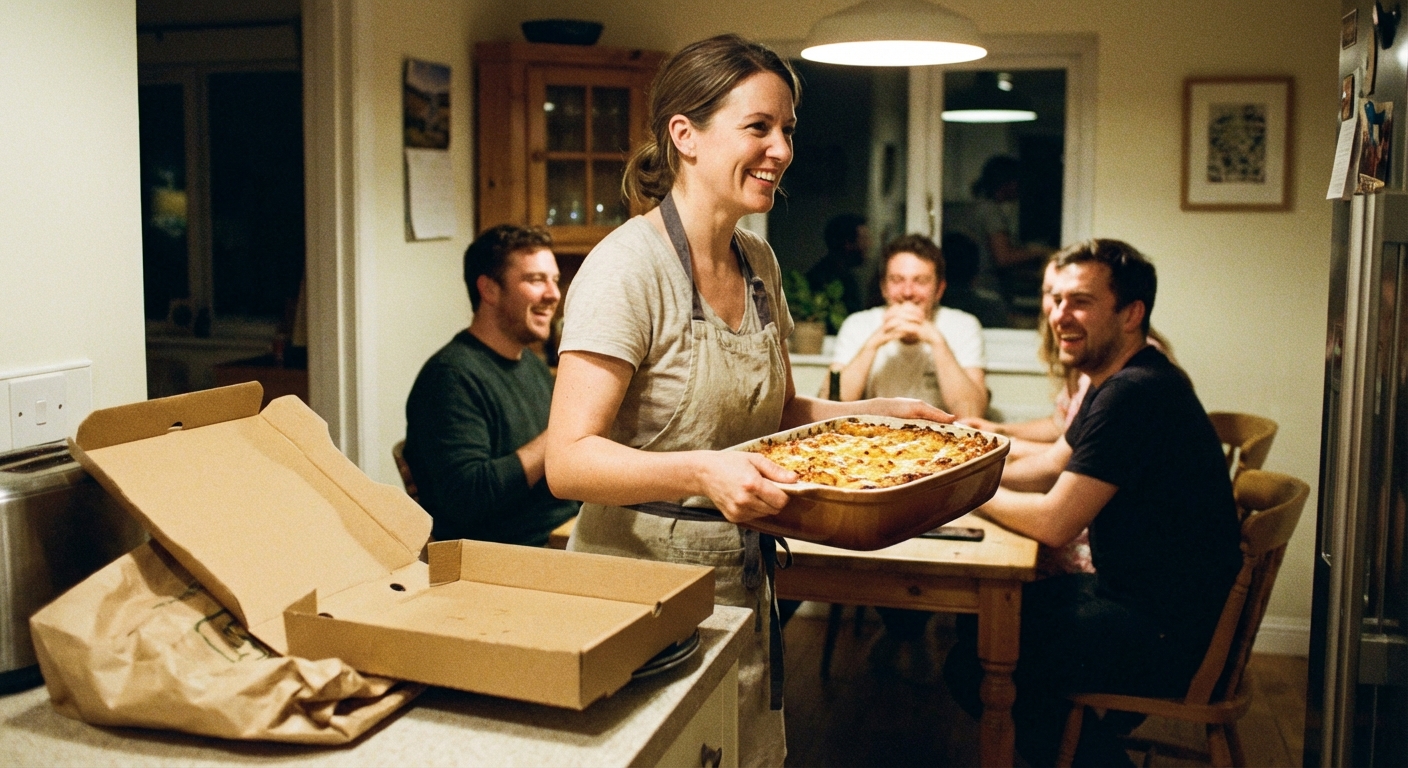
When you have a Signature Dish, you become the person who makes that dish. You become a hub for community. There is a reason the kitchen is the heart of the home. Sharing a meal is one of the most powerful predictors of well-being—more so than income or job status. Research suggests that sharing meals frequently is a "sweet spot" for life satisfaction.
When you invite people over and serve them something you have mastered, you are offering them a gift of service. You are engaging in an act of care.
There is also a physiological benefit to the cook. We often talk about "mental health," but we forget the body. Most of your serotonin is produced in your gut. The act of preparing food—washing vegetables, chopping herbs, stirring a pot—is a form of silence and stillness in a noisy world. It is a kinetic discipline.
The rhythmic motion of a knife or the repetitive stirring of a risotto can quiet the mind effectively. It forces you to be present. You cannot doom-scroll while you are sautéing spinach; you will burn it. This forced focus acts as a break from the catastrophizing thoughts that plague us. It allows you to enter a state of quiet contemplation.
In the Christian Orthodox tradition, and indeed in many ancient paths, there is a deep respect for the physical act of breaking bread. It is not just fuel; it is fellowship. By mastering one dish, you give yourself the tool to facilitate that fellowship. You combat loneliness—both your own and your guests'—with a single plate.
The Transformative Power of "That Dish"
Ultimately, having a Signature Dish changes how you view yourself. You stop being a passive consumer of expensive, mediocre restaurant food. You become a producer of quality and comfort.
You save money, certainly. But more importantly, you build a fortress of competence. When the world feels out of control, you know that you can walk into your kitchen, pull out a few simple ingredients, and within an hour, create something perfect.
You don't need to be a master chef. You just need to be the master of one thing. Pick your dish. Cook it until you can do it with your eyes closed. Invite a friend over. Put the phone away. Eat.
This is how you reclaim your time, your health, and your peace. Start tonight.

See also in Self-Improvement
How to Love Your Life
15 Ways to Build Emotional Strength
The Japanese ‘Shinrin-Yoku’ Method That Lowers Cortisol in 20 Minutes
15 Tips for Building Self-Validation
20 Self-Discovery Questions to Ask Yourself
Adult Coloring Books for Stress Relief