You’ve seen the ads promising that a simple pair of clear-lens glasses will cure your insomnia, fix your headaches, and turn you into a sleeping champion, but the clinical reality is far more nuanced and a lot less magical.
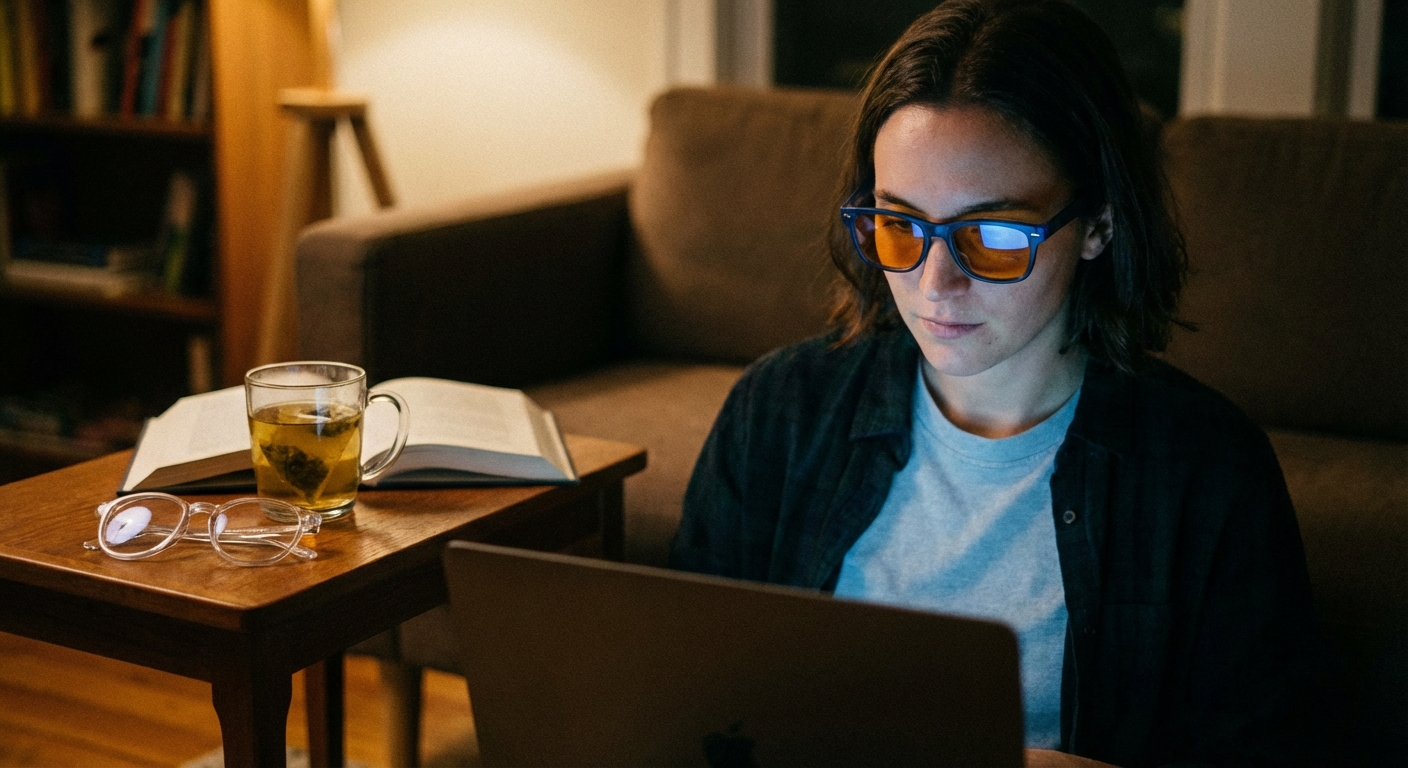
It is 2026, and the sleep hygiene industry has ballooned into a massive, multi-billion-dollar juggernaut. We are drowning in gadgets, trackers, rings, and specialized eyewear, all designed to knock us out for a solid eight hours. Yet, despite all this technology, we seem to be sleeping worse than ever. Just this month, on March 5, the National Sleep Foundation released startling new data for Sleep Awareness Week. The report highlighted that nearly half of U.S. children and a significant portion of adults are failing to meet even the most basic sleep requirements.
The culprit isn't just one thing, but the Foundation pointed a heavy finger at "active screen use" and the constant state of alertness driven by our content consumption. Naturally, the market solution is blue light blocking glasses. The pitch is seductive: keep scrolling, keep watching, keep working, but wear these glasses and your sleep won't suffer. It sounds like the perfect loophole. You can have your digital cake and eat it too.
But as someone who digs through the noise to find what actually works, I have to be the bearer of pragmatic news. The glasses are not a "get out of jail free" card for bad habits. They are a tool, and like any tool, they only work if you understand the mechanics of how to use them. The gap between what the marketing departments claim and what clinical sleep studies actually show is wide, and if you want real rest, you need to learn how to navigate it.
The Evidence Gap
There is often a massive disconnect between how a product makes you feel and what is actually happening physiologically in your body. In the world of sleep research, we distinguish between subjective sleep quality (how you feel you slept) and objective sleep quality (what the data says).
Marketing campaigns love to rely on subjective testimonials. "I wore these and slept like a baby!" constitutes a great headline. However, when we look at the hard data, the picture changes. A 2025 meta-analysis published in the NIH database took a hard look at this. They crunched the numbers on sleep onset latency—fancy speak for how long it takes you to fall asleep once your head hits the pillow.
The result? The glasses showed a numerical trend toward reducing that time by approximately 4.86 minutes.
Five minutes. That is the "miracle" for the general, healthy adult population. Statistically, in many studies, this doesn't even count as significant. If you are struggling with severe insomnia, saving five minutes of tossing and turning isn't going to change your life. This is where the skepticism is warranted. If you are buying these glasses thinking they work like a sedative pill, you are going to be disappointed.
However, we have to look at the nuance. While the "average" person might not see a huge shift, specific groups of people do. For individuals with delayed sleep phase disorder—essentially the "night owls" whose internal clocks are naturally set to 2 a.m.—the results are different. In these specific cohorts, wearing amber-tinted glasses for two weeks resulted in significantly earlier sleep onset. The glasses didn't just knock them out; they helped shift the biological window of when their bodies felt ready for rest.
Melatonin vs. Sleep Architecture
To understand why these glasses work for some and not others, you have to understand the mechanism. It isn't about "relaxing" your eyes; it is about protecting a hormone.
Your eyes have special sensors called intrinsically photosensitive retinal ganglion cells (ipRGCs). You can think of these cells as the sentries of your brain. They aren't there to help you see shapes or colors in the traditional sense; they are there to tell your brain what time of day it is. When these sentries detect blue light in the 446–477nm range, they scream to your brain, "It is noon! Stay awake! Be alert!"
When your brain gets that signal, it shuts down the production of melatonin, the hormone that signals to your body that it is time to wind down. Harvard Health research indicates that blue light suppresses melatonin for about twice as long as green light and can shift your circadian rhythms by up to three hours.
This is where my own experience mirrors the science. I used to be a heavy gamer. I would sit in front of a dual-monitor setup until 2:00 or 3:00 in the morning, convinced I just "wasn't tired yet." I told myself I was a night owl. The reality was much simpler: I was blasting my retinas with high-intensity blue light, chemically preventing my brain from understanding that the sun had gone down. I wasn't just entertained; I was physiologically hijacking my own hardware. When I finally quit the late-night gaming sessions and doom-scrolling, the shift was almost immediate. It wasn't that my personality changed; it was that I stopped blinding my internal clock.
The clinical data supports this. The glasses are better at being a "melatonin shield" than they are at fixing "bad" sleep architecture. If you wear the glasses but still drink a double espresso at 8 p.m., or if you wear them while reading stressful work emails that spike your cortisol, the glasses cannot save you. They can protect your melatonin, but they cannot force you to be calm.
The Tint Matters: Clear vs. Amber
Here is the most practical piece of advice I can give you, and it is the one most people hate to hear because of vanity: if the lenses are clear, they probably aren't doing much for your sleep.
The market is flooded with "computer glasses" that have clear lenses with a slight blue reflection. These are often sold to reduce eye strain. While they might help your eyes feel a little less tired during the workday, the University of Houston and other research institutions have found they show little to no benefit for melatonin protection.
To actually stop the specific wavelength of light that triggers those ipRGC cells, you need high-density filtration. Clinical studies that show positive results almost exclusively use glasses that block 90% or more of blue light. These lenses aren't clear. They are deep amber or bright orange.
Think of it like sun protection. A clear t-shirt might block a tiny bit of UV light, but if you are standing in the blazing sun, you need a thick layer of protection to prevent a burn. Clear lenses are the t-shirt. Amber lenses are the sunblock. If you put on a pair of glasses and the colors on your TV screen still look relatively normal, they aren't strong enough to protect your circadian rhythm. When you wear effective blue blockers, the color blue should disappear from your vision entirely.
Practical Application: How to Use Them
If you are going to invest in these, do it right. Based on the most effective clinical protocols, here is how you should actually use blue light blocking glasses to see a result.
1. Go High-Density
Ignore the fashion-forward clear lenses. Buy a pair of "ugly" orange or deep amber glasses. You are wearing these in your living room, not on a runway. If the goal is sleep, prioritize function over form.
2. The 120-Minute Rule
Putting the glasses on five minutes before bed is useless. Your brain needs a wind-down period. The most effective clinical protocols require participants to put the glasses on at least 120 to 180 minutes before their intended sleep time. This prevents the suppression of the body's natural "dim light melatonin onset." If you want to sleep at 11:00 p.m., the glasses go on at 8:30 p.m. or 9:00 p.m.
3. Combine with Dimming
This is the step everyone misses. Your biological clock is sensitive to the color of light, but it is also sensitive to the intensity (lux) of light. Even with orange glasses, if you are sitting under six bright LED floodlights in your kitchen, your brain is still getting a "wake up" signal from the sheer brightness. Researchers emphasize that glasses should be used in conjunction with dimmed ambient lighting. Turn off the overheads. Use lamps. Lower the brightness on your screens.
4. Watch the Content
This brings us back to the 2026 NSF data. It is not just the light; it is the "active screen use." If you are wearing orange glasses but you are arguing with strangers on the internet or playing a high-adrenaline video game, your brain is producing adrenaline and cortisol. No amount of melatonin protection can override a fight-or-flight response. You need discipline here. Use the glasses, but also switch to passive consumption—reading, listening to music, or quiet contemplation—rather than active engagement.
The Verdict
Blue light blocking glasses are not a scam, but they are often oversold. They are a specific tool for a specific biological function: shielding your melatonin production from artificial light in the evening.
If you are expecting them to knock you out like a sleeping pill, you are wasting your money. But if you view them as part of a larger strategy of discipline—combined with dimming the lights, managing stress, and respecting your body's need for a wind-down routine—they can be highly effective.
For 2026, the verdict is clear: Don't buy the clear ones for sleep. Buy the orange ones. Put them on three hours before bed. And remember that the glasses can filter the light, but only you can filter the stress.