You walk through your front door, and the first thing you see is a pile of chaos—a heap of sneakers, a stray boot, and the mail you dropped yesterday. Your shoulders tense up before you’ve even taken your coat off.
The First Impression Problem
We need to talk about the "threshold." In architecture and design, the threshold is the transition point between the chaotic outside world and your inner sanctuary. But for most of us, it’s just the place where we dump our stuff.
There is a reason the entryway is often the most stressful few square feet in the entire house. It is the bottleneck of your life. It is where you are rushing to leave in the morning, coffee in hand, desperately looking for your left shoe. It is where you crash land in the evening, exhausted, only to trip over a backpack.
I’m not a scientist, but I read the research so you don’t have to. Studies from the UCLA Center on Everyday Lives of Families have shown a direct link between visual clutter and cortisol—the stress hormone. When your eyes scan a messy room, your brain registers it as a task list. "Pick that up." "Move that." "Clean that." Your brain’s CEO gets tired, just like you do. If the first thing you see when you walk in is a mess, you are spiking your stress levels before you even greet your family.
This is why the trends for 2026 are shifting so heavily toward "less aggressive" organization. We are moving away from the stark, hospital-sterile look of clear plastic bins and toward "biophilic" systems. We want natural materials—wood, stone, rattan. We want our homes to feel like a deep breath, not a storage unit.
The problem is that most entryways are tiny. You can’t just buy a massive armoire to hide the mess. You need a trick. You need a system that hides the clutter without eating up your floor space.
The "Vertical Lift" Trick
The solution isn't to buy a bigger shoe rack. The solution is to get the shoes off the floor entirely.
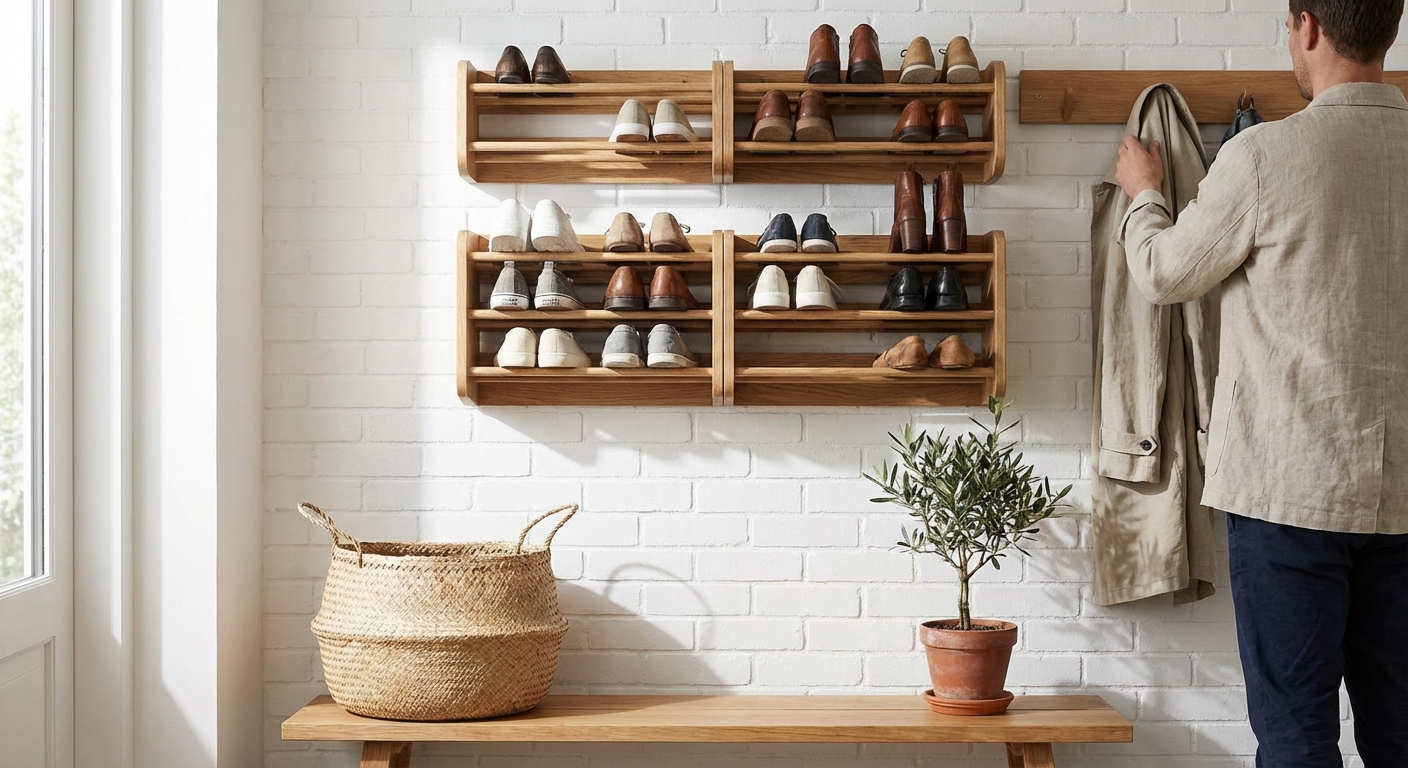
We call this the "Vertical Lift." The core concept is simple but transformative: utilizing wall-mounted, "floating" storage to reclaim floor space.
Most standard shoe racks are bulky. They sit on the floor, extending twelve to fifteen inches out into the hallway. They block your walking path and, crucially, they block the sightline of the floorboards. When your eye can’t see the corner where the wall meets the floor, the room feels smaller. It feels cramped.
The "trick" involves using slim-profile, wall-mounted shoe cabinets. Think of the classic IKEA TRONES or similar narrow-depth cabinets. These units are usually under eight inches deep. When you mount them six to twelve inches off the ground, you create a "floating" effect.
This does two things immediately. First, it physically gives you back square footage. You can stand closer to the wall, widening the hallway flow. Second, and more importantly, it creates an optical illusion. Because you can see the floor underneath the cabinet, your brain perceives the room as wider and more open.
You are essentially taking dead space—the vertical wall area—and turning it into a high-capacity storage engine. Data on entryway organization suggests that using vertical space this way can increase your effective storage capacity by nearly 30% compared to floor-standing racks, all while taking up less room.
Step-by-Step Transformation
You don’t need a contractor to do this. You just need a free Saturday afternoon and a little bit of patience. Here is how you execute the hack on a budget while making it look like a high-end custom build.
1. Mount the Units Off-Floor
The most common mistake people make is resting these cabinets on the baseboard. Don't do that. You want them to float.
Secure two to four of these slim-profile cabinets to the wall. I recommend mounting them at waist height or slightly lower. The goal is to have enough clearance underneath to easily sweep, vacuum, or kick off your everyday slides without them getting in the way.
If you are renting and can’t drill holes, the 2026 market has responded with heavy-duty adhesive options. There are now industrial-strength magnetic mounts and picture-hanging strips capable of holding these lightweight plastic cabinets, provided you don't load them with steel-toed boots.
2. The Custom Wood Topper
This is the secret sauce. If you just mount plastic cabinets to the wall, it looks like a locker room. You need to introduce that "biophilic" element we talked about earlier.
Go to your local hardware store and buy a piece of pine or walnut board. Cut it to the exact length of your row of cabinets. Stain it. I prefer a dark walnut stain for a sophisticated look, or a light oak if you want that airy, Scandinavian vibe.
Place this wood board across the top of the plastic cabinets. You can secure it with double-sided tape or construction adhesive.
Suddenly, you aren't looking at plastic bins anymore. You are looking at a sleek, custom console table with a warm wood surface. You have hidden the seams and elevated the aesthetic instantly.
3. The "Drop Zone" Boundaries
Now that you have this beautiful surface, you have to protect it. Flat surfaces in a home are like magnets for clutter. If you aren't careful, that new wood topper will become a graveyard for junk mail and receipts.
You need to establish boundaries. Place a small marble tray or a woven basket on the surface. This is your "drop zone." Keys, wallet, and sunglasses go in the tray. Nothing else.
This creates a visual container for the "micro-clutter." When items are contained in a tray, they look intentional. When they are scattered across the surface, they look like a mess.
The Science of a Clear Path
Why does this specific setup work so well? It comes down to removing friction from your daily life.
I learned this lesson the hard way. Years ago, when I was in the process of losing 110 pounds, I realized that relying on willpower is a trap. If I had to make a "choice" to be healthy, I usually failed. I had to design my environment so the right choice was the easiest one. If junk food was on the counter, I ate it. If my gym clothes were hidden in a drawer, I didn't work out.
The same logic applies to your home. If putting your shoes away requires you to open a closet door, bend down, clear a space, and shove them in, you won't do it. You will kick them off by the door.
The wall-mounted cabinet changes the default behavior. The storage is right there. It tilts open effortlessly. You drop the shoes in and close it. The clutter disappears behind a clean facade. It lowers the barrier to tidiness.
Furthermore, hiding the shoes reduces "decision fatigue." When you are rushing out the door, you don't need to dig through a pile. Your most-worn pairs are at eye level (or hand level), sorted and ready. It streamlines your departure routine, saving you those precious few minutes in the morning that determine whether you are late or on time.
The psychological reset of walking into a clear hallway cannot be overstated. It provides an immediate "visual exhale." You cross the threshold, and instead of chaos, you see a clean wood surface and an open floor. It signals to your brain that the work day is done, and it is time to rest.
Scaling the Trick
The beauty of the vertical lift trick is that it scales to any home size.
If you live in a sprawling suburban house, you can run a row of six or eight cabinets along a long hallway, creating a massive amount of storage that looks like a high-end built-in system. If you are in a tight city apartment, a single column of two stacked cabinets behind the door can save your sanity.
You don't need to spend thousands of dollars on custom carpentry to get that "magazine ready" look. You just need to understand the principles of vertical space and visual flow.
By lifting your storage off the floor and capping it with a natural material, you aren't just organizing your shoes. You are reclaiming the entrance to your home. You are setting the tone for the rest of your living space. And most importantly, you are giving yourself the gift of a calm welcome, every single day.