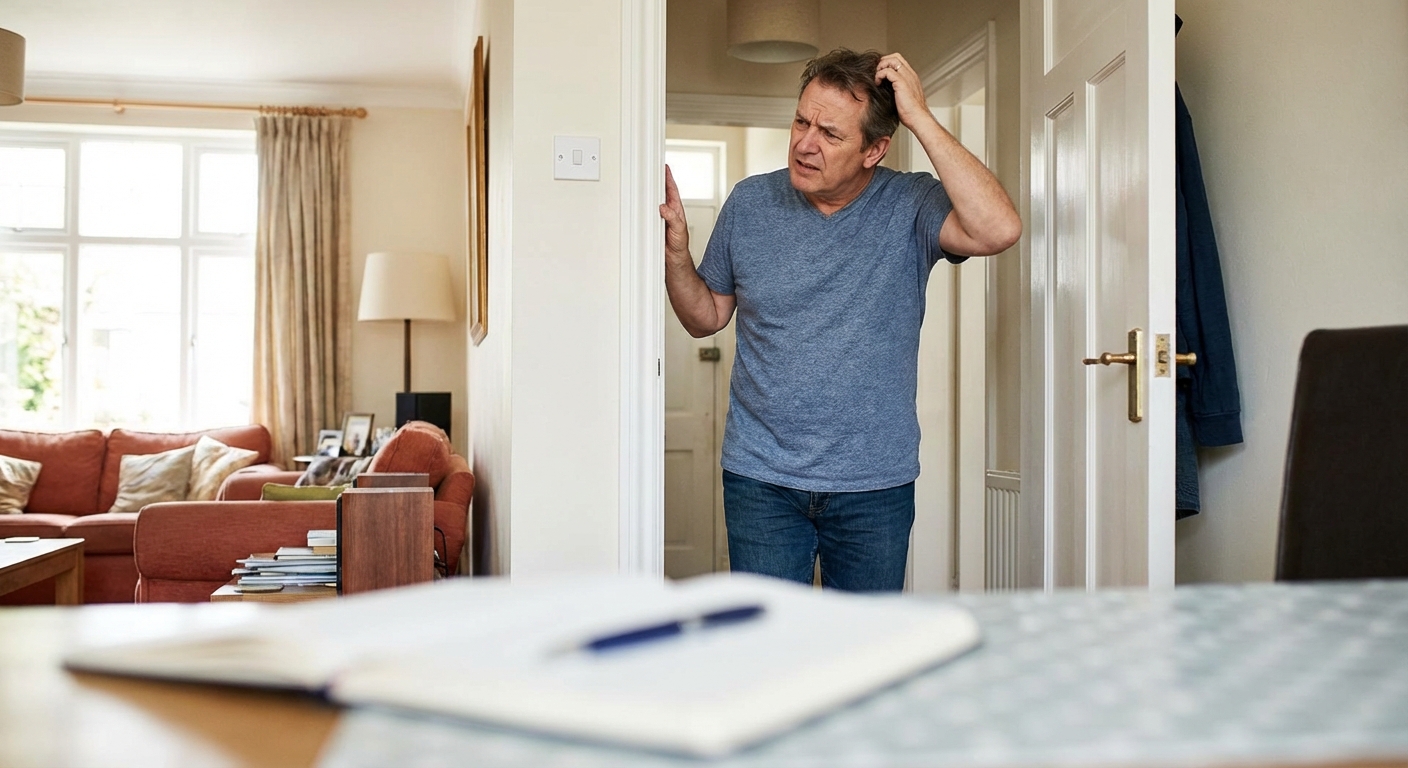
You stand in the middle of the kitchen, staring blankly at the refrigerator, paralyzed by a single, frustrating question: "Why am I here?" It is a universal experience. You were sitting on the couch, you had a clear mission, and you got up with purpose. But somewhere between the living room rug and the kitchen tile, that purpose evaporated. You didn’t suffer a mini-stroke. You aren’t losing your mind. You just fell victim to a very specific psychological glitch known as the Doorway Effect.
The Event Horizon Model
For a long time, we treated this phenomenon as a funny quirk of aging or a sign that we were just scatterbrained. But researchers have dug into the mechanics of why this happens, and the answer is surprisingly logical. It comes down to something called Event Segmentation Theory.
Think of your brain as a very efficient film editor. It does not view your day as one long, continuous take. That would be too much information to process all at once. Instead, it chops your day up into distinct scenes or "episodes." This helps your mind organize memories and manage information without crashing the system.
When you are in the living room, your brain opens a file folder labeled "Living Room." It fills that folder with relevant context: the show on TV, the comfort of the sofa, the conversation you were having. But the moment you cross a threshold—a physical doorway—your brain perceives an "event boundary."
It decides that the "Living Room" scene is over. To save cognitive energy and prepare for the new scene, it closes that file and opens a fresh one labeled "Kitchen." The problem is that the thought "I need the scissors" was filed inside the "Living Room" folder. When your brain aggressively filed that away to make room for the new environment, it effectively dumped your short-term cache.
This isn't just a theory. Researchers at the University of Notre Dame, led by Gabriel Radvansky, tested this extensively. They found that people were significantly more likely to forget an object they were carrying or a task they were assigned after walking through a doorway, compared to walking the exact same distance across a single room. The distance didn't matter. The time didn't matter. The doorway—the physical boundary—was the trigger that forced the brain to hit the reset button.
The Distraction Catalyst
While the doorway acts as the trigger, the gun is usually loaded by something else entirely: your cognitive load.
The Doorway Effect is not a guarantee. You walk through doors all day long without losing your mind. You successfully navigate from your bedroom to the bathroom every morning without forgetting why you went there. So, why does it happen sometimes and not others?
The science suggests that the "memory wipe" is far more likely to occur when your working memory is already taxed. If your brain is operating at full capacity, it is desperate to free up space. It is looking for any excuse to dump old data.
A major study from 2021 verified this nuance. They found that the effect is most powerful when you are multitasking or under stress. If your mind is wandering, or if you are juggling multiple complex thoughts, the transition between rooms becomes a chaotic handoff.
I see this constantly in my own professional life. I work as a web developer and marketer, which means I am constantly juggling different projects, usually all at once. When I am deep in the code or trying to map out a complex strategy, I have to work in intense bursts to keep my focus. If I get up to grab a glass of water while my brain is still compiling code or mentally drafting a client email, I am almost guaranteed to forget my mission the second I hit the hallway. My brain is simply too full to carry the intention over the threshold.
This context shift is critical. If you move from a quiet room to another quiet room that looks similar, the effect is minimized. But if you move from a dim, quiet office into a loud, bright, bustling kitchen, the sensory change is massive. Your brain screams, "New context! Dump the old files!" and suddenly you are standing there wondering if you came in for a snack or a screwdriver.
This phenomenon is evolving, too. We are seeing reports that this "mental reboot" is no longer just physical. It is metaphysical. Switching between browser tabs or jumping from Instagram to your email app creates a "digital doorway." You open your phone to check the weather, see a notification, switch apps, and instantly forget that you cared about the weather at all. The screen change acts just like a doorframe.
Practical Strategies to Reclaim Your Memory
Understanding the science is comforting because it confirms you aren't crazy. But that doesn't make it any less annoying when you have to walk back to the living room three times just to remember you wanted a glass of water.
You don't have to be a passive victim of your brain's filing system. You can hack the process. Here are four strategies to keep your intentions safe as you cross boundaries.
The Verbal Anchor
This is the simplest and most effective tool in your arsenal. Before you stand up and leave the room, say your intention out loud. Literally speak it into existence. "I am going to the kitchen to get the scissors."When you keep a thought purely mental, it is fragile. It is easy for the brain to sweep it away during a context switch. But when you speak it, you engage the auditory loop in your brain. You are giving the memory a physical "sound" tag that is harder to overwrite. You might feel silly talking to yourself, but you will feel less silly than you would standing confused in the pantry for five minutes.
The Doorframe Touch Ritual
This technique relies on a concept called "embodied cognition." The theory is that our physical actions are deeply linked to our mental processes. Currently, the physical act of walking through a door signals a "reset" to your brain. You need to change that signal.As you walk through the doorway, reach out and physically touch the doorframe while thinking about your task. This creates a tactile link between the movement and the memory. You are essentially telling your brain, "This boundary is not a cut point; it is part of the mission." It turns the doorway from a barrier into a retrieval cue.
Intentional Visualization
Most of us move on autopilot. We have the thought "I need an apple," and our legs start moving before the thought has actually settled into long-term storage.Slow down. Before you leave the room, spend three seconds visualizing yourself holding the object you need. Don't just think the word "apple." See the red skin. Imagine the crunch. Visualize your hand grabbing it from the fruit bowl. This creates a vivid mental image. Images are much "heavier" data than abstract words, and they are harder for your brain to dump during the transition.
The Physical Return
Sometimes, despite your best efforts, the wipe happens. You cross the threshold and your mind goes blank. The worst thing you can do is stand there and try to force the memory back. It usually won't work because you are in the wrong context (the "Kitchen" folder).Instead, physically walk back to the room you came from. Go to the exact spot where you were sitting or standing. This isn't superstition; it's science. By re-entering the original environment, you reopen the "Living Room" file. The context cues—the lighting, the furniture, the screen—will often "reload" the memory instantly. Once you recover it, say it out loud (Strategy 1) and try the trip again.
A Sign of Efficiency
It is easy to get frustrated with ourselves when these glitches happen. We view them as failures of discipline or intellect. But the reality is quite the opposite. The Doorway Effect is actually a sign that your brain is working exactly as it should.
Your mind is designed for efficiency. It is designed to prioritize the "now." If our ancestors were running from a predator in a forest and ducked into a cave, their brains needed to instantly dump the data about the trees and load the data about the cave (darkness, slippery rocks, potential bears). Holding onto the "forest" data would have been a waste of precious energy.
Your brain is doing the same thing today. It is trying to help you be present in the room you are currently in. It is clearing the clutter so you can focus on the new environment. The fact that it works so well is actually a testament to how organized your mind really is.
So, the next time you find yourself lost in the kitchen, take a breath. Don't beat yourself up. Just walk back to the couch, grab your file, and carry it through the door with a little more intention next time.