The architectural world is currently holding its breath. It is March 2026, and the usual rhythm of the design year has been disrupted. The Pritzker Architecture Prize announcement, typically the Super Bowl of our industry, has been delayed. While the rumors swirl about internal shifts within the foundation, the silence has actually done something useful. It has forced us to look back at what really matters in the spaces we inhabit.
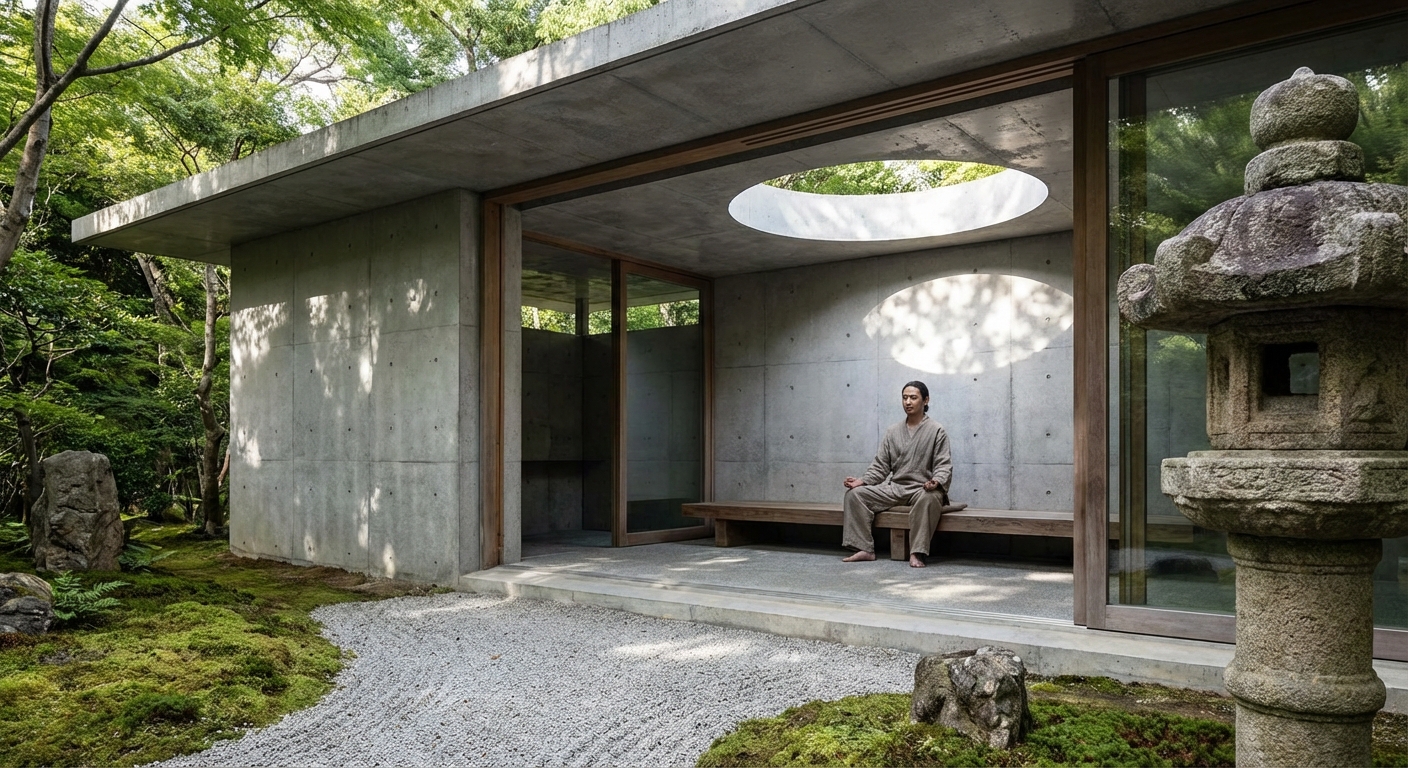
The 2026 Shift: From Cold Showrooms to Healing Sanctuaries
We are seeing a massive cultural pivot right now. For decades, "minimalism" in the West meant something very specific—and often very cold. It was about white walls, uncomfortable furniture, and an obsession with looking clean rather than feeling good. It was performative. It was a showroom, not a home. But that version of minimalism is dying, and honestly, good riddance.
What is replacing it is something much older and far more human. We are seeing a move toward what designers are calling "nervous system regulation." That might sound like a buzzword, but the feeling is real. We are collectively exhausted. The digital noise is relentless, the economy is volatile, and our attention spans are shattered. We don't need our homes to impress our neighbors anymore; we need our homes to help us survive the day.
This is why the delay in the Pritzker announcement has refocused so many eyes on previous laureates like Riken Yamamoto and the legendary Tadao Ando. Their work doesn't just look good; it acts as a physiological reset button. We are turning to the Japanese principles of emptiness and authenticity not as a style trend, but as a survival mechanism. We are moving away from the sterile and toward the "calibrated refuge." This is the rise of a warmer, deeper minimalism—a "Japandi" evolution that isn't about buying beige furniture, but about creating a space that allows your brain to finally exhale.
The Philosophy of Emptiness
To understand why this shift is happening, you have to understand that the Western and Japanese views of "space" are fundamentally different. In the West, we tend to view space as something to be filled. If there is an empty corner, we stick a chair in it. If there is a blank wall, we hang a picture. We treat emptiness as a void that needs to be conquered.
The Japanese concept of Ma flips this entirely on its head. Ma is often translated as "negative space," but that doesn't quite capture it. It is the "interval." It is the pause between notes in a piece of music that gives the melody its shape. Without the silence, the music is just noise.
In architecture, Ma is the intentional creation of empty space to create a sense of potential. It is not empty because the architect forgot to put something there; it is empty to allow you to be there. When you walk into a room designed with Ma, you aren't overwhelmed by visual data. Your brain doesn't have to process a thousand different objects. Instead, the space invites you to settle down.
I found a personal connection to this concept through a different avenue. A few years ago, I began exploring the Christian Orthodox tradition, specifically the discipline of prayer. I used to think prayer was just about talking—listing off requests or thoughts. But as I spent time in the liturgy and in private prayer, I realized the power wasn't in the noise I was making; it was in the silence. It was in the stillness and the pauses between the words. That silence wasn't "nothing"; it was where the connection actually happened. That is exactly what Ma does for a physical room. It provides the stillness necessary for life to actually happen.
alongside Ma, we have the concept of Wabi-sabi. You have probably heard this term thrown around to sell cracked pottery, but the philosophy is much deeper. It is the acceptance of transience and imperfection. In 2026, we are finally tired of "perfect" synthetic materials that look cheap the moment they get a scratch. Wabi-sabi argues that things should become more beautiful as they age, not less. A leather chair that is worn in, a wooden floor that shows the path of footsteps, a stone wall that weathers—these things have a soul. They remind us that life is impermanent, which, paradoxically, makes us feel more grounded.
Historical Integration: Tracing the Blueprint
It is easy to think this is a new trend, but the Western obsession with Japanese spatial theory goes back over a century. We are just finally catching up to the masters who saw it first.
Look at Frank Lloyd Wright. He is arguably the most famous American architect in history, but his "Organic Architecture" was heavily indebted to Japan. Wright spent significant time in Japan and was an avid collector of woodblock prints. He understood the "elimination of the insignificant." If you look at his Prairie-style homes, with their low horizontal lines and open floor plans, you are looking at a direct translation of the traditional Japanese home. He wanted to bring the human scale back to American housing, removing the boxy, vertical claustrophobia of the Victorian era.
Then you have the Bauhaus movement in Germany. Walter Gropius and the other founders were looking for a way to strip design down to its honest essentials. When they discovered the Katsura Imperial Villa in Kyoto, they were floored. Gropius famously wrote that everything the modernists were fighting for—structural honesty, modularity, lack of ornamentation—had already been perfected in ancient Japanese architecture.
The difference was that the Bauhaus often leaned into the industrial—steel, glass, cold precision. The Japanese source material was always rooted in nature. Today, we are seeing a synthesis of the two. We are taking the clean lines of the Bauhaus and injecting the warmth and natural materials of the Japanese tradition. We are realizing that while we like the logic of modernism, we need the "soul" of nature to feel at home.
Modern Application: The Concrete Poetry of 2026
So, what does this actually look like right now? How is this philosophy manifesting in the buildings going up in March 2026?
It is most visible in the resurgence of Tadao Ando’s influence. Ando is known for his use of concrete, but he uses it differently than the Brutalists of the mid-20th century. For Ando, concrete is a way to capture light. He calls it "concrete serenity."
His recent work, like the MPavilion 10 in Melbourne, serves as a perfect example. It acts as a blank canvas of emptiness. It’s a geometric intervention in nature that doesn't try to overpower the landscape but frames it. The walls are there to show you the shadow of a tree or the movement of the wind. Western designers are copying this en masse, using exposed concrete not to look "tough," but to create a neutral backdrop for the play of natural light.
We are also seeing the concept of Engawa take over residential design. In a traditional Japanese house, the engawa is a wooden strip of flooring that runs around the outside of the house, protected by the overhanging roof. It is a liminal space—neither fully inside nor fully outside.
In 2026, this has translated into the massive sliding glass walls and "transitional terraces" we see in high-end renovations. Architects are dissolving the barrier between the living room and the garden. The goal is to make the transition seamless. You shouldn't feel a hard jolt when you move from indoors to outdoors. This connects back to the nervous system; looking at nature, even from the inside, lowers cortisol levels. By blurring that boundary, the home becomes an extension of the natural world.
Finally, there is a massive shift in materials driven by figures like Kengo Kuma. Kuma talks about "particlization"—breaking down massive structures into smaller, human-scale elements, often using wood. We are moving away from the monolith. We are seeing a rejection of perfect, glossy finishes in favor of Shou Sugi Ban (charred cedar), unseasoned bamboo, and cork.
If you want to apply this to your own life or space, you don't need a million-dollar renovation. You just need to apply the logic:
- Clear the Intervals: Look at your main living area. Is every wall covered? Is every surface filled? clear a space. Create a "void." Give your eyes a place to rest where absolutely nothing is happening.
- Celebrate the Wear: Stop trying to fix every scratch in your wooden table. If you have materials that look worse when they age (like cheap plastic or veneer), replace them slowly with materials that patina—solid wood, leather, stone, unpolished brass.
- Soften the Light: Japanese interiors often celebrate "shadow" rather than the harsh, uniform brightness of Western offices. Use lamps, dimmers, and lower positioning of light sources to create depth and shadow, rather than obliterating it with overhead LEDs.
Architecture as a Bridge
The architectural landscape of March 2026 is teaching us that our environment is not neutral. The spaces we inhabit are constantly acting upon us. They are either winding us up or winding us down.
For a long time, we designed for the eye. We wanted spaces that looked impressive in a magazine spread. But the influence of Japanese minimalism—the real stuff, the deep philosophy of Ma, Shizen, and Wabi-sabi—is teaching us to design for the body and the spirit.
We are remembering that we are biological creatures who need rhythm, silence, and connection to the earth. Whether it is through the silence of a concrete wall by Tadao Ando or the warm imperfection of a cedar floor, these design choices act as a bridge. They connect our frantic modern lives back to the slow, steady rhythm of the natural world. And right now, that is exactly the kind of sanctuary we need.