You walk through your front door after a long day, and before you even take off your coat, your eyes land on the pile of mail on the counter. Your stomach tightens. That isn't just annoyance; it is a measurable, biological stress response kicking your body into survival mode.
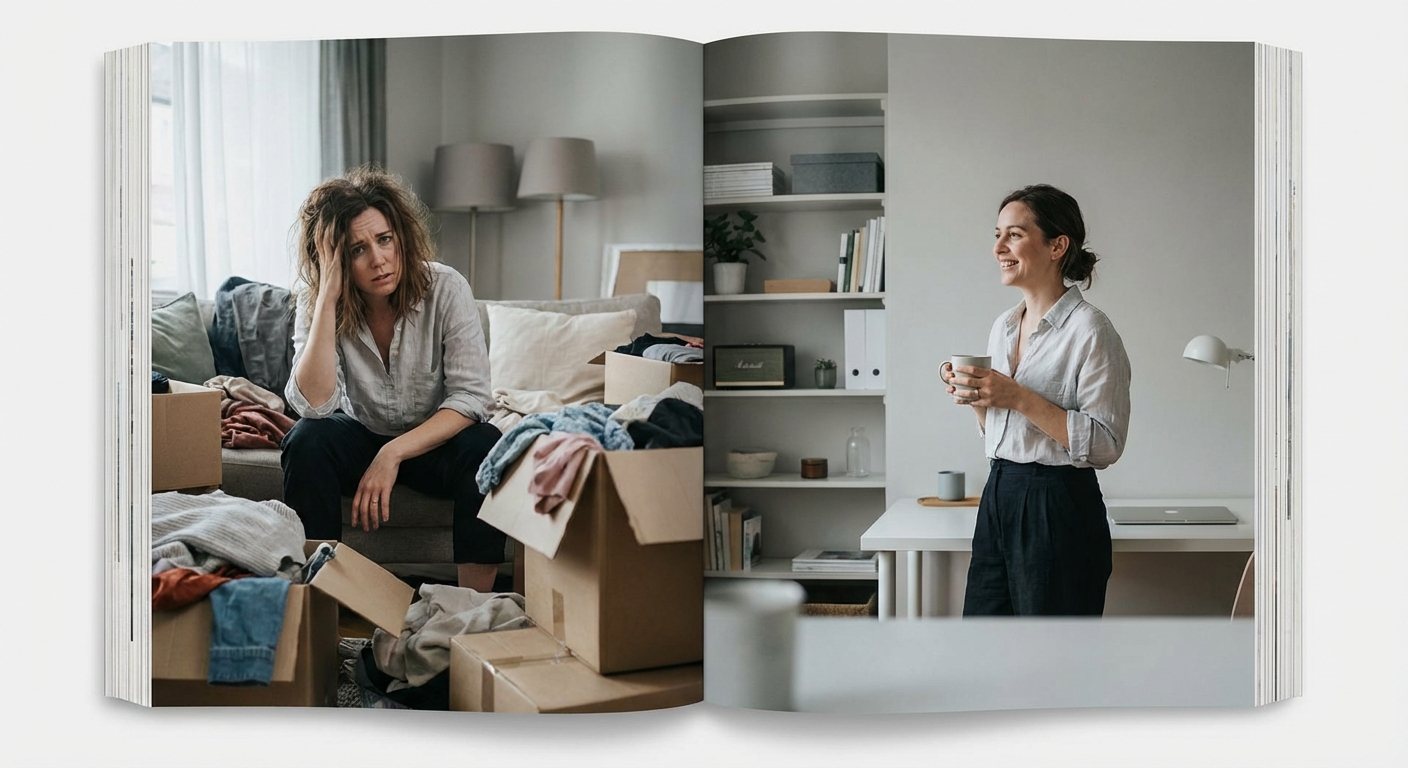
The Shift From Chores to Biology
For decades, we have treated home organization as a matter of aesthetics or moral character. We thought a clean house meant you were a "good" homeowner, and a messy one meant you were lazy. We treated cleaning as a chore—something we had to do to keep up appearances for the neighbors or the in-laws.
But that perspective is outdated. In recent years, and specifically looking at the design trends dominating 2026, the conversation has shifted. We aren't organizing our homes to impress guests anymore. We are doing it to regulate our nervous systems.
We now understand that your environment is the "third teacher" and the silent dictator of your health. When you live in a state of chronic disorganization, you aren't just untidy; you are subjecting yourself to a low-grade, constant biological attack. The stack of dishes in the sink isn't just a task to be done; it is a signal to your brain that your environment is out of control.
This is not about being a minimalist or living in a sterile museum. It is about understanding that your home is supposed to be a recovery tank. If that tank is polluted with visual noise, you never actually recover. You just reload.
The Biological Marker: Your Home and Your Hormones
Let’s get into the hard science, because this is where most people get it wrong. They think the stress they feel looking at a mess is purely emotional. It’s not. It is neuroendocrine.
Your body operates on a rhythm. In a healthy cycle, your cortisol (the stress hormone) levels should be high in the morning to wake you up and get you moving, and they should gradually taper off throughout the day, hitting a low point at night to allow for sleep and restoration. This is called the diurnal cortisol slope.
However, a landmark study involving dual-income families found a disturbing correlation. Women who described their homes as "cluttered" or "full of unfinished projects" displayed a flatter diurnal cortisol slope. Their stress hormones didn't dip at the end of the day.
Think about what that means. When you sit down on the couch at 8:00 PM, surrounded by toys, laundry, and unread magazines, your body is chemically mimicking the state of being at work or facing a threat. You might feel like you are resting because you are sitting down, but your biology is still running a marathon.
This chronic elevation of cortisol is dangerous. It is directly linked to adverse health outcomes like depression, chronic fatigue, and weight gain. If you are struggling to lose weight or you feel perpetually burned out, look around your living room. The chaos outside is creating chaos inside.
The Cognitive Cost: Why Your Brain Can’t Ignore the Mess
You might tell yourself, "I don't even see the mess anymore." You are lying to yourself. You might not be consciously focusing on the pile of clothes in the corner, but your brain is.
Your brain is the CEO of your body, and it has a limited amount of energy to spend each day. Every object in your field of vision competes for neural representation. This concept, known as "visual competition," means that everything you see is fighting for a slice of your brain's processing power.
Research from the Princeton Neuroscience Institute has shown that multiple stimuli present in your visual field at the same time mutually suppress each other. They clog the bandwidth. When your environment is cluttered, your visual cortex is constantly working to filter out the noise so you can focus on the task at hand.
I know this feeling well. As a web developer and marketer who often juggles multiple complex projects at once, I live by the need for deep focus. There was a time when my desk was a graveyard of sticky notes, coffee cups, and tangled cables. I realized that on the days my physical space was chaotic, my code was sloppy and my writing was disjointed. I wasn't just distracted; I was exhausted before I even started typing. Clearing the desk wasn't just cleaning; it was preparing my brain to actually function.
Recent findings from Yale University have taken this understanding even further. They found that visual clutter actually degrades the flow of information between layers of the brain. It physically becomes harder for your brain to identify and process targets when the background is messy.
When you live in clutter, you are forcing your brain to run a marathon with a backpack full of rocks. You are inducing cognitive fatigue before you even start your actual work. If you feel irritable, snappy, or unable to focus, it might not be a personality flaw. It might just be that your brain is tired of processing your living room.
The Psychological Toll of Deferred Decisions
Beyond the biological and cognitive costs, there is a heavy psychological weight to clutter. Clutter is rarely just "stuff." It is usually deferred decision-making.
That pile of mail isn't just paper; it is a pile of decisions you haven't made yet. Do I pay this bill? Do I file this? Do I shred this? That broken appliance in the garage isn't just junk; it's a reminder of a project you haven't finished.
Dr. Joseph Ferrari of DePaul University has noted that clutter is essentially a physical manifestation of procrastination. Every time you walk past that pile, your brain registers a failure. This creates a "guilt loop." You see the mess, you feel guilty for not dealing with it, the guilt causes stress, and the stress makes you want to avoid the mess even more.
This is particularly punishing for those who carry the "mental load" of a household. In many homes, one person is the designated project manager. They aren't just seeing a messy room; they are seeing a to-do list that never ends. This leads to a loss of life satisfaction and a measurable loss of productive time.
We have to stop looking at objects as inert. Objects are active. They demand attention, maintenance, and decision-making energy. If you own too much, you are essentially employed by your possessions.
Practical Steps for Environmental Regulation
So, how do we fix this? We don't do it by becoming ruthless minimalists overnight, and we certainly don't do it by following generic advice that doesn't account for real life. We need a tactical approach that respects your biology.
Here are three strategies to reclaim your space and your sanity.
1. Implement the "Sunday Reset"
Stop trying to deep clean your house every day. It’s not sustainable, and you will fail. Instead, adopt the "Sunday Reset." This is a dedicated block of time—usually 60 to 90 minutes—where you reset the "bottleneck" areas of your home.
Focus on the entryway, the kitchen island, and the living room coffee table. These are the arteries of your home. When they are clogged, the stress spreads everywhere. By clearing these specific zones before the week begins, you prevent the Monday morning cortisol spike. You are essentially clearing the runway so your week can take off smoothly.
2. Transition to Biophilic Containment
Plastic bins are ugly, and they subconsciously signal "storage facility" or "factory" to your brain. We are seeing a massive shift toward biophilic organization—using natural materials to hold our things.
Replace your clear plastic tubs with bamboo, seagrass, wood, or canvas. Research suggests that natural textures and materials reduce physiological stress and the "alert" state in the brain compared to synthetic materials. When you look at a row of wooden baskets, your brain registers "nature" and "calm." When you look at a stack of plastic bins, your brain registers "work" and "inventory."
3. Categorize by "Daily Life Support"
Forget asking if an item "sparks joy." That is too abstract for most of us. Instead, ask a pragmatic question: "Does this item support my daily life right now?"
If you are keeping 15 Tupperware containers but only have lids for three, those extra containers are not supporting your life; they are obstructing it. If you have clothes that fit a version of you from ten years ago, they are not supporting your life; they are mocking it.
We need to view our possessions as tools. If a tool isn't working, or if it's in the way of the tools you actually use, it needs to go. This reduces the decision fatigue associated with decluttering. You aren't making an emotional choice; you are making a logistical one.
The Long Game
This is about more than a clean house. It is about stewardship of your own body and mind. It is about discipline and the quiet peace that comes from order.
When you clear your physical space, you are clearing a path for stillness. You are removing the visual noise that blocks you from prayer, from thinking clearly, and from resting deeply.
Your home is the one place on earth where you should have total control over the environment. Don't let that environment turn against you. By taking control of your space, you are taking control of your cortisol, your focus, and your health. It’s not just organizing. It’s self-defense.