Tomorrow marks the beginning of the Global Day of Unplugging, a twenty-four-hour challenge where millions of people across the globe will voluntarily shut down their devices. It is a desperate, collective gasp for air in a world that feels increasingly suffocating. We treat this event like a modern invention, a necessary counter-measure to the smartphone era. But the truth is, the urge to disconnect is not a 2026 phenomenon. It is a human one.
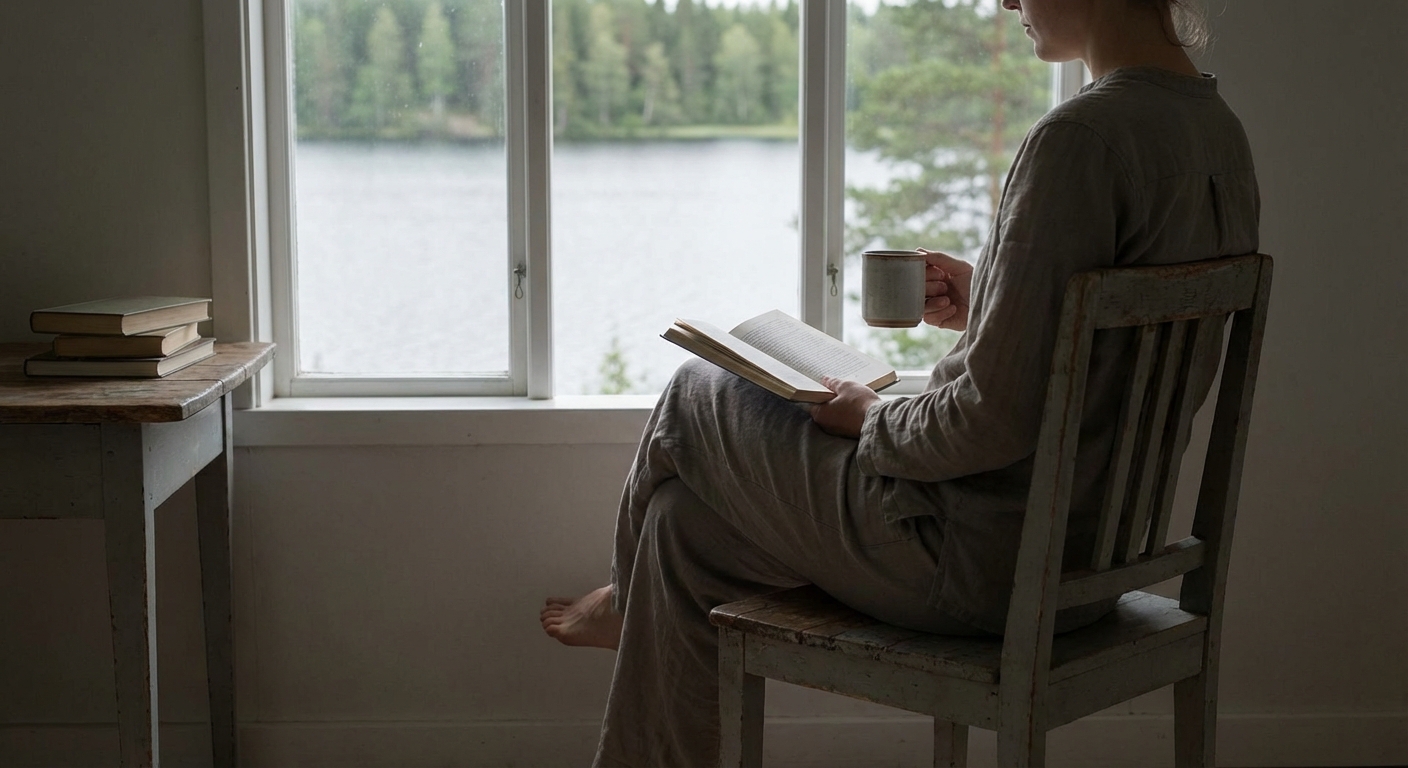
When Henry David Thoreau walked into the woods near Walden Pond in 1845, he wasn't just going camping. He was escaping the "information overload" of the nineteenth century. He was fleeing a society that he felt was already over-civilized, noisy, and obsessed with the wrong things. He wanted to live deliberately. He wanted to front only the essential facts of life.
It is easy to romanticize Thoreau as a hermit, but his experiment was incredibly practical. He wasn't trying to hide from the world; he was trying to figure out how to live in it without being crushed by it. Today, as we stare down the barrel of burnout and digital fatigue, his lessons are more relevant than they were two hundred years ago. We are seeing a massive resurgence in minimalism, not just as an aesthetic choice, but as a survival mechanism.
The Philosophy of "Life-Cost"
We usually think of minimalism as a design trend. We imagine stark white walls, uncomfortable furniture, and owning exactly one fork. But that is a superficial understanding. True minimalism, the kind Thoreau practiced, is an exercise in economics. But he didn't define "economy" the way Wall Street does.
Thoreau offered a definition of cost that changes everything: "The cost of a thing is the amount of what I will call life which is required to be exchanged for it, immediately or in the long run."
Read that again. The cost isn't dollars. The cost is life.
When you look at a new car, a bigger house, or even the latest phone, the price tag is misleading. The real price is the amount of time you had to work—the hours you had to sit in a chair you hate, the stress you had to endure, the family dinners you missed—to acquire it.
Recent consumer data from 2025 shows that this mindset is finally going mainstream. Seventy percent of people in the U.S. now say they prioritize intentional spending over accumulation. We are waking up to the fact that we have been swindled. We have been trading our limited time on earth for things that gather dust.
If you earn twenty dollars an hour, a one-hundred-dollar pair of shoes doesn't cost one hundred dollars. It costs five hours of your life. Is that trade worth it? Sometimes, the answer is yes. But often, if we are honest, the answer is no. This is the core of the minimalist movement. It isn't about deprivation. It is about refusing to make bad trades. It is about realizing that wealth isn't having many things; it is having the freedom to let things alone.
From the Woods to the Web: Practical Steps
Understanding the philosophy is one thing, but applying it to a world of constant notifications and one-click ordering is another. You don't need to build a cabin in Massachusetts to apply the Walden experiment to your life. You just need to change your tactics.
Here is how you can bring that deliberate living into 2026.
Calculate the Time-Cost of Possessions
Thoreau was meticulous. He built his cabin for exactly $28.12. He documented every nail, every hinge, and every plank of wood. He did this to prove a point: a dignified shelter requires very little capital.
You can apply this same rigor. Before you make a purchase, do the math. Calculate your "real hourly wage"—your income minus the costs of working (commuting, work clothes, convenience food due to lack of time). Then, divide the price of the item by that number.
- Does that new gadget cost forty hours of your life?
- Is that subscription service worth two hours of your life every single month?
When you start viewing purchases as time-trades, you naturally buy less. You stop bleeding "life" for things that don't matter.
Practice Digital Deliberation
Thoreau went to the woods because he wanted to hear himself think. He couldn't do that amidst the "hustle and bustle" of the town. Today, our noise is digital. It is the constant ping, the buzz, and the red notification dot.
We need periods of silence. This isn't about being a Luddite; it's about reclaiming your attention.
I know how hard this is. I used to lose hours of my day to gaming and doom-scrolling. I would tell myself I was "relaxing" after a hard day of work, but in reality, I was just numbing my brain. I wasn't present. I was trading my evening hours—my free time—for a dopamine loop that left me feeling empty and anxious. When I finally made the decision to quit, the silence was jarring at first. But eventually, that silence turned into clarity. I regained the ability to focus, to sit still, and to actually rest rather than just distract myself.
You can replicate this by scheduling tech-free intervals. Use the Global Day of Unplugging as a kickstart, but make it a habit. Create boundaries. Maybe your bedroom is a no-phone zone. Maybe you don't turn on a screen until you've had your morning coffee. These are small acts of rebellion against the noise.
Curate an Intentional Environment
There is a trend growing right now called "Warm Minimalism." It rejects the sterile, hospital-like look of early 2000s minimalism in favor of natural materials. Think stonewashed cotton, raw wood, and clay.
This aligns perfectly with Thoreau's aesthetic. He didn't live in a plastic box. He lived surrounded by the texture of the forest.
Your environment shapes your mind. If your home is cluttered with cheap plastic and mass-produced junk, your mind will feel cluttered. "Warm Minimalism" focuses on textures that provide clarity and comfort. It prioritizes quality over quantity. It invites you to touch, to feel grounded. By stripping away the visual chaos and replacing it with a few meaningful, natural items, you create a space where your brain can actually downshift.
The Psychological Shield
Why does this matter? Why should we care about simplifying our lives?
Because simplicity is a shield.
Thoreau argued that as you simplify your life, the "laws of the universe will be simpler." Solitude will no longer feel like loneliness. Poverty will no longer feel like deprivation.
When you reduce your wants, you become harder to manipulate. The advertising industry relies on you feeling inadequate. They need you to believe that you are one purchase away from happiness. When you step off that treadmill, you gain a psychological resilience that is rare in the modern world.
We are currently facing an epidemic of burnout and decision fatigue. Your brain's CEO gets tired, just like you do. Every object you own demands a piece of your attention. You have to clean it, store it, repair it, or insure it. Every app on your phone demands you look at it.
By reducing these "superfluous material encumbrances," you protect your mental energy. You stop suffering from decision fatigue because you have fewer decisions to make. You have fewer clothes to choose from, fewer apps to check, and fewer bills to juggle.
This creates space for the things that actually restore you: quiet contemplation, connection with loved ones, and engagement with the natural world. It allows you to build a life that is rich in experiences rather than things.
Conclusion
The resurgence of minimalism in 2026 isn't a fad. It is a correction. We swung too far into the direction of excess, noise, and speed, and now we are remembering that the human spirit wasn't designed for this pace.
Thoreau's experiment at Walden Pond was never really about the pond. It was about sovereignty. It was about proving that you don't have to live the way everyone else does. You have the power to step back, to look at the "cost" of your life, and to decide that you want to keep more of it for yourself.
As you navigate the noise of the modern world, remember that the most radical thing you can do is simply stop buying what they are selling—both the products and the lifestyle. Choose simplicity. Choose silence. Choose to live deliberately.