You know that feeling when you just can’t seem to turn your brain off at night, and your body feels like it’s vibrating with leftover energy from the day? It’s not just in your head; it’s a physical state of being, and sometimes, the solution is heavy.
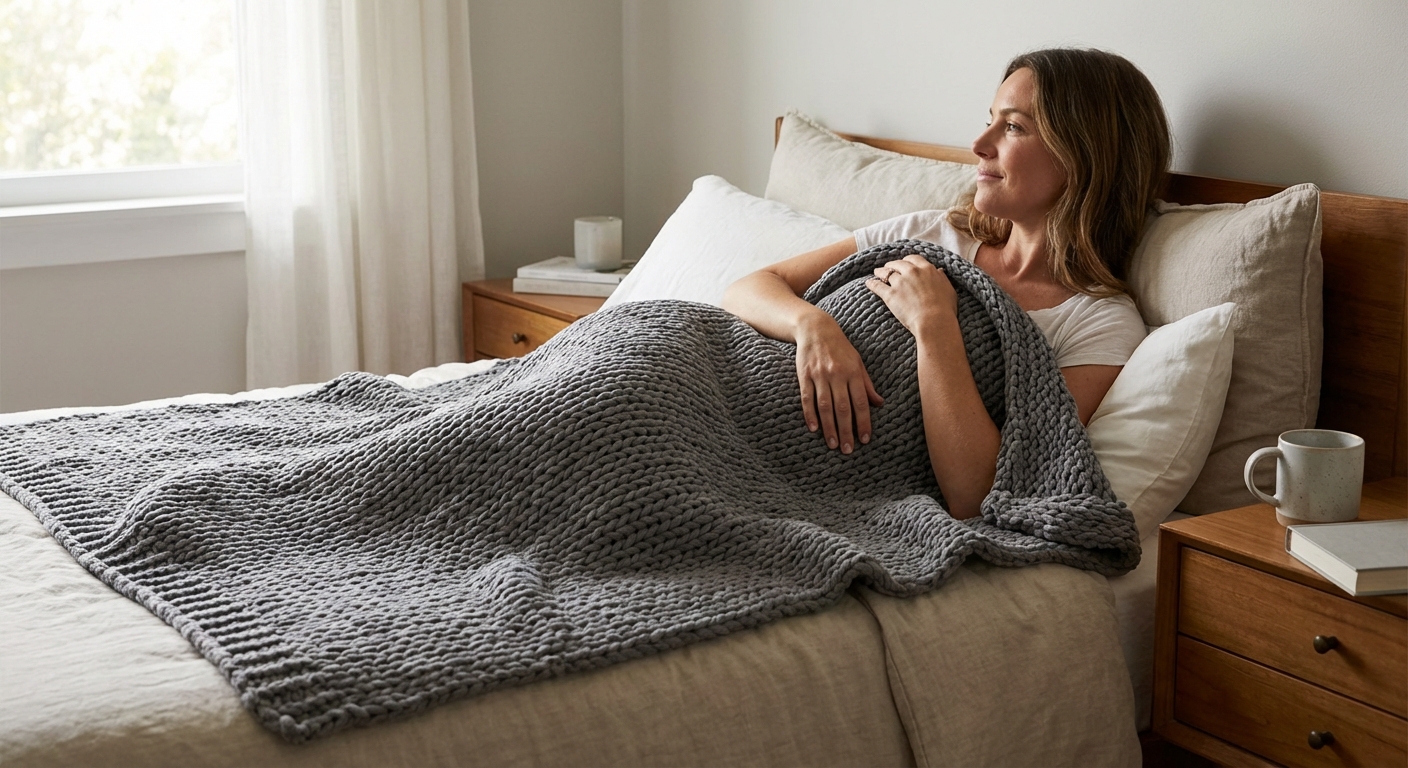
The Sensory Bridge to Peace
We are living in a time that is louder, brighter, and faster than anything our ancestors ever had to deal with. It is no surprise that recent health reports from early 2026 are highlighting a massive surge in "wellness technology." Everyone is looking for a gadget or a hack to fix their sleep. But what stands out to me isn't the high-tech glasses or the sleep-tracking rings; it's the return to something incredibly basic.
Sleep experts are increasingly pointing toward weighted blankets as a primary tool for managing anxiety and insomnia. It sounds almost too simple to work. How can a heavy quilt compete with pharmaceutical interventions or complex therapies?
The answer lies in how our bodies process safety. As the world gets more chaotic, the prevalence of sleep and anxiety disorders is rising globally. We are constantly in a state of low-grade "fight-or-flight." We are scanning for threats, checking emails, and worrying about deadlines.
Clinical reviews confirm that the evenly distributed weight of these blankets signals a "calm environment" to the brain. It is a physical override switch. It creates a sensory bridge that takes you from a state of high alert to a state of stillness. It’s not magic; it’s biology. And to understand why it works, you have to understand a sense you probably don't think about very often.
Understanding Your Sixth Sense
Most of us grew up learning about the five senses: sight, sound, taste, touch, and smell. But you actually have more than that. There is a "sixth sense" called proprioception.
Proprioception is the information sent to your brain by receptors in your muscles and joints. It tells you where your body is in space. It’s the reason you can touch your nose with your eyes closed or walk down the stairs without looking at your feet. Your brain is constantly receiving a stream of data from your limbs, confirming that you are solid, you are here, and you are together.
When you are anxious or overstimulated, that signal can get fuzzy. Your nervous system gets a little disorganized. You might feel "floaty," restless, or unable to settle. This is where the weighted blanket comes in.
The weight provides what is called Deep Pressure Stimulation (DPS). It turns the volume up on those proprioceptive signals. It enhances your body awareness. By providing firm, consistent feedback to your joints and muscles, the blanket helps organize the nervous system.
Think of it like swaddling a baby. A baby has very little control over their limbs and can easily startle themselves awake. Swaddling provides that tight containment that makes them feel secure. As adults, we aren't that different. We might not flail our arms physically, but our nervous systems are flailing. The weighted blanket communicates safety directly to the brain, bypassing your worried thoughts. It tells your body, "You are safe. You are held. You can rest now."
The Chemistry of Calm
I juggle a lot of different projects. Between web development work, marketing clients, and trying to write meaningful content, my brain often feels like a browser with a hundred tabs open. There are days when I finish a twelve-hour deep-work burst and physically cannot shift gears. My mind is still coding or strategizing even when I’m staring at the ceiling.
I used to think I just needed more discipline to shut it off, but I realized my physiology was working against me. I was swimming in cortisol—the stress hormone.
This is where the science of Deep Pressure Stimulation gets really interesting. It doesn’t just feel nice; it actually changes your chemical makeup. The deep pressure provided by weighted blankets triggers the brain to release specific "feel-good" hormones.
First, there is serotonin. This is a neurotransmitter that helps regulate mood. The pressure stimulates its production, acting as a natural mood stabilizer. Then there is dopamine, the reward chemical, which can help lower anxiety levels.
But the biggest player here, especially for sleep, is melatonin. A study conducted by researchers at Uppsala University found that the use of a weighted blanket resulted in a 32% greater rise in melatonin compared to using a light blanket. That is a massive difference. Melatonin is the hormone that tells your body it is time to sleep.
At the same time, this pressure suppresses cortisol. When you are stressed, your heart rate is up, and your blood pressure might be slightly elevated. You are in that sympathetic "fight-or-flight" state. The heavy blanket pushes you toward the parasympathetic nervous system—the "rest-and-digest" mode. It physically forces your body to lower its physiological arousal.
Practical Guidelines for Real Results
If you are thinking about trying this, don't just go out and buy the heaviest blanket you can find. There is a right way and a wrong way to do this. I have seen people buy blankets that are way too heavy, and they end up feeling trapped rather than hugged.
Here is the golden rule: aim for 10% of your body weight.
If you weigh 150 pounds, look for a 15-pound blanket. If you are 200 pounds, a 20-pound blanket is your target. Most manufacturers make them in standard increments (10, 15, 20, 25 lbs), so just get as close to that 10% to 12% range as you can. You want it to feel substantial, but not suffocating.
You also need to introduce it gradually. When I first tried one, I thought I had to sleep with it all night immediately. That was a mistake. My body wasn't used to the sensation, and I woke up feeling sore and confused.
Start by using the blanket for short 20 to 30-minute sessions during quiet activities. Use it while you are reading on the couch or just sitting in silence. Let your body get used to the sensory input. Once that feels normal, try using it for a nap or for the first part of your night.
There are also some serious safety considerations you cannot ignore.
- Mobility is non-negotiable. You must be able to remove the blanket yourself without struggle. If you feel stuck, it’s too heavy.
- Respiratory issues. If you have asthma, sleep apnea, or other breathing trouble, check with a doctor first. You don't want extra weight on your chest if your lungs are already compromising.
- Age limits. Never, ever use these for infants or toddlers under two. They do not have the strength to move the blanket if it covers their face, and it poses a suffocation risk.
A Tool for Stillness
We often look for complex intellectual solutions to our problems. We try to "think" our way out of anxiety. We try to reason with our insomnia. But sometimes, the problem isn't in our thoughts; it's in our nerves.
The weighted blanket is a tool for physical stillness. It creates a sanctuary of calm in a chaotic world. It allows you to engage in quiet contemplation without your body fighting against you.
It is important to remember that this is a non-drug intervention. It’s not a pill that forces you to sleep; it’s an environmental change that invites sleep. A comprehensive 2024 scoping review found significant evidence that these blankets improve sleep quality and reduce medication use in adults. That is a win in my book.
If you are tired of fighting your own nervous system every night, it might be time to stop fighting and start grounding. Get the weight right, give it a few days, and see if a little bit of pressure is exactly what you need to finally let go.