It is March 5, 2026, which means we are staring down the barrel of National Cleaning Week later this month. If you are like most people, you are probably already dreading the social pressure to turn your home upside down in a frenzy of "spring cleaning." The statistics tell us that 64% of people prioritize the kitchen during this week, and the average American spends a soul-crushing six days scrubbing their lives back into order.
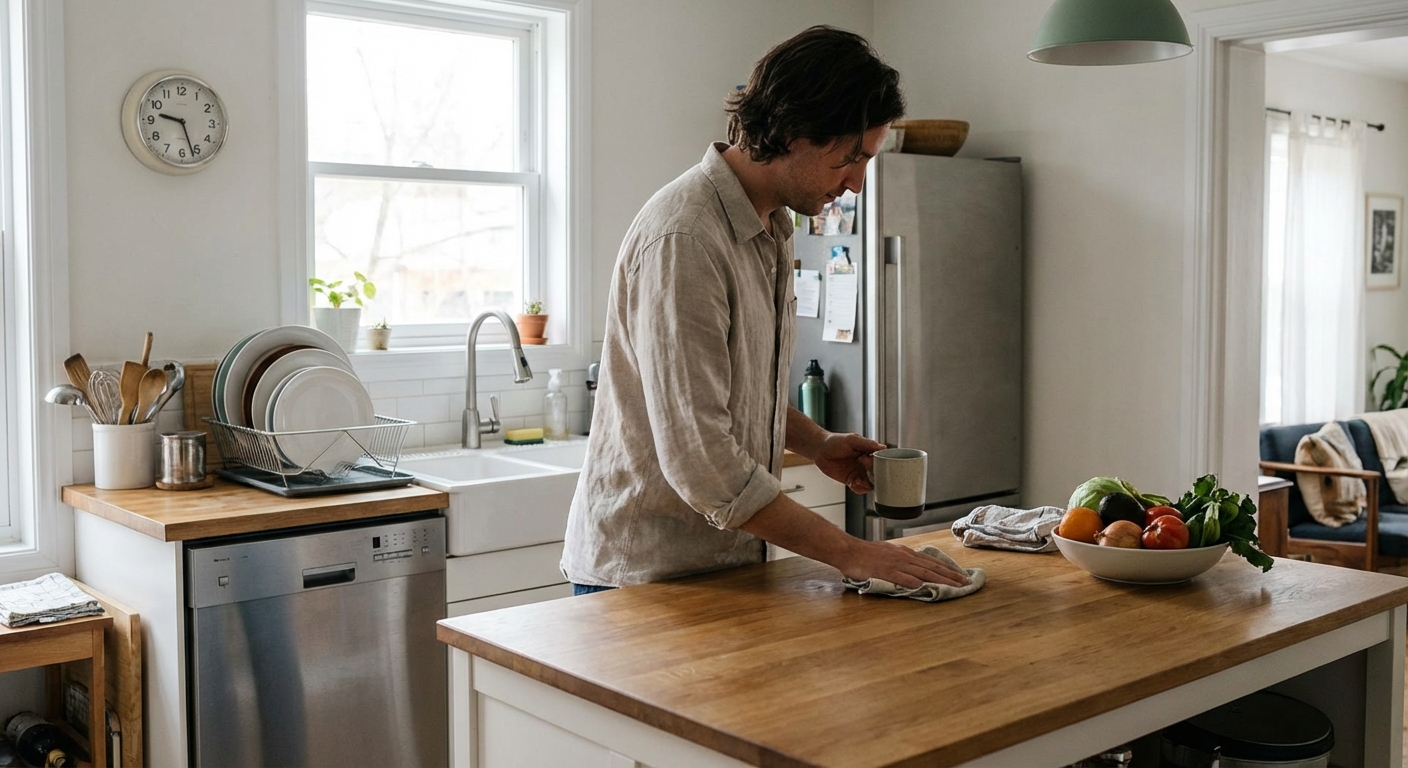
I am here to tell you that this approach is a trap. The "marathon clean" is a recipe for burnout, resentment, and eventual failure. It reinforces the idea that cleaning is a punishment you have to endure rather than a simple tool for a better life.
There is a better way. It doesn’t require an entire Saturday, and it certainly doesn’t require you to enjoy scrubbing grout lines. It requires ten minutes. That is it.
I call it the 10-Minute Reset. It is a hard rule, a strict boundary, and the single most effective way to keep your kitchen from becoming a source of stress. By shifting your mindset from "deep cleaning" to "maintenance," you stop the chaos before it starts. Let’s talk about how to reclaim your kitchen, your evenings, and your sanity.
The Core Idea: Why Time-Capping Works
The biggest enemy of a clean kitchen isn't laziness; it is overwhelm. When you walk into a kitchen piled high with dishes, sticky counters, and overflowing trash, your brain's "CEO"—the prefrontal cortex—checks out. The task feels too big, so you don't start at all. You tell yourself you will do it "later" when you have the energy to do it "perfectly."
That is where the 10-minute hard stop changes the game.
This rule functions by creating a low-friction entry point. You are not committing to scrubbing the baseboards or reorganizing the pantry. You are committing to ten minutes. Anyone can do ten minutes. This simple boundary tricks your brain into starting a task it would otherwise avoid.
It is crucial to understand that perfectionism is the enemy of done. When you uncap the time limit, you allow the scope of the work to expand until it feels impossible. When you cap it at ten minutes, you force yourself to prioritize. You stop worrying about the crumbs behind the toaster and start focusing on the things that actually impact how the room feels.
We know from University of California studies that living in clutter keeps your cortisol levels—your primary stress hormone—elevated throughout the day. A messy kitchen literally keeps your body in fight-or-flight mode. By executing a quick, timed reset, you aren't just cleaning a room; you are biologically down-regulating your stress response.
The 5-Step Kitchen Sprint
To make this work, you need a plan. You cannot spend your ten minutes staring at the mess wondering where to start. You need a tactical workflow designed for maximum efficiency.
Here is the sprint. Set a timer on your phone. Do not negotiate with it.
1. Clear the MIAs (Most Important Areas)
Start exclusively with the sink and the countertops. These are your "Most Important Areas." Visually, these surfaces take up the most space. If they are cluttered, the whole room looks like a disaster zone. If they are clear, the room feels 90% clean, even if the floor is a little dusty. Clear the mail, put away the random spices, and get the clutter off the flat surfaces. This provides an immediate visual reward that reinforces the habit.
2. The Dishwasher Cycle
Spend two minutes—no more—loading or unloading the dishwasher. The sink is the "bed of the kitchen." Just as making your bed transforms the bedroom, clearing the sink transforms the kitchen. If the sink is full of dirty water and plates, the kitchen is closed for business. If the sink is shining, you feel a sense of order. If you can’t finish all the dishes in two minutes, that is fine. Do the big stuff. Pots, pans, plates. Get them out of sight.
3. The Cursory Wipe
Grab your multi-purpose cleaner and do a fast pass over the stovetop and the main counter space. You aren't trying to sanitize a surgical theater here. You are simply lifting the layer of oil and crumbs that settles daily. This prevents that grease from getting "baked on" over time, which is what eventually forces you into those six-day cleaning marathons. A quick wipe today saves you an hour of scrubbing next month.
4. Habit Stacking
You have to anchor this routine to something you already do. If you rely on willpower, you will fail. Your willpower battery is empty by 8:00 PM. Instead, use "habit stacking." This is where you attach the new behavior to an old one.
- "After I start the coffee maker, I do the reset."
- "After I put my phone on the charger for the night, I do the reset."
- "While the evening tea is brewing, I do the reset."
Make it subconscious. It shouldn't be a decision; it should be a reflex.
5. The Trash Audit
Check the bins. If they are near capacity, take them out. Nothing kills the vibe of a clean kitchen faster than "olfactory fatigue"—the smell of old food that you have gone nose-blind to. Taking the trash out is the period at the end of the sentence. It signals that the day is done.
The Science of "Small Wins"
You might look at this list and think, "That doesn't seem like enough." That is exactly the point. It isn't supposed to be a deep clean. It is a psychological scaffold.
When you complete a 10-minute task, your brain releases dopamine. This is the "reward" chemical. It makes you feel capable and in control. This reduces the "dithering" you feel the next day when you walk into the kitchen. Instead of dread, you feel momentum.
There is also a profound benefit to the focus required during this time. When you are washing a dish or wiping a counter, you are engaging in a physical act of order. Focusing on the sensory details—the warmth of the water, the smell of the soap, the friction of the sponge—can actually act as a reset button for your nervous system.
I used to struggle immensely with this "all or nothing" mentality, and not just in the kitchen. Back when I was carrying an extra 110 pounds, I thought the only way to get healthy was to suffer through hours of punishing exercise every single day. Because that was unsustainable, I would quit, binge eat, and start the cycle over. I didn't lose the weight and keep it off by trying to move mountains occasionally. I did it by showing up every single day and doing the small, unglamorous work. I learned that consistency beats intensity every time. The same rule applies to your counters. You don't need a marathon; you need a daily pulse.
2026 Kitchen Sustainability
We are living in 2026, and the tools we use to clean have changed for the better. The aesthetic of cleaning matters because it reduces friction. If your cleaning tools are ugly, toxic, and hidden under a pile of junk in the cabinet, you won't want to use them.
The trend toward intentional storage and refillable glass systems is not just about being eco-friendly; it is about accessibility. When you have a beautiful glass spray bottle and a clean, bamboo scrub brush sitting neatly by the sink, the barrier to starting your 10-minute timer disappears.
Refillable systems reduce the visual clutter of branded plastic bottles screaming for your attention. By simplifying your toolkit to a few high-quality, sustainable items, you make the process feel more like a ritual and less like a chore.
Moving From Chore to Reset
The goal here is to change your vocabulary. Stop calling it "cleaning." Cleaning implies dirt. Cleaning implies drudgery.
Call it a "reset." A reset is a favor you do for your future self. It is a way of closing out the chaos of the day and preparing a blank slate for tomorrow morning. When you walk into your kitchen tomorrow to brew your coffee, you won't be greeted by the failures of yesterday—crusty plates, sticky spots, and bad smells. You will be greeted by stillness and order.
You do not need six days this spring to fix your home. You need ten minutes tonight. Set the timer. Go.