If you’ve ever watched your child stare at a single math problem for forty minutes while the evening slips away, you know the struggle isn’t usually about intelligence. It’s about time perception.
We have entered a new era in education. As of March 2026, major organizations like the AASA (The School Superintendents Association) have launched the "Real Skills for Real Life" initiative. This marks a massive pivot away from pure rote memorization and toward self-regulation. Why the shift? Because teachers are reporting a staggering reality: since 2019, over 70% of educators have seen a sharp rise in student inattention and the inability to self-start tasks.
The old method of standing over your child’s shoulder and saying "focus" every thirty seconds doesn't work. It just creates tension in the household and resentment in the child. Instead, we need to look at the neuroscience of how a developing brain understands—or fails to understand—the passage of time.
There is a specific, process-based method to fix this. It’s not a punishment, and it’s not a reward chart. It is a cognitive "hack" that bridges the gap between how long a child feels a task will take and how long it actually takes.
The Gap Between Estimation and Reality
To understand why homework battles happen, you have to understand the child's brain. Children, and even teenagers, operate largely in "subjective time."
If they are playing a video game, an hour feels like five minutes. If they are asked to write three sentences about a history chapter, five minutes feels like three hours. Their internal clock is governed by dopamine and interest, not by the mechanical ticking of a watch.
This leads to two distinctive problems that ruin their evenings:
- Procrastination: They believe a task will take "forever," so they delay starting it to avoid the pain.
- The Planning Fallacy: When they finally do start, they vastly underestimate how long complex tasks take, leading to late-night panic.
Current data suggests that over 75% of students struggle with procrastination, largely because they lack a dedicated system to measure time objectively. They are flying blind.
The "hack" to fix this is the Time Estimation Exercise. It turns homework from a vague, endless slog into a series of predictable, manageable sprints. It moves the child from subjective time (feelings) to objective time (data).
How to Execute the Strategy
You can start this tonight. It requires no special software, just a piece of paper and a timer. However, the execution matters. You cannot just tell them to "time themselves." You have to guide them through the four-phase process until their brain starts doing it automatically.
Phase 1: The Micro-Breakdown
Most kids freeze up because they look at an assignment book that says "Write Science Report." To a young brain, that looks like a mountain. It’s too big, too vague, and too scary.
You need to teach them Task Analysis. This is the cognitive process of breaking a single "assignment" into its actual sub-components.
Sit down with them and explain that "Do Math" isn't a task. It's a project. Break it down into tangible actions:
- Get out book and notebook.
- Complete problems 1 through 5.
- Check answers for 1 through 5.
- Complete problems 6 through 10.
When the tasks are small, the resistance lowers. "Get out notebook" is easy. Anyone can do that. This prevents the initial overwhelm that causes them to stare at the wall.
Phase 2: The Prediction Game
This is the most critical step. Before they lift a pencil to do the work, ask them to write down a time estimate next to each small task.
Ask them, "How many minutes do you think it will take to do those first five problems? Best guess."
They might say "10 minutes." They might say "30 seconds." It doesn't matter if they are wrong—in fact, it’s better if they are wrong at first. Write their prediction down in a column labeled Estimated Time.
This forces the brain's prefrontal cortex (the CEO of the brain) to engage. They have to assess the difficulty of the work and their own speed. They are no longer passive victims of homework; they are active analysts of it.
Phase 3: Visible Timing
Now, they work. But they don't just work until they are done; they work against a visible clock.
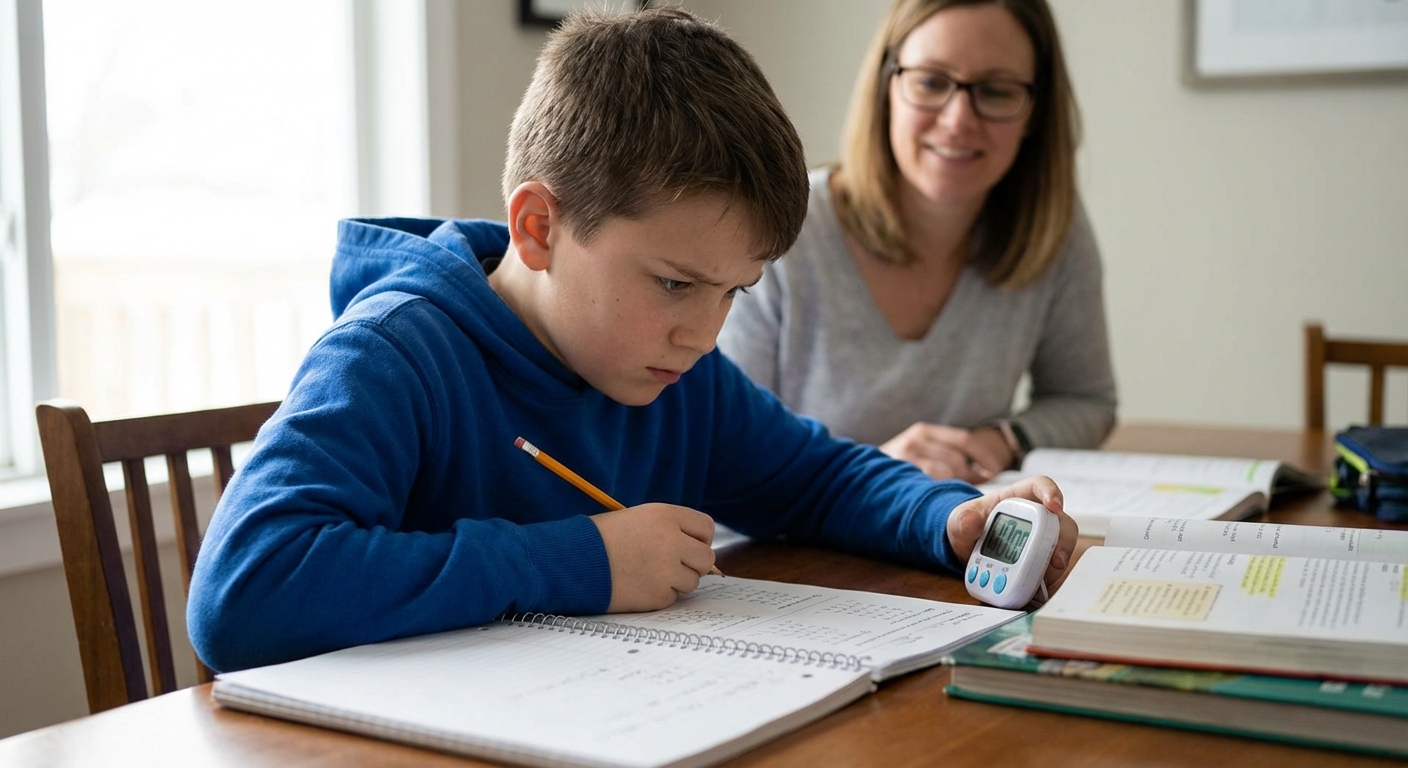
Do not use a phone for this. Phones are portals to distraction. Use a kitchen timer, a stopwatch, or a specific visual timer where a red disk disappears as time passes.
The goal here isn't to rush them into sloppy work. The goal is to make time visible. When a child sees the hand moving or the digital numbers counting up, time becomes a concrete object rather than a vague feeling.
I have found that this creates a "race" mentality that actually boosts dopamine. Instead of dreading the work, they become curious: "Can I actually beat my time?"
Phase 4: The Post-Mortem
Once the task is done, look at the clock. Write the Actual Time next to the Estimated Time.
Compare the two numbers.
- Did they predict 10 minutes, but it only took 4? Great! Point out that the task wasn't as painful as they feared.
- Did they predict 5 minutes, but it took 20? Also great. Now you can discuss why. Did they get distracted? Was the material harder than expected?
This reflection is where the learning happens. It builds the executive function skill of "Self-Monitoring." Over time, their predictions will become frighteningly accurate.
Why This Rewires the Brain
You might think this sounds like a lot of extra work for a simple worksheet. But we aren't just trying to get the worksheet done; we are trying to build a brain that can function in the adult world.
This method directly combats the "Planning Fallacy"—the human tendency to be optimistic about how fast we can work. This isn't just a kid problem; it's a human problem.
I used to struggle with this myself significantly. As a web developer juggling multiple client projects, I would consistently underestimate how long a "quick fix" would take. I’d promise a client an update by noon, thinking a coding change would take twenty minutes, only to find myself still debugging at 5 PM, stressed and behind schedule. It wasn’t until I started strictly logging my predicted vs. actual hours that I learned to scope my work properly. I had to see the data to break the delusion.
Your child is facing the same battle, just with algebra instead of code. When they realize that a "huge" assignment actually only takes 12 minutes of focused work, the anxiety surrounding homework collapses.
This strengthens the brain's executive functions—specifically working memory, inhibitory control, and cognitive flexibility. By treating time as a resource to be managed rather than an enemy to be fought, you are giving them a tool that scales.
Scaling for Future Success
The beauty of this "hack" is that it grows with the child.
In third grade, it helps them get through a spelling sheet without crying. By high school, it helps them break down a term paper into research, drafting, and editing phases over two weeks. By the time they hit the labor market in the late 2020s or 2030s, they will possess the autonomy to manage complex workflows without a boss hovering over them.
We know that the ability to handle "multitasking pressure" and self-regulate is a primary predictor of career success. We also know that brain plasticity is highest during these "breakthrough years" (ages 4–12).
If you can teach your child to respect the clock and understand their own capacity now, you aren't just solving a Tuesday night homework problem. You are handing them the keys to a disciplined, low-stress life.
Start small. Break it down. Make them guess. Watch the timer. The results will speak for themselves.