

You are late. You pat your pockets. Nothing. You check the kitchen counter. Nothing. The panic sets in, your heart rate spikes, and suddenly your morning is ruined because of a small piece of metal.
We need to fix this, right now.
The average person wastes about two and a half days every single year just looking for lost items. That is an incredible amount of time to spend frustrated, sweating in your coat while the clock ticks down. But here is the good news: losing your keys isn't a symptom of a failing memory or a "scatterbrained" personality. It is simply a spatial design flaw in your home.
As of early 2026, we are seeing a massive shift in how professional organizers approach these problems. The trend is moving away from purely aesthetic organization and toward "frictionless entryways." The goal isn't just to make things look pretty; it is to lower your blood pressure the moment you walk through the door.
I have spent years optimizing my own life and workflow, and I can tell you that the solution to the key hunt is not about trying harder to remember. It is about building a system that remembers for you.
The "Landing Strip" Methodology
The core concept used by interior experts to manage entryways is often called the "Launchpad" or the "Landing Strip." If you think about an airport, planes do not just land wherever the pilot feels like parking. They have a designated, non-negotiable strip of tarmac where they transition from flight to ground.
Your keys need the same thing.
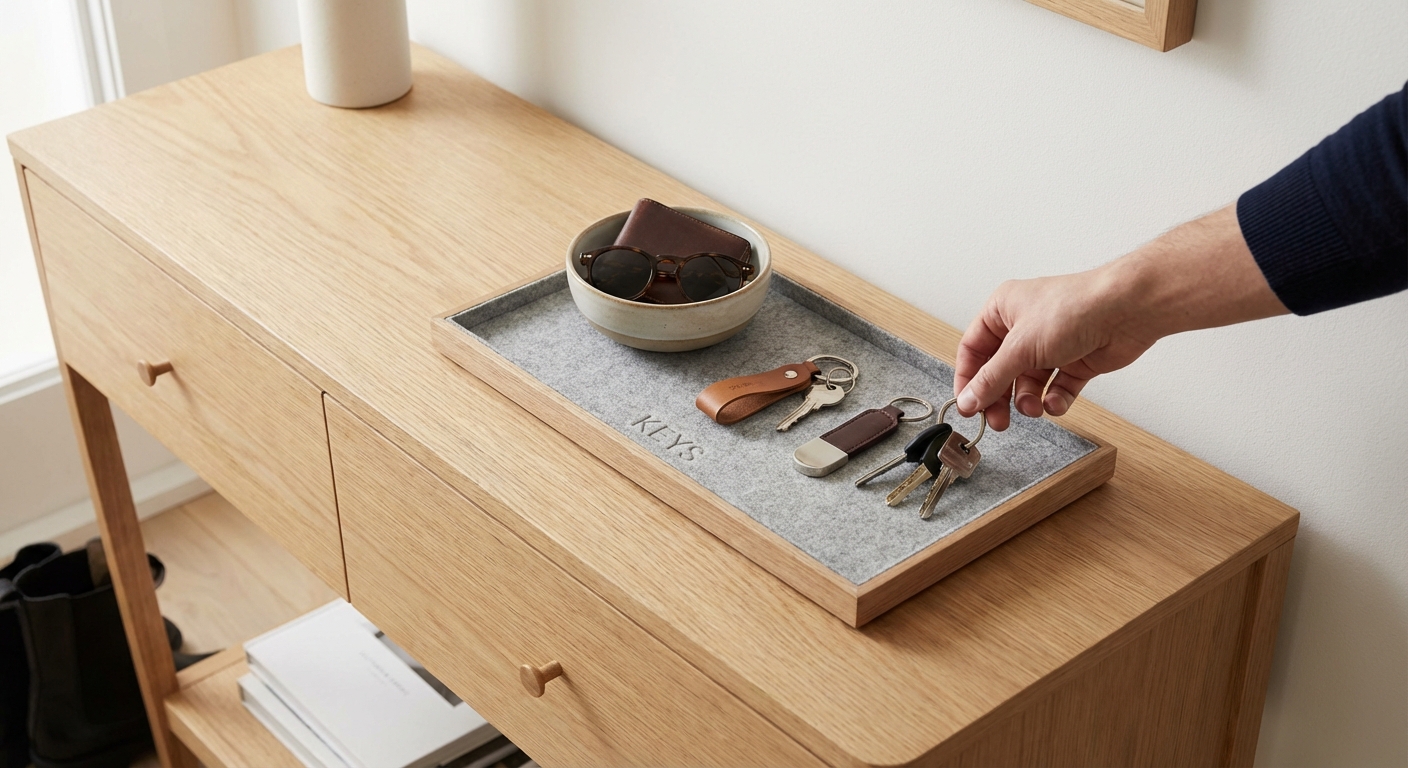
The Landing Strip is a dedicated zone located within arm's reach of your primary entrance. This is where your essential transition items—keys, wallet, phone, sunglasses—must live. It is not a suggestion; it is a rule of physics for your home.
The mistake most people make is treating their entryway as a hallway. It isn't a hallway. It is a transition chamber. It is the airlock between the chaos of the outside world and the sanctuary of your home. When you treat this space casually, you invite chaos into your living room.
When you enter your home, you are usually carrying things. Your mind is often still at work, or you are thinking about what to cook for dinner. You are not present. Because you are distracted, you put your keys down on the first available flat surface. Sometimes that’s the dining table, sometimes it’s the kitchen island, and sometimes it’s the top of the washing machine.
The Landing Strip methodology creates a "Point-of-Performance" storage solution. This means the storage is located exactly where the action happens. You don't store your toothbrush in the kitchen, so why do you store your keys on the dining room table? The action of "entering" happens at the door, so the storage must happen at the door.
Step-by-Step Implementation
You don't need to buy expensive furniture or remodel your hallway to make this work. You just need to follow three specific rules that professional organizers use to foolproof this system.
1. The "One-Step" Rule
This is the most critical rule. Your key storage must be located within one single step of your door handle.
If you have to walk five steps into the living room to put your keys away, the system will fail. If you have to open a closet door to hang them up, the system will fail. If you have to walk around a corner, the system will fail.
Why? Because human beings are efficiency machines. If we are tired, or carrying three bags of groceries, or rushing to the bathroom, we will not take those extra five steps. We will drop the keys on the nearest surface "just for now." And "just for now" is exactly how they get lost.
I used to struggle with this. I lost 110 pounds a few years ago, and one of the biggest lessons I learned during that journey was that relying on willpower is a trap. I didn't lose the weight because I had an iron will every single day; I lost it because I built systems that made the healthy choice the easiest choice. The same logic applies here. If putting your keys away requires effort, you won't do it. The "home" for your keys must be so close to the door that it is actually harder to walk past it than to use it.
2. Use a "High-Boundary" Container
Do not use a flat table or a shelf. Flat surfaces are clutter magnets. If you have a flat entry table, it will inevitably become a graveyard for junk mail, receipts, and loose change. Your keys will get buried under a flyer for a pizza place, and you will lose them again.
Instead, you need a "High-Boundary" container. This means a bowl, a deep tray, or a specific box.
There is a sensory reason for this. When you drop your keys into a ceramic bowl, they make a distinct noise. Clack. That auditory feedback, combined with the physical action of releasing the keys into a contained space, provides a sensory anchor. Your brain registers the action as "complete."
A high-boundary container also visually separates your keys from the rest of the clutter. Even if you toss a receipt in there, the keys remain contained in their specific vessel. They aren't floating in a sea of paper; they are in their boat.
3. Habit Stacking
Once you have the bowl placed within one step of the door, you need to program your brain to use it. We do this through a technique called Habit Stacking.
You already have a habit you perform every time you come home: you lock the door. That habit is non-negotiable. You likely do it without even thinking.
You need to "stack" the new habit (dropping the keys) on top of the old habit (locking the door). The sequence must be immediate:
- Turn the deadbolt.
- Drop the keys.
Do not take off your shoes first. Do not greet the dog first. Do not check the mail. Lock, then drop. By pairing these two actions, the second one eventually becomes just as automatic as the first.
The Psychology of Retrieval
Why does this work so much better than just "trying to remember"? It comes down to how your brain manages energy.
Your brain has a limited amount of decision-making power each day. The part of your brain responsible for complex thought and decision-making—the "CEO" of your brain—gets tired just like you do. By the time you get home from work, your CEO is exhausted. It doesn't want to make decisions about where to put small metal objects.
When you don't have a designated spot for your keys, your brain has to make a micro-decision every time you walk in the door: "Where should I put these?"
If your brain is tired, it skips the decision and defaults to the path of least resistance. That is how keys end up in the pocket of yesterday's jeans or between the couch cushions.
By establishing a Landing Strip, you remove the decision entirely. You are moving the task from the decision-making part of your brain to the habit-forming part of your brain (the basal ganglia).
Professional organizers use a mantra called "Don't Put It Down, Put It Away." But that only works if "Away" is convenient. When you use the Launchpad concept, you are hacking your own psychology. You are preventing "clutter blindness," which is what happens when your brain starts to ignore items that are left in random locations.
Conclusion
The trick to never losing your keys again isn't about buying a Bluetooth tracker or doing memory exercises. It is about respecting your own cognitive limits.
You have enough to worry about. You have a job, a family, and a life to manage. You shouldn't have to waste your precious mental bandwidth tracking the location of your car keys.
Set up your Landing Strip today. Find a bowl. Clear a spot within one step of your door. Commit to the "lock and drop" routine. It is a small change in your environment that creates a massive shift in your daily peace of mind. Stop searching, and start living.
