You look in the mirror. You are wearing a nice shirt and a solid pair of jeans. Everything fits. Nothing is stained. Yet, when you look at your reflection, the outfit feels incredibly boring.
You don't look bad, but you certainly don't look "finished." You look like you just put on clothes to avoid being arrested for public indecency. This is the common struggle between being covered and being styled.
We often assume that people who look effortlessly put-together possess some innate artistic talent that we lack. We think they have an eye for fashion that you have to be born with. But the reality is much more pragmatic. They aren't using magic; they are using math.
Specifically, they are using a formula known in the industry as the "Third Piece Rule."
As Paris Fashion Week 2026 wraps up, we are seeing a distinct shift in street style. The chaos of maximalism is fading. In its place, we are seeing highly polished, tailored looks. The trend is moving back to intentional structure—blazers, specific color pops, and definitive finishing touches.
This return to classic styling highlights why the Third Piece Rule is so effective. It is the secret weapon used by major retailers like Nordstrom, Madewell, and Banana Republic to train their floor staff. It is a simple, actionable framework that takes the guesswork out of getting dressed and turns a collection of clothes into a cohesive look.
The "Third Piece" Philosophy
The core philosophy here is simple: A top and a bottom equal a functional necessity. A top, a bottom, and a third element equal an outfit.
When you wear just a t-shirt and jeans, or a blouse and slacks, you are in the realm of the functional. You have met the basic societal requirement of clothing your body. This is often referred to as a "1 + 1" outfit. It is flat. It lacks depth. It tells the world that you got dressed because you had to, not because you wanted to present yourself in a specific way.
The Third Piece Rule dictates that for an outfit to feel "styled," you must add a third element to that base. This third piece acts as the anchor. It provides the visual interest that tricks the eye into seeing a complete thought rather than just separate garments.
Retailers have used this for decades because it works psychologically. When a sales associate at a high-end store helps you, they are almost always wearing a third piece—a blazer, a statement necklace, or a cardigan. This isn't an accident. It projects authority, competence, and attention to detail.
When you adopt this philosophy, you stop looking at your closet as a pile of shirts and pants. You start seeing it as a toolkit for building structure. It shifts your mindset from "covering up" to "showing up."
Practical Steps to Mastering the Rule
You do not need to buy a new wardrobe to make this work. You likely have everything you need right now. The key is simply rearranging how you layer these items.
Here is the step-by-step process to building a look using this rule.
1. Establish Your Foundation
Every house needs a foundation, and every outfit needs a base. Your first two pieces are your non-negotiables.
- The Top: This is your t-shirt, button-down, blouse, or sweater.
- The Bottom: This is your denim, trousers, or skirt.
Note that if you are wearing a dress or a jumpsuit, this single item counts as both Piece 1 and Piece 2 combined. It creates the entire base of the silhouette on its own.
2. Select Your "Hero" Piece
This is where the magic happens. You need to choose an item that adds texture, color, or structure to the foundation. This item effectively "completes" the equation.
Common choices for the third piece include:
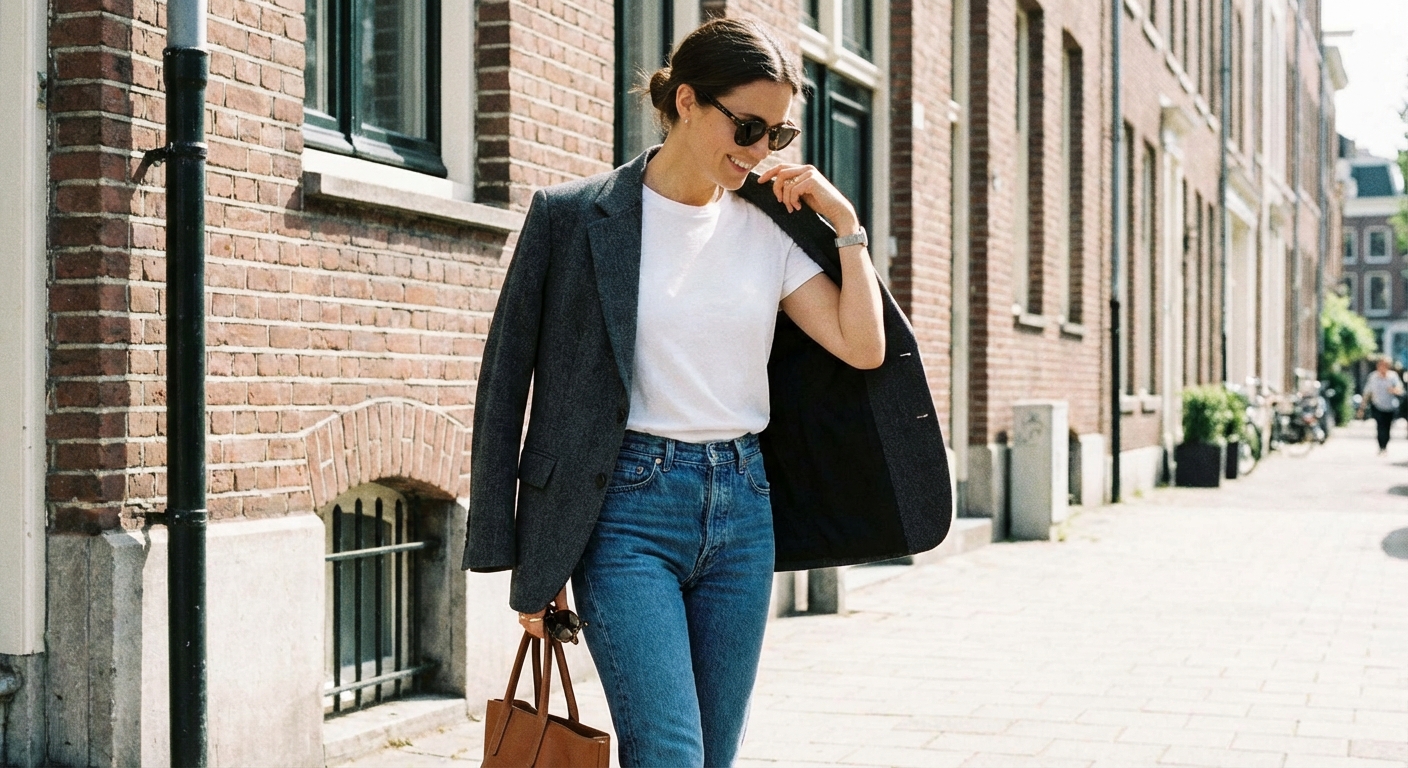
- Outerwear: A denim jacket, a leather moto jacket, a trench coat, or a blazer.
- Knitwear: A cardigan or a pullover sweater draped over the shoulders (a classic preppy move).
- Accessories: This is crucial for warmer weather. A statement belt, a silk neck scarf, or a hat can serve as the third piece.
I remember when I finally understood the power of this layer. Years ago, I lost 110 pounds. For a long time after, I was terrified of drawing attention to myself. I stuck to the absolute basics—baggy grey t-shirts and loose jeans. I thought I was being safe, but I just looked unfinished. I felt invisible.
One day, I forced myself to put on a structured, dark denim jacket over my usual grey shirt. It was a small change, but the difference was immediate. I wasn't just "the guy who lost weight" anymore; I looked like a person with intent. That third piece gave me a strange sense of armor. It made me stand taller. It turned a "covering" into an identity.
3. Ensure Visibility
For the rule to be effective, the third piece must be part of the outfit, not just something you carry. Carrying a coat over your arm doesn't count.
The third piece needs to frame your silhouette. If you are wearing a blazer, it creates vertical lines that break up the torso, which is often more flattering than a solid block of fabric. If you are using a statement necklace as your third piece, it draws the eye up to your face, creating a focal point.
The goal is to create a cohesive visual narrative where all three elements interact with one another.
Why It Works
You might be wondering why adding a scarf or a jacket makes such a profound difference. It comes down to how the human brain processes visual information.
The Power of Odd Numbers
Our brains are wired to find groups of three more engaging than groups of two. In design, photography, and writing, the "Rule of Three" is a fundamental principle. A pair creates symmetry, which can be pleasing, but it can also be static and boring. A group of three creates a dynamic imbalance that forces the eye to move around the image.
In fashion, three pieces create a "layered" look. This layering suggests dimensionality. A flat outfit (1 + 1) has no foreground or background—it is just surface. Adding a third piece creates depth. It implies that you thought about the weather, the color coordination, and the silhouette.
Proportion and Balance
The third piece is also a tool for correcting proportion. If you are wearing wide-leg trousers and a tight top, the outfit might feel bottom-heavy. Adding a structured jacket can broaden the shoulders and balance out the width of the pants.
If you are wearing a monochrome outfit—black pants and a black shirt—you risk looking like a stagehand. Adding a camel trench coat or a textured belt breaks up the monotony and defines the waist. It prevents the "blob" effect where the body loses its definition in a sea of single-colored fabric.
The 3-3-3 Minimalist Framework
If you are reading this and thinking, "I don't have enough clothes to do this," let's look at the capsule wardrobe approach. The Third Piece Rule is highly compatible with minimalism, specifically through the "3-3-3 Rule."
This framework challenges you to select:
- 3 Tops
- 3 Bottoms
- 3 Pairs of Shoes
By mixing and matching these nine items—and applying the Third Piece Rule (using the shoes or layers as the variant)—you can create over 27 unique combinations.
This approach emphasizes versatility over volume. You don't need a closet bursting with fast fashion to look stylish. You need items that play well together. If your three tops are neutral (white, black, gray) and your third pieces are textured (a tweed blazer, a chunky knit cardigan, a leather jacket), you have infinite options.
This is particularly useful for travel. Instead of packing "outfits," pack a 3-3-3 capsule. You will save luggage space and eliminate the decision fatigue that comes with having too many mismatched options.
Conclusion
Style is often mistaken for a status symbol, something reserved for those with unlimited budgets and leisure time. But true style is a skill. It is the application of discipline and geometry to the way you present yourself to the world.
The Third Piece Rule is the most pragmatic tool you can use to sharpen that skill. It requires no money to start—just a willingness to experiment with what you already own.
Tomorrow morning, when you put on your pants and shirt, pause. Look in the mirror. Don't leave the room yet. Grab a belt. Throw on a vest. Tie a sweater around your shoulders. Add that third element. You will notice the shift immediately. You won't just look dressed; you will look ready.