The golden age of "luggage leniency" is officially dead. If you have flown recently, you know exactly what I mean. As of March 2026, the operational contract between you and the airline has shifted dramatically. The days of smiling at a gate agent and charming your way past the size limits with a bulging roller bag are over. Those new automated scanners at the gates don't care about your charm, and they don't negotiate. They measure dimensions to the millimeter, and if your bag is swollen, you are paying.
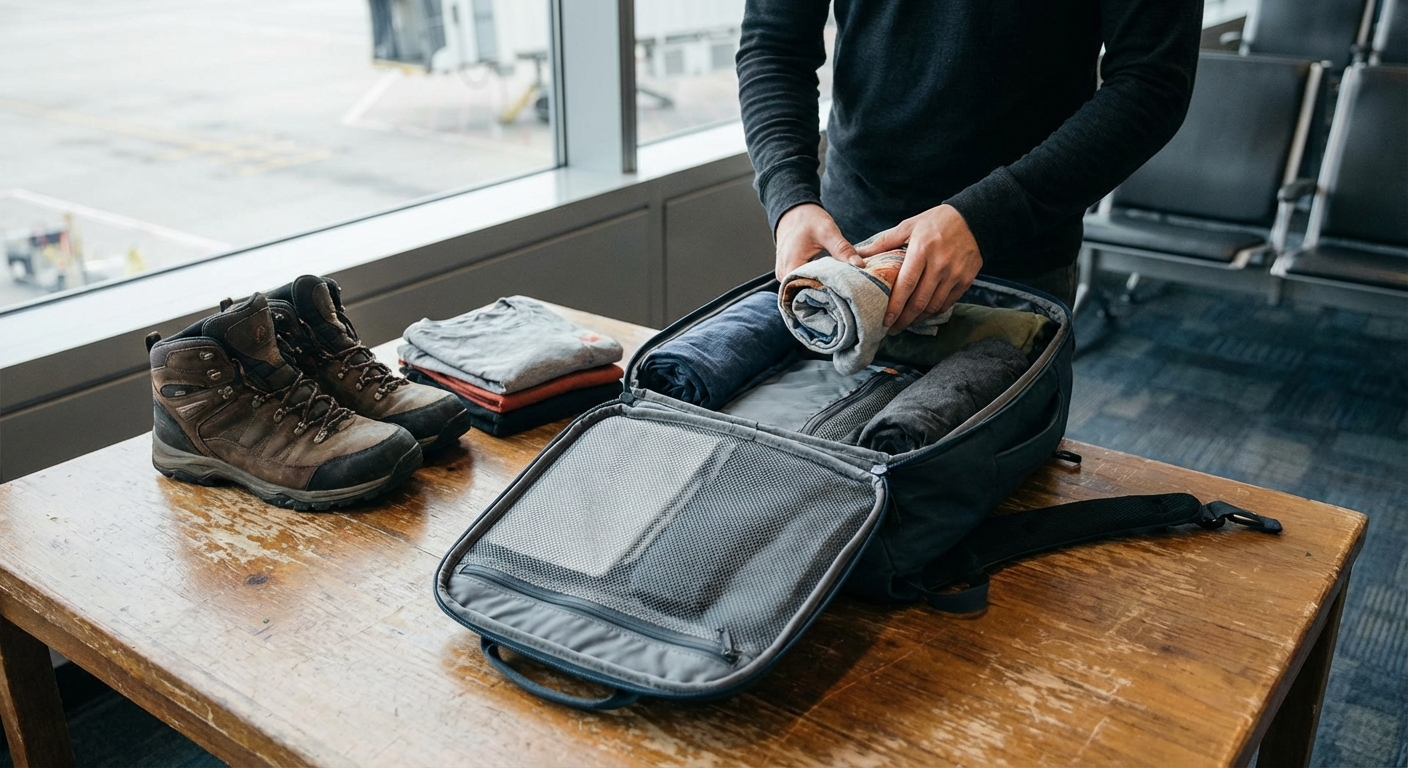
We are seeing a travel landscape where "carry-on" is no longer a right; it is a privilege guarded by strict enforcement. But the real cost isn't just the surprise fee—which, by the way, contributed to a record $6.8 billion for U.S. airlines recently. The real cost is the mental tax you pay from the moment you start packing until the moment you unpack.
Most people view the "one-bag" method as a sacrifice. They see it as a limitation, a way to save fifty bucks at the expense of comfort. They are wrong. Switching to a single 22x14x9 carry-on isn't about saving money, though that is a nice bonus. It is about fundamentally redefining what luxury means. Real luxury isn't having six pairs of shoes for a weekend trip; real luxury is walking right past the baggage claim carousel while three hundred other people stand there anxiously watching an empty conveyor belt spin.
The Philosophy of Mobility
We need to have an honest conversation about why we overpack. It usually has nothing to do with the weather at our destination and everything to do with fear. We pack for the "what ifs." What if it rains? What if I get invited to a formal dinner? What if I spill coffee on my shirt? This mindset is "just-in-case" preparedness, and it is a trap. It forces you to carry the physical weight of your anxiety on your back.
When you pack for every possible contingency, you are essentially telling yourself that you don't trust your ability to handle a situation if it arises. You become a logistics manager for your own stuff rather than a participant in your journey.
I view this through a very specific lens because I used to carry a different kind of baggage. Years ago, I lost 110 pounds. Before that weight loss, every movement was a calculation. Walking up stairs was a chore; fitting into spaces was stressful; simply moving through the world required extra energy that I didn't have. When I finally dropped that weight, the physical sensation of lightness was overwhelming. I realized that for years, I had been making life infinitely harder for myself by carrying a burden I didn't need.
Traveling with heavy luggage is the exact same sensation, only voluntary. When you are hauling fifty pounds of gear you might not use, you are physically manifesting a lack of freedom. You are tethered to your stuff. If you want to change your plans, you can't. If you want to sprint for a train, you can't. The things you own end up owning you.
By stripping your kit down to the absolute essentials, you reclaim that energy. You stop worrying about where to stash your bag or if it was stolen. As the psychologist Michael Brein points out, traveling light turns the trip back into a lived experience rather than a series of logistical problems to solve. You become present. You stop guarding your fortress of bags and start looking at the world around you.
The 54321 Framework
The biggest hurdle to one-bag travel isn't desire; it's the "how." How do you actually fit a week or two of life into a single backpack without looking like a mess? You need a system. Discipline beats motivation every time, and the discipline here is the 54321 method.
This is the capsule framework that solves the paradox of choice. Decision fatigue is real; your brain has a limited amount of "executive function" fuel each day. If you burn half a tank deciding what to wear in the morning, you have less patience and focus for the rest of your day. By limiting your options, you actually increase your freedom.
Here is the formula for a versatile travel capsule:
- Five Tops: These are your core layers. Think t-shirts, button-downs, or blouses. They must all coordinate with your bottoms. If a top only matches one pair of pants, it stays home.
- Four Bottoms: This includes the pair you wear on the plane. Pants, shorts, or skirts. Darker colors are generally better because they hide stains and look dressier in a pinch.
- Three Pairs of Shoes: This is where most people fail. You wear your bulkiest pair (usually boots or heavy sneakers) on the plane. You pack a walking shoe and a nicer shoe (or sandals, depending on the climate). Three is the hard limit.
- Two Layering Pieces: A hoodie, a blazer, a cardigan, or a light jacket. These are for warmth and for changing the "vibe" of an outfit from day to night.
- One Set of Accessories: This creates your variety. A hat, a scarf, a belt, or a specific piece of jewelry.
This combination creates over 200 potential outfit variations. You could travel for months and never wear the exact same combination twice. The math works. The constraint breeds creativity.
Gear and Fabric Strategy
The 54321 method only works if you choose the right tools. If you pack five heavy cotton t-shirts, you are going to smell, and your bag is going to be heavy. Cotton is the enemy of the one-bag traveler. It absorbs moisture, holds onto odors, takes forever to dry, and wrinkles if you look at it wrong.
To make this work, you have to prioritize high-performance fabrics. You want materials that work as hard as you do.
- Merino Wool: This is the gold standard. It is naturally anti-bacterial and odor-neutralizing. You can wear a Merino wool shirt three or four times before it even begins to need a wash. It regulates body temperature, keeping you cool in the heat and warm in the cold. It dries overnight in a hotel bathroom.
- Bamboo and Synthetics: If wool isn't your thing, look for bamboo blends or high-quality technical synthetics designed for compression and moisture-wicking.
Once you have your gear, you have to apply the "Three-Use Rule." This is the gatekeeper. Before any item goes into your bag, ask yourself: Will I use this at least three distinct times? If you are packing a swimsuit but only plan to hit the beach once, rent a suit there or go without. If you are packing high heels for one specific dinner, leave them. If the item does not serve multiple purposes, it is dead weight.
Finally, you must master the "Personal Item Vault." Airlines are strict about the overhead bin, but the space under the seat in front of you is your safety net. Use a small daypack or messenger bag as your personal item. This is where you keep your absolute essentials: medication, electronics, passport, and one change of socks and underwear.
Why? Because even if you follow all the rules, sometimes a flight is completely full, and the gate agents force a "gate check." If your main bag gets tossed into the cargo hold, you do not want your laptop or your heart medication going with it. Treat the personal item as your survival kit. It ensures that even in the worst-case scenario—which happens to 0.4% of bags, but feels like 100% when it's yours—your journey is not disrupted.
Redefining Luxury
We are conditioned to believe that "more" equals "better." We think that having options is the ultimate freedom. But when you are three thousand miles from home, dragging a fifty-pound suitcase over cobblestones because you wanted the option of a third formal outfit, you realize that "more" is actually a prison.
There is a profound silence and stillness that comes with traveling light. It is a form of discipline that bleeds over into the rest of your life. When you realize you can live happily for two weeks with just fifteen items, you start looking around your house differently. You start wondering why you are storing, cleaning, and insuring so much junk that you never use.
The one-bag method changes how you see your possessions. It teaches you that your security does not come from your inventory. It comes from your adaptability. It comes from your willingness to engage with the world as it is, rather than trying to insulate yourself from it with layers of cotton and polyester.
Travel is risky. International flights have an eight-times higher risk of baggage loss than domestic ones. The variables are endless. But when you keep everything you need on your back, you remove the biggest variable of all. You opt out of the system. You walk past the carousel, out the sliding doors, and into the world. That is the only luxury worth paying for.