

If you have spent any time online lately, you have probably heard someone dismiss the Enneagram as "astrology for intellectuals" or a parlor game for people who love to talk about themselves. I used to fall into that camp. It is easy to roll your eyes when people start reducing their entire existence to a single number.
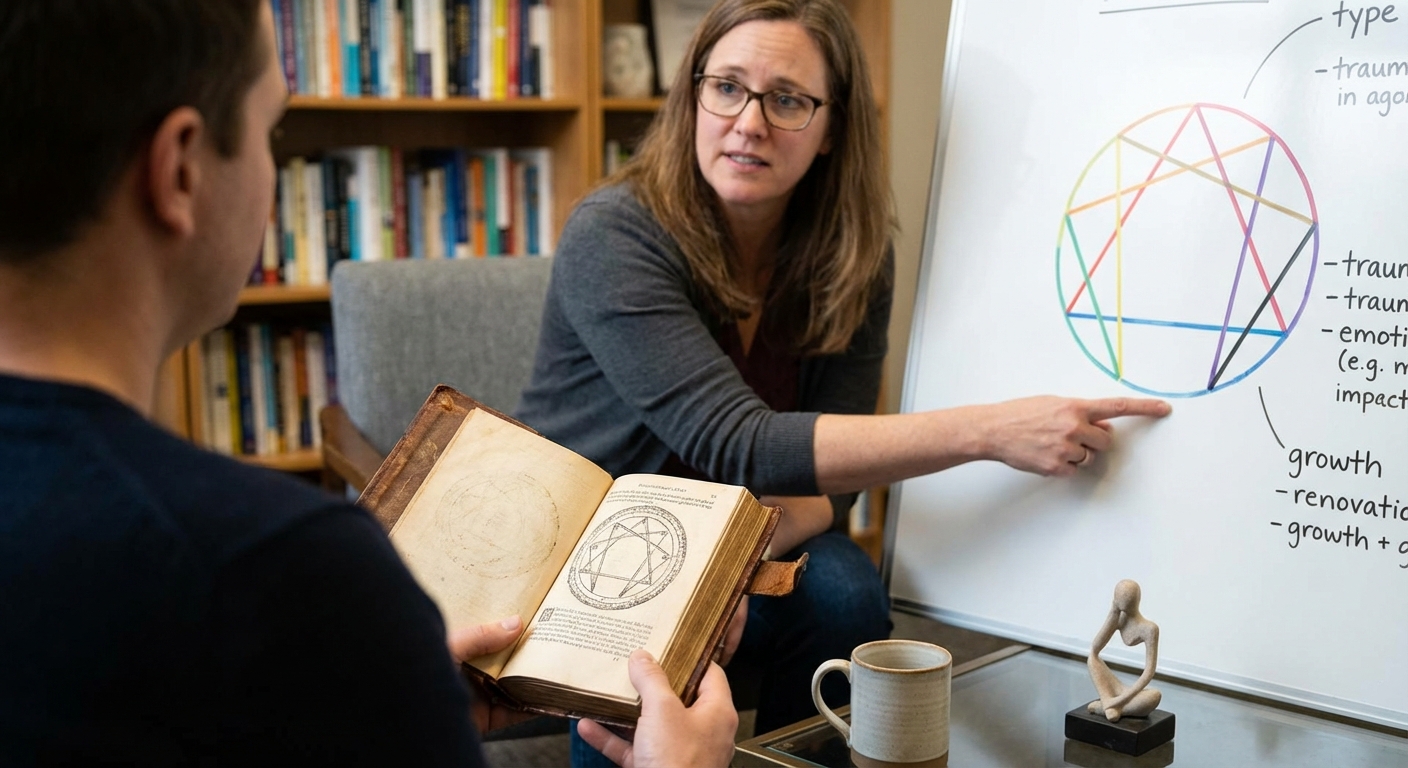
But if you look past the memes and the Instagram graphics, you find something much more substantial. As of March 2026, we are seeing a massive shift in how this tool is viewed. The Psychotherapy Networker Symposium in Washington, D.C., is featuring workshops that pair the Enneagram with Internal Family Systems (IFS) to map the "inner architecture of personality." This isn't about putting you in a box; it is about trauma-informed care. It is about understanding the defenses you built to survive.
To really use this tool, you have to respect where it came from. It didn't pop out of a marketing meeting in the 1990s. It is a synthesis of ancient mathematical laws, desert spirituality, and modern psychiatry. Understanding this history changes the way you look at your "number." It stops being a label and starts being a map out of the woods.
The Ancient Roots of the Symbol
The origins of the Enneagram are murky, which adds to its mystique, but we can trace two distinct threads: the geometry and the psychology.
The symbol itself—the circle, the triangle, and the hexad (that twisted figure-eight shape)—is deeply rooted in mathematics. Many historians point to Pythagoras in the 6th century BC. He wasn't just a math teacher; he was looking for the fundamental laws that govern reality. He used numerical symbolism to describe the universe. The idea was that specific numbers held specific energies or laws.
However, the psychological content—the descriptions of the vices and passions—comes from a completely different source: the Christian desert tradition.
In the 4th century, a monk named Evagrius Ponticus lived in the Egyptian desert. He was a master of observation. He spent his life in silence and prayer, watching the way the human mind wanders and attacks itself. He identified eight "logismoi," or pattern of intrusive thoughts, that distract a monk from their purpose.
These eventually evolved into what the Western world knows as the Seven Deadly Sins (plus fear/deceit). Evagrius wasn't trying to create a personality test. He was identifying the specific "demons" or mental traps that keep us from stillness and connection with the Divine. When you read the descriptions of the Enneagram types today, you are reading a modern adaptation of these ancient warnings against spiritual sleep.
It Wasn't Originally About Personality
Here is the twist that most people miss: for a long time, the Enneagram had nothing to do with personality types.
In the early 20th century, a man named George Ivanovich Gurdjieff brought the symbol to the West. Gurdjieff was an enigmatic figure, a teacher of what he called "The Work." He didn't use the Enneagram to tell you if you were a Helper or an Achiever. He used it as a process model.
Gurdjieff taught that the Enneagram was a "universal hieroglyph." He believed it represented two fundamental cosmic laws:
- The Law of Three: The three forces required for any creation (affirming, denying, and reconciling).
- The Law of Seven: The process of transformation, like the musical octave.
For Gurdjieff, the symbol was dynamic. It showed how a project, a melody, or a human life evolves through time. It showed where things get stuck (the intervals) and where they need a "shock" or new energy to keep going. He famously said that "all knowledge can be included in the enneagram."
He wasn't interested in categorizing your ego. He was interested in waking you up. He believed most people live their lives in a state of waking sleep, reacting mechanically to the world. The Enneagram, in his hands, was a tool to understand the movement of energy, not a list of character traits.
Turning the Symbol into a Mirror
The transition from a cosmic process map to a personality typology happened in the mid-20th century. This is where the modern era begins.
In the 1950s and 60s, a Bolivian philosopher named Oscar Ichazo developed a system he called "Protoanalysis." He took the ancient symbol and the "passions" (derived from those desert monks) and mapped them onto the nine points of the Enneagram. Ichazo is the one who gave us the concept of "ego-fixations." He saw the nine types not as who we are, but as the false identities we adopt because we have lost contact with our essence.
Then came Claudio Naranjo, a Chilean psychiatrist. If Ichazo built the car, Naranjo put the engine in it and drove it to California.
Naranjo was a brilliant synthesizer. He took Ichazo’s insights and correlated them with Western psychiatric frameworks. He looked at the DSM (Diagnostic and Statistical Manual of Mental Disorders) and mapped the Enneagram types to specific neuroses and defense mechanisms.
For example, he looked at Type 1 and saw the obsessive-compulsive personality. He looked at Type 9 and saw the dependent or resigned personality. Naranjo validated the system in the eyes of Western psychology. He moved it from the realm of esoteric philosophy into the clinic. He taught that our "type" is essentially a crystallization of our childhood defense mechanisms. It is the armor we put on to survive our early environment.
From Mysticism to Mental Health
This brings us to where we are today. The Enneagram is currently undergoing a massive surge in clinical adoption. We are moving past the pop-psychology era into a time of rigorous application.
Modern therapists are realizing that behaviorism—looking only at what people do—isn't enough. You have to understand why they do it. This is where the Enneagram shines compared to other models like the Big Five. The Big Five measures traits (e.g., how extroverted are you?). The Enneagram reveals motivations (e.g., why are you extroverted? Is it to be liked, to control the room, or to avoid your own inner silence?).
I know this distinction intimately. Years ago, I lost 110 pounds and finally stopped a cycle of binge eating that had plagued me for a decade. For years, I tried to fix the behavior with diets and strict rules. I treated it like a math problem. But the weight always came back. It wasn't until I looked at the underlying engine—the emotional hunger and the specific way my ego used food to numb out stress—that I actually changed. I had to understand the mechanism of the fixation, not just the symptom on the scale.
That is what is happening at the 2026 symposiums. Clinicians are integrating the Enneagram with Polyvagal Theory (the science of safety and the nervous system) and Internal Family Systems. They are using the map to help clients befriend their nervous systems.
If you are a Type 8 (The Challenger), your aggression isn't just a "trait." It is a biological response to feeling vulnerable. If you are a Type 2 (The Helper), your over-giving is a survival strategy to ensure you aren't abandoned.
A Living System
There is still a lot of debate about the scientific validity of the Enneagram. Critics point out that it lacks the statistical clustering found in the Big Five. And they are right—it is hard to measure "unconscious motivation" in a lab.
But in the pragmatic world of self-improvement and therapy, utility often trumps raw data. The Enneagram persists because it works. It provides a vocabulary for internal states that are otherwise hard to describe.
We have come a long way from the desert caves of Egypt and the secret schools of Gurdjieff. The Enneagram has evolved from a tool for spiritual contemplation into a descriptive psychological system. It invites you to stop identifying with your armor and start understanding the person underneath it. It is not about finding your number so you can wear it like a badge. It is about finding your number so you can finally stop being run by it.

See also in Personal Growth
30 Networking Event Success Tips
The Bystander Effect and Why You Shouldn’t Wait for Others to Act
Why Therapists Say People-Pleasing Is a Trauma Response
15 Strategies for Setting and Achieving Goals
20 Tips for Building a Strong Personal Foundation
Oxytocin Research Reveals Why Hugging for 20 Seconds Changes Your Mood