

It is March 2026, and if you are paying attention to the cultural mood, you have probably noticed a strange contradiction. The self-help industry has exploded into a $45 billion behemoth. You cannot scroll through a feed or walk through an airport bookstore without being bombarded by promises of optimization, productivity, and the secrets to a perfect life. Yet, simultaneously, our collective well-being is tanking.
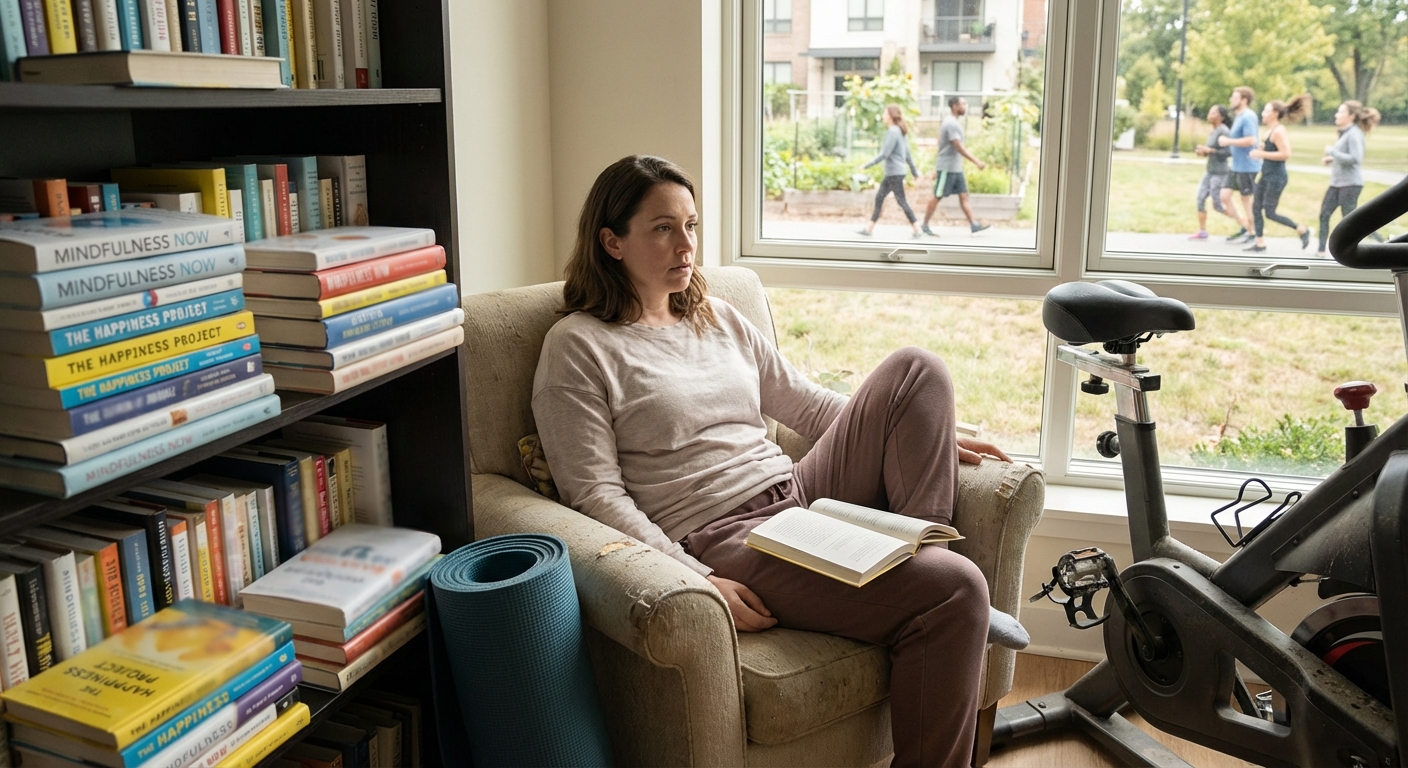
Recent data paints a grim picture: American well-being scores have dipped to 54 out of 100, driven by a massive surge in fear and worry. We are consuming more "answers" than ever before in human history, yet we seem to have more questions—and more anxiety—than ever.
This is the "wellness paradox." The more we obsess over "fixing" ourselves through consumption, the more broken we feel. We have traded genuine peace for the constant, nagging pressure of optimization.
The brutal truth is that most self-help books are not designed to be the last book you ever read. If they worked perfectly, the industry would collapse. Instead, we are caught in a cycle of "shelf-help," collecting wisdom we rarely use, mistaking the act of buying a book for the grit of changing a life. It is time to look at why this happens and how to actually move forward.
The Optimization Paradox
There is a specific reason why buying a new book feels so good, often better than actually reading it. It is a psychological phenomenon called the "Illusion of Competence."
When you purchase a guide on how to build discipline or manage your finances, your brain releases a hit of dopamine. For a brief moment, you feel as though you have already accomplished the task. You visualize the new, improved you. The purchase signals intent, and your brain rewards you for that intent as if it were action.
But intent is cheap.
The problem arises when we substitute this feeling of preparedness for the messy, uncomfortable reality of doing the work. Reading is safe. It is passive. You can read about a difficult conversation without having to endure the awkward silence. You can read about physical fitness without sweating.
I know this trap intimately because I spent years reading about nutrition while weighing over 300 pounds. It wasn't until I stopped looking for the perfect diet book and simply started the grueling, daily work of calorie deficits and exercise that I finally lost 110 pounds. The books made me feel prepared; the work made me change.
This creates a dangerous loop. We get the dopamine hit from the purchase, the high fades as the reality of the work sets in, and we feel like failures. To soothe that feeling of failure, we buy another book.
This isn't an accident; it is a business model. Industry analytics show that 40% of the total revenue in the self-improvement market is driven by repeat customers over the age of 30, suggesting that for many, the "help" is temporary and the cycle of buying is the actual habit.
We are reaching a point of "wellness burnout." The pressure to optimize every second of our day—to track our sleep, our steps, our nutrient intake, and our screen time—has become a source of stress in itself. We have turned our lives into projects to be managed rather than experiences to be lived. The constant self-surveillance is exhausting. It implies that you are fundamentally broken and require endless tinkering to be acceptable.
True change doesn't come from a new technique or a secret hack found in chapter four. It comes from the boring, unsexy application of basic principles over a long period of time.
The 2026 Shift: From Passive to Active
So, how do we break this cycle? We are seeing a shift in 2026. People are tired of the aesthetic, polished version of wellness. The trend is moving away from passive consumption toward active, sometimes gritty, implementation.
If you have a shelf full of books that haven't changed your life, you don't need another book. You need a new framework for handling the information you already have.
Here are three ways to stop reading and start doing:
1. The Implementation Ratio
We need to radically alter the way we consume information. A good rule of thumb is the 1:10 Implementation Ratio. For every one hour you spend reading or learning, you should spend ten hours applying that material before you are allowed to consume more.
If you read a chapter on budgeting, you do not turn the page until you have opened your bank statement, categorized your expenses, and set up an auto-transfer to your savings. If you read about the benefits of silence and prayer, you put the book down and sit in silence for twenty minutes.
This slows you down. It makes reading a manual for action rather than a form of entertainment. It forces you to confront the gap between "knowing" and "doing." Knowledge without application is just trivia. It takes up mental space without paying rent.
2. Tech Abstinence and Deep Work
The modern self-help trap is fueled by our devices. We have apps for everything, yet we are more scattered than ever. One of the most effective "self-help" moves you can make in 2026 is to embrace periods of total tech abstinence.
This is not about being a Luddite; it is about reclaiming your nervous system. Your brain was not designed to process the grief, anger, and opinions of millions of people instantly. When we are constantly plugged in, we are in a state of reactive stress.
Try leaving your phone in another room for three hours a day. Use that time for deep work or quiet contemplation. You will likely feel withdrawal symptoms—boredom, agitation, the phantom buzz in your pocket. That is the feeling of your brain detoxing. Sit with it. That boredom is the fertile soil where real thought and creativity grow.
3. Ignore the "Hack" Culture
There is no hack for character. There is no shortcut to discipline. The industry tries to sell you speed, but deep change is slow.
Stop looking for the trick that makes it easy. Accept that it will be hard. When you accept the difficulty, you stop looking for the exit (the next book) and start doing the climbing.
The "Social Health" Revolution
Perhaps the biggest lie of the self-help genre is in the name itself: "Self."
For decades, we have been told that happiness is an individual pursuit. We have been taught to look inward, to optimize our own psychology, to set boundaries, and to become self-sufficient islands of success.
But as we look at the trends for 2026, the pendulum is swinging back. We are realizing that hyper-individualism is making us miserable. We are lonely.
Human beings are biologically wired for connection. We are pack animals. We regulate our nervous systems through the presence of others. When we isolate ourselves to "work on ourselves," we cut off the very thing that keeps us sane.
This is the "Social Health" revolution. It is the understanding that your well-being is tied to the strength of your community, not just the strength of your abs or your bank account.
Many "selfish self-help" books encourage a transactional view of relationships—evaluating people based on whether they "serve your growth." This is a recipe for isolation. Real growth often happens when we serve others, when we sacrifice our own comfort for the good of a friend or a family member.
Instead of asking, "How can I improve myself today?" try asking, "How can I help someone else today?"
It sounds cliché, but it is physiologically grounding. Acts of service and genuine connection lower cortisol and boost oxytocin. They pull you out of the neurotic echo chamber of your own mind.
If you are struggling with anxiety or a lack of purpose, do not buy a workbook on purpose. Go volunteer. Go help a neighbor move furniture. Go to church. Sit with your family without looking at your phone.
The next frontier of growth isn't found in a book; it is found in the messy, beautiful complexity of other people.
Conclusion
We are drowning in information and starving for wisdom. The $45 billion industry wants you to believe that you are one purchase away from fixing your life. They want you to believe that the problem is a lack of knowledge.
But you know enough. You probably knew enough five years ago.
The brutal truth is that you have to reclaim your agency. You have to stop treating your life like a problem to be solved and start treating it like a duty to be fulfilled.
The "Illusion of Competence" is comfortable, but it is a cage. The only way out is through action.
Close the book. Cancel the order for the next one. Put your phone in a drawer. Look at the people around you. Look at the work in front of you.
That is where the real life begins.

See also in Self-Improvement
15 Life Lessons from Successful Entrepreneurs
11 Ways to Decompress High Stress
12 Ways to Build Better Summer Habits
The Real Science Behind Why Cold Exposure Reduces Inflammation
10 Self-Improvement Ideas for Fall Renewal
16 Steps to Financial Wellness