

The cranes are finally coming down in Barcelona. After 144 years of relentless construction, civil wars, and technological revolutions, the Tower of Jesus Christ at the Sagrada Familia is finished.
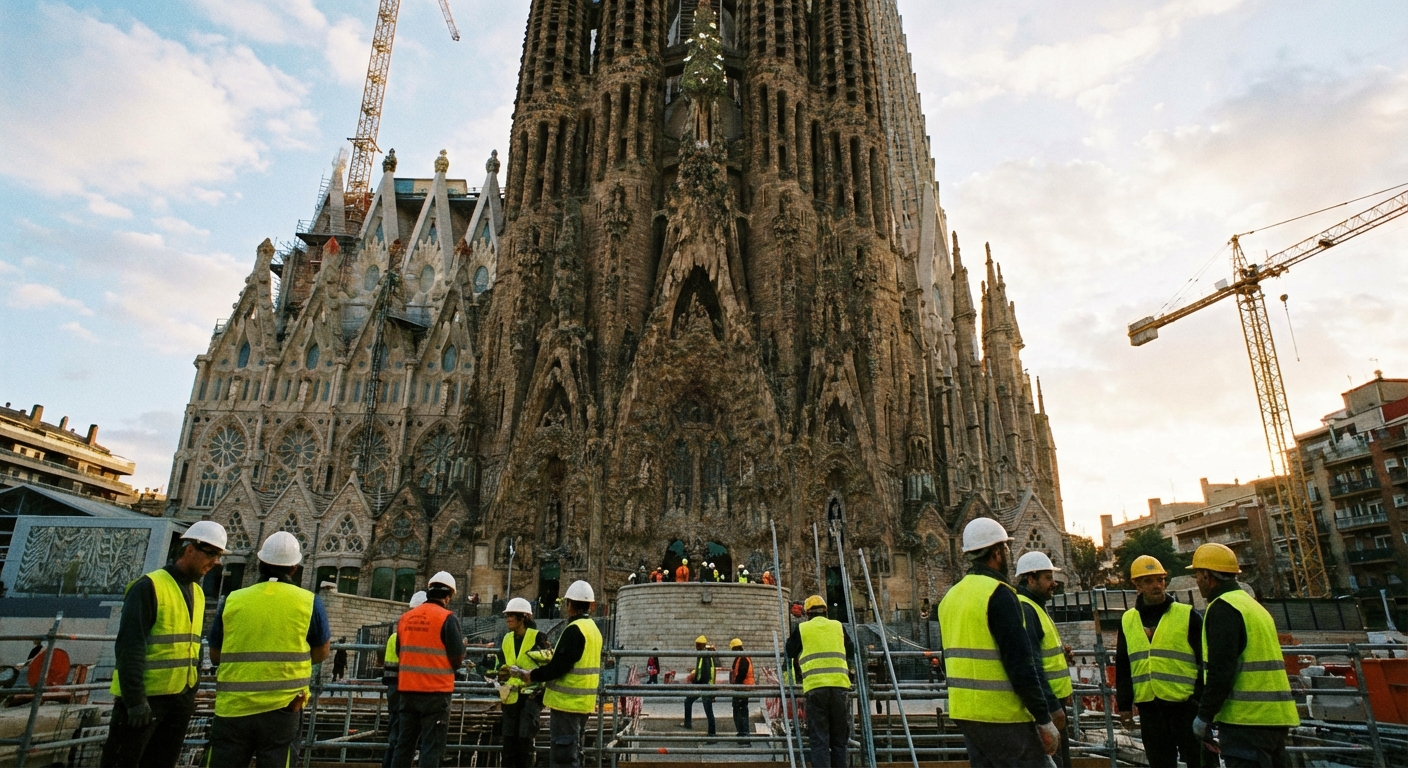
This moment is more than just an architectural milestone; it is a confrontation. It confronts our modern obsession with speed, forcing us to stare into the face of a project that dared to span generations. The architect, Antoni Gaudí, knew he would never see this tower. When asked about the endless delays, he famously replied, "My Client is not in a hurry."
This is the essence of Cathedral Thinking. It is the ability to conceive and plan projects that will not be completed within your lifetime. It is a mindset that prioritizes significance over speed and legacy over quarterly returns. In a world that is increasingly frantic, fragmented, and obsessed with the immediate "now," adopting this century-scale perspective might be the single most effective way to find focus, purpose, and genuine stillness.
The Anatomy of a Century-Scale Mindset
To understand why this way of thinking is so revolutionary today, we have to look at where we lost our way. We are currently living through an epidemic of "temporal myopia." This is a fancy way of saying we are near-sighted when it comes to time.
In the corporate world, the average tenure of a CEO has shrunk to just over seven years. Decisions are made based on quarterly reports, stock prices, and immediate gratification. We want faster shipping, faster internet, and faster results. If we can’t measure the ROI in six months, we often scrap the project entirely.
Contrast this with the mindset of the medieval builders who broke ground on the Florence Duomo. They began construction on a massive cathedral knowing full well they did not yet possess the technology to build the dome that would eventually cover it. They laid the foundations anyway. They trusted that future generations—people they would never meet—would possess the ingenuity and the tools to finish what they started.
That is a terrifying level of trust. It requires a humility that is almost completely absent from modern discourse. It requires you to accept that you are not the main character of the entire story. You are merely a steward of a specific chapter.
When you shift your perspective from "What can I get done by Friday?" to "What foundation am I laying for fifty years from now?", the noise of the daily grind quiets down. The urgency to react to every notification or crisis fades, replaced by a slower, heavier, and more meaningful rhythm of work.
The Five Pillars of Cathedral Leadership
You don't have to be an architect or a stonemason to apply this thinking. Whether you are running a business, raising a family, or building a community, the principles of Cathedral Thinking provide a blueprint for enduring impact.
Here is how you can start building your own cathedral today:
1. Lay Invisible Foundations
In the early years of a cathedral’s construction, nothing seems to happen above ground. The work is deep, dirty, and invisible. The builders spend years digging, stabilizing the earth, and laying stones that will never be seen by the public. In your life and work, this equates to culture, ethics, and character. If you are building a business, this means investing in values that don't immediately show up on the balance sheet. If you are raising a family, it means prioritizing discipline and integrity over external achievements. You must be willing to do the work that gets no applause.
2. Practice Seven-Generation Sustainability
The Iroquois people held a concept that we desperately need to recover: the Seventh Generation Principle. This mandates that every decision made today should be considered in light of its impact on descendants seven generations into the future—roughly 150 years. Before you make a major pivot in your career or a significant financial decision, ask yourself: Does this consume resources my great-grandchildren will need? Does this create stability or chaos for the people who will carry my last name long after I am gone?
3. Embrace Strategic Flexibility
Cathedral Thinking is not about rigid adherence to a 100-year-old blueprint. It is about holding tight to the purpose while holding loosely to the plan. The builders of the Sagrada Familia used stone and chisel; today, they use 3D printing and computer-aided design. The tool changed, but the vision remained. You must allow those who follow you—your employees, your children, your mentees—the freedom to use their own creativity and the technologies of their time to complete the next stage of the project.
4. Move from Monuments to Mentorship
A true cathedral builder knows they are not building a monument to themselves. If your goal is to have your name on the building, you are thinking too small. The goal is to build the capacity of others. The most enduring legacy isn't a structure; it's a system of knowledge and values transferred to people. Shift your focus from personal achievement to institutional stewardship. Who are you training? Who will know how to cut the stone when your hands are too arthritic to hold the chisel?
5. Steward the "Long Now"
This pillar is about responsibility. Organizations like the Long Now Foundation encourage us to think in a 10,000-year framework. This sounds abstract, but it has real-world applications. For instance, the European Space Agency is currently studying how to create a "Circular Economy in Space" to prevent orbital debris. They are planning infrastructure for 2045 and beyond. This is stewardship. It is the refusal to leave a mess for the next shift. It is cleaning up your workspace, your finances, and your relationships so that the next person starts with a clean slate, not a deficit.
The Psychology of the "Long Now"
Adopting this mindset isn't just good for the world; it is necessary for your mental health. We are currently drowning in anxiety because we are hyper-focused on the immediate. When you zoom in too close to a jagged line, every dip looks like a catastrophe. When you zoom out, you realize it’s just a small fluctuation in a long, upward trend.
The "Long Now" offers an antidote to the frantic pace of modern life. It connects your small, everyday actions to an enduring purpose that transcends your ego. It relieves the pressure to "be everything" right now.
I’ve found this peace in my own life through the Orthodox faith. Standing in prayer, surrounded by a tradition that hasn’t changed in two thousand years, offers a kind of stillness I can’t find anywhere else. It reminds me that I am just one small link in a very long chain, and paradoxically, that removes the weight of the world from my shoulders. I don't have to invent the meaning of life every morning; I just have to be faithful to the tradition I've been given.
When you view your life through this lens, the setbacks of the day lose their sting. You realize that a bad quarter, a failed project, or a difficult season is just one stone in a massive wall. It doesn't compromise the structural integrity of the whole cathedral unless you quit.
This perspective also builds resilience. If you are only working for the weekend, a Tuesday crisis is a disaster. If you are working for the next century, a Tuesday crisis is just weather. You put on your coat, you keep working, and you wait for the storm to pass.
Conclusion
The completion of the Sagrada Familia’s tower is a challenge to us all. It asks us if we are brave enough to be "good ancestors."
Being a good ancestor requires an imaginative leap. You have to care about people you will never know. You have to plant trees that will provide shade you will never sit in. It is a selfless act, but it is also the only way to achieve a form of immortality that actually matters.
We live in a culture that screams "faster" and "cheaper." It tells you to hack your way to success, to maximize your personal brand, and to consume as much as possible before the clock runs out. Cathedral Thinking whispers a different truth: Slow down. Build it right. Build it to last.
Look at your life today. Look at your work, your relationships, and your habits. Are you building a tent that will blow away with the next gust of wind? Or are you laying the foundation for a cathedral?
The choice is yours. But remember, the view is much better when you are building something that touches the sky.

See also in Productivity
12 Ways to Enhance Your Digital Productivity
15 Ways to Beat the Afternoon Slump
15 Productivity Boosters for Holiday Parties
12 Ways to Improve Feedback
Why Successful People Never Make Decisions After 7 PM
12 Tips for Prioritizing Your To-Do List