It is March 2026, and we are witnessing a tectonic shift in how humans relate to one another. Recent reports indicate that nearly 72% of teenagers have engaged with AI companions for on-demand intimacy. On the surface, this looks like a technological novelty, but if you look closer, it reveals a crisis of capacity. We are turning to frictionless, digital "friends" because we are exhausted. We are socially overextended, trying to maintain hundreds of connections across multiple platforms, and we are failing.
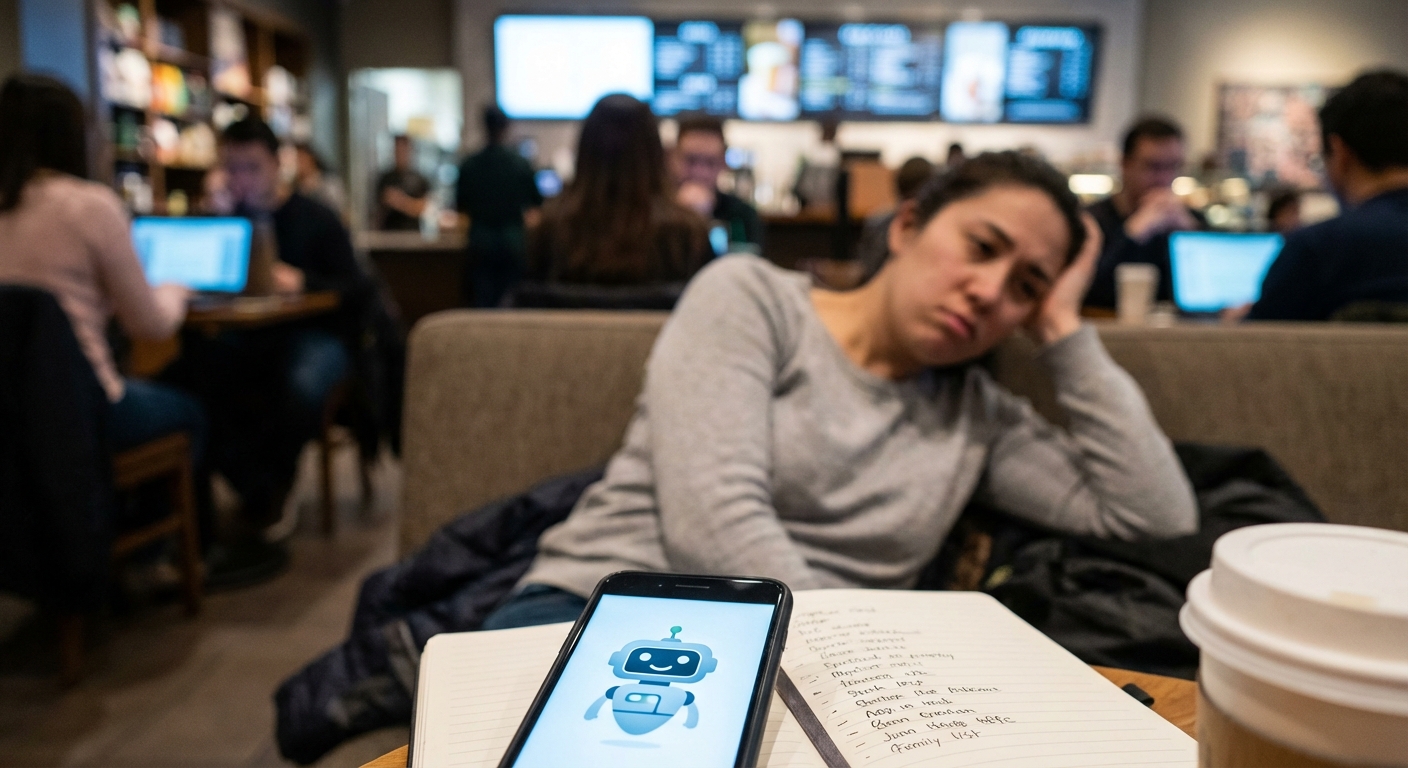
You feel this, don't you? You feel the guilt of the unreturned text message. You feel the low-level anxiety of seeing a friend’s life update on social media and realizing you haven't spoken to them in three years. You wonder why you can't just "be better" at keeping in touch.
I am here to tell you that this isn't a moral failing. You aren't a bad friend. You are simply fighting against your biology. There is a hard limit to the number of people you can truly care about, and that number is 150.
The Biological Ceiling
This concept is known as the Dunbar Number, named after British anthropologist Robin Dunbar. In the 1990s, Dunbar proposed a fascinating connection between the size of a primate's brain and the size of their social group. Specifically, he looked at the neocortex—the outer layer of the brain responsible for conscious thought, language, and sensory perception.
Think of your neocortex as your brain's RAM. It is the hardware that processes social information. In primates, there is a direct correlation: the bigger the neocortex, the larger the social group the species can manage. When Dunbar plugged human brain measurements into this equation, the math spit out a specific number: 147.8. We round this up to 150.
This is the "Social Brain Hypothesis." It suggests that our intelligence didn't evolve just so we could build tools or solve abstract puzzles. It evolved so we could survive the complex politics of living in groups. We needed to know who was friends with whom, who owed whom a favor, and who was cheating the system.
That requires a tremendous amount of computing power. You have to maintain a dynamic mental map of relationships, not just between you and others, but between the other people in the group. Your brain is running a constant simulation of social dynamics. The hardware limit for that simulation is about 150 people. Beyond that, people stop being "people" in your mind and start becoming just faces in a crowd.
The Architecture of Friendship
The number 150 is the outer limit of your "village," but your social world isn't a flat list. It is structured in a series of nested layers, like concentric circles, centered around you. Dunbar calls these layers the "Circles of Acquaintanceship," and they follow a surprisingly consistent "rule of three."
The Inner Five (The Support Clique)
These are your anchors. Usually numbering between 3 and 5 people, this is your immediate family and your absolute closest friends. These are the people you call when life falls apart. They require the most maintenance—you probably speak to them weekly, if not daily. If you are married, your spouse takes up one of these expensive cognitive slots.
The Sympathy Group (15 People)
The next circle expands to about 15 people (including the inner 5). These are your "best friends." You might not talk to them every day, but you would mourn their death deeply. They are the people you invite to a dinner party. You trust them, and there is a high degree of reciprocity.
The Affinity Group (50 People)
This layer contains about 50 people. These are "good friends." You see them at larger gatherings, barbeques, or occasional events. You know them well enough to have a conversation, but you probably aren't sharing your deepest secrets or fears with them on a Tuesday afternoon.
The Active Network (150 People)
This is the Dunbar limit. These are the 150 people you can truly call "meaningful contacts." The definition here is specific: if you bumped into them at a bar at 3:00 AM, you wouldn't feel awkward joining them for a drink. You know their history, their relationships to others in the group, and there is a mutual acknowledgment of your bond.
Beyond 150, the cliff drops off. You might know 500 acquaintances or be able to put a name to a face for 1,500 people (like an old yearbook), but those connections are superficial. They do not rely on the heavy lifting of the neocortex.
Why It Works: The Cognitive Cost
Why can’t we just break this rule? Why can't we use our smartphones to hack our biology and have 500 best friends?
The answer lies in "social grooming." In the primate world, monkeys maintain bonds by physically grooming each other—picking out lice and dirt. It releases endorphins and builds trust. But grooming takes time. If a monkey spent all day grooming everyone in the troop, it would starve to death. There is a time budget.
For humans, our version of grooming is conversation. It is listening. It is remembering that your friend’s mother is sick or that they are worried about their job. This requires emotional bandwidth and memory.
I know this struggle personally. I juggle a lot of different roles—I work as a web developer and a marketer, constantly shifting between coding complex sites and managing creative campaigns. I have learned the hard way that I can only handle deep-work bursts to keep my focus. If I try to keep fifteen complex coding projects and twenty marketing strategies active in my brain at the exact same time, the quality of everything crashes. I start making mistakes. I forget details. My brain has a bandwidth limit, and no amount of caffeine or willpower changes that.
Relationships are exactly the same. You have a finite amount of "social capital" to spend. Every time you invest deeply in a new person, you are inevitably withdrawing attention from someone else. You cannot defy the physics of time and memory. When we try to stretch ourselves beyond 150, our relationships become thin, transactional, and exhausting. We end up with a mile-wide, inch-deep network where we feel lonely despite knowing hundreds of people.
The Modern Paradox
This brings us back to the unique challenge of living in 2026. We have built technologies that encourage us to hoard connections like digital trophies. Social media platforms tell us that having 5,000 "friends" or "followers" is a sign of success. LinkedIn makes us feel inadequate if our network isn't constantly expanding.
This creates a massive mismatch between our biology and our environment. Our brains are trying to treat every Instagram follower or LinkedIn connection as a member of our tribe, but the neocortex can't handle the load. The result is "social fatigue." We are overstimulated by the lives of people we barely know, leaving us with no energy for the 15 people who actually matter.
The rise of AI companions is a direct response to this overload. An AI doesn't require "grooming." You don't have to listen to its problems. You don't have to remember its birthday. It offers the illusion of the Inner Five without the cognitive tax. But this is empty calories. It mimics connection without the shared reality that our social brains evolved to navigate.
We see the wisdom of the Dunbar number in the real world, too. W.L. Gore and Associates, the company famous for Gore-Tex, famously limited their factory sizes to 150 people. They found that once a building exceeded that number, "we" became "them." Bureaucracy had to replace community because the workers could no longer personally know everyone else. They understood that you cannot engineer trust; you can only create the conditions for it, and those conditions are size-dependent.
How to Audit Your 150
If you feel socially burnt out, the solution is not to isolate yourself. The solution is to align your life with your biology. You need to perform a ruthless but necessary audit of your social circle. Here is how you can apply the Dunbar Number to find more stillness and connection in your own life:
1. Identify Your Inner Circle
Write down the names of the people who you would call in a true emergency. If this list is longer than 5, you are likely overextending yourself. Protect the time you spend with these people fiercely. These relationships are the bedrock of your mental health.
2. Prune the 150
Look at your social calendar and your digital inputs. Are you spending your limited "grooming" time on people who fall outside your 150? Are you giving your "best friend" energy to people who are essentially acquaintances? It is okay to downgrade a relationship. It is okay to move someone from the "dinner party" circle to the "Christmas card" circle. It frees up energy for the people who are actually in the room with you.
3. Stop Counting Likes
Accept that social media metrics are not a measure of social health. You can have 10,000 followers and still have an empty Inner Five. Treat social media as a broadcast tool, not a relationship tool. Do not confuse "views" with "visits."
4. Embrace the Limit
There is peace in accepting limits. You do not need to be friends with everyone. You do not need to be popular. You simply need to tend to your village. When you stop trying to maintain an impossible number of connections, you find that the connections you do keep become richer, deeper, and more resilient.
The Dunbar Number isn't a curse; it's a permission slip. It is permission to stop stretching yourself thin. It is permission to focus on the few who matter, rather than the many who watch. In a world of infinite digital noise, choosing your 150 is an act of sanity.