You are tired. You drank the coffee, you powered through the afternoon, and you finally crashed into bed. Yet here you are again, waking up foggy, irritable, and instinctively reaching for the mug before your eyes are even fully open. It feels like a necessity, but it is actually a cycle of diminishing returns that you are actively funding with your own health.
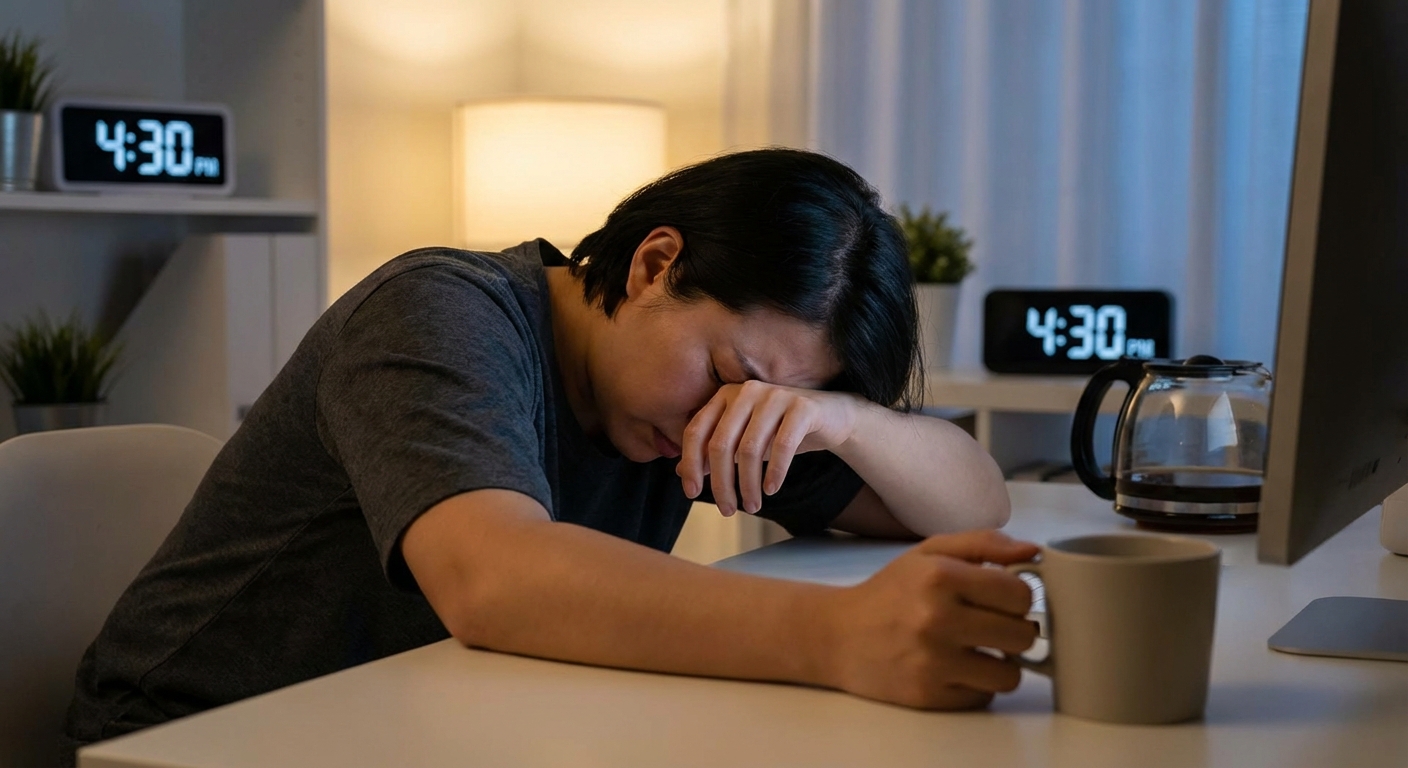
We treat coffee like a magical battery charger, plugging ourselves in whenever we feel our internal percentage drop into the red. But the reality of what that dark roast is doing to your physiology is far more complex and, frankly, a bit deceptive. With Daylight Saving Time looming this March, the collective anxiety about sleep is palpable. A recent survey revealed that nearly half of coffee drinkers are actually going to bed earlier just to ensure they have enough time for their morning coffee ritual.
Think about that for a second. We are prioritizing the drug that wakes us up over the actual sleep that restores us. It is backward, and it is time to look at the biology of why your afternoon cup is destroying your tomorrow.
The Biology of "Fake" Energy
To understand why timing matters, you have to understand that caffeine does not actually give you energy. It doesn't provide fuel in the way a steak or a sweet potato does. It is a chemical liar.
Your brain has a chemical called adenosine. Think of adenosine as "sleep pressure." From the moment you wake up, this chemical starts accumulating in your brain. It is like an hourglass filling with sand. The more sand in the bottom, the sleepier you feel. By the time night falls, the pressure is high enough that you naturally want to close your eyes and drift off.
Caffeine works by impersonating adenosine. It has a similar molecular shape, so it slides into the adenosine receptors in your brain and parks there. It blocks the real adenosine from entering. It is like putting a piece of tape over the "check engine" light in your car. The engine problem (your fatigue) is still there, building up in the background, but the caffeine prevents your brain from registering the signal.
When the caffeine finally wears off, the tape is ripped away, and all that accumulated adenosine floods the receptors at once. This is the crash. If you time this wrong, you are messing with the fundamental rhythm of your body, forcing it to remain alert when every biological system is screaming for rest.
The Math That Ruins Your Morning
The biggest mistake most people make is underestimating how long caffeine sticks around. We tend to think that once the "buzz" or the jitters are gone, the drug has left the building. That is factually incorrect.
Caffeine has a "half-life" of approximately five to six hours. In pharmacology, a half-life is the time it takes for your body to eliminate half of the substance from your system. This isn't like alcohol, which the body processes at a relatively steady and quick rate. Caffeine is a squatter.
Let’s do the math on your afternoon pick-me-up.
If you have a large coffee at 4:00 PM containing 200mg of caffeine, by 10:00 PM—when you are trying to wind down—you still have 100mg of caffeine active in your bloodstream. That is the equivalent of drinking a fresh cup of coffee right before brushing your teeth. Even at 4:00 AM the next morning, you might still have 25mg to 50mg floating around.
I know this trap intimately. I used to be a web developer juggling multiple projects, often working in deep-work bursts late into the night. I would slam espresso at 3:00 PM or 4:00 PM, convinced it was the only way to keep my focus sharp for the coding marathon ahead. I thought I was hacking the system, optimizing my output. In reality, I was just borrowing energy from tomorrow at an exorbitant interest rate. The work got done, but the quality of my sleep cratered, and the next day I needed double the caffeine just to reach baseline. It wasn't sustainable, and it certainly wasn't healthy.
If you are wondering why you wake up feeling like you were hit by a truck, this is likely the culprit. You aren't just tired; you are chemically hungover from a stimulant that overstayed its welcome.
The "I Can Sleep Anywhere" Lie
I hear this all the time: "Oh, I can drink a double shot after dinner and fall asleep instantly. I must have a high tolerance."
If this is you, you need to listen closely. Falling asleep and getting restorative sleep are two completely different physiological events. Alcohol helps you pass out, but it ruins your sleep quality. Caffeine does the same thing, just via a different mechanism.
Even if your eyes are closed and you are unconscious, the presence of caffeine in your system degrades your "sleep architecture." Specifically, it targets your deep sleep—also known as slow-wave sleep. This is the stage of sleep where physical restoration happens. It is when your body repairs muscle tissue, strengthens the immune system, and scrubs the brain of metabolic waste products.
A 2026 meta-analysis confirmed that caffeine reduces total sleep time by an average of nearly 35 minutes and significantly prolongs the time it takes to actually drift off. But the scary part is the "silent" disruption. You might sleep for seven hours, but if the caffeine restricted your deep sleep cycles, you are going to wake up feeling unrefreshed and physically drained.
There is also a genetic component here. There is a gene called CYP1A2 that controls the enzyme responsible for breaking down caffeine in the liver. If you have a specific variation of this gene, you are a "slow metabolizer." For you, that 4:00 PM coffee might hang around not just for six hours, but for ten or twelve. You literally cannot afford to gamble with late caffeine if your liver isn't built for speed.
The Magic 2:00 PM Threshold
So, when should you actually stop?
To protect your sleep and ensure your brain is actually clearing out the day's waste, experts generally recommend a buffer of at least 8 to 10 hours between your last sip and your bedtime.
If you aim to be asleep by 10:00 PM or 11:00 PM, this sets a hard, non-negotiable cutoff at 2:00 PM.
Dr. Nighat Arif and other sleep experts advocate for this window because it gives your body enough time to process the majority of the stimulant. By the time your head hits the pillow, your adenosine levels can do their job naturally, lulling you into a sleep that is deep and actualizing, rather than light and fragmented.
This 2:00 PM rule is a boundary you set for your future self. It requires discipline. It means that when the 2:30 PM slump hits, you cannot rely on the crutch. You have to find another way to cope, or you have to accept that you are going to be a little tired.
The Morning Wait
There is another side to this timing coin. It’s not just about when you stop; it’s about when you start.
Most of us stumble out of bed and immediately pour a cup. This is also a mistake. When you first wake up, your cortisol levels (the stress hormone that naturally wakes you up) are spiking. If you add caffeine on top of that peak, you are increasing your tolerance and jitteriness without getting the maximum benefit.
Furthermore, you want to clear out any lingering adenosine naturally. By waiting 90 to 120 minutes after waking before you have your first cup, you allow your body's natural wake-up cascade to function properly. You use the coffee to sustain momentum, rather than to jump-start a dead battery.
Practical Strategies to Taper Off
If you are currently drinking a pot a day or relying on a 4:00 PM energy drink, switching to a 2:00 PM cutoff is going to hurt. You will get headaches. You will get irritable. Your brain will throw a tantrum because you are taking away its favorite toy.
Do not go cold turkey. That is a recipe for failure. Instead, use a strategic taper.
- The Half-Caf Bridge: For the first week, keep your afternoon ritual, but switch to half-caff or fully decaf. Often, the ritual of brewing and sipping something warm provides a placebo effect that is almost as good as the drug itself.
- Hydrate the Slump: The mid-afternoon fatigue is often dehydration disguised as tiredness. When 2:00 PM hits, drink 20 ounces of water with a pinch of sea salt. It sounds too simple to work, but your brain is largely water; when it dries out, it slows down.
- Embrace the Stillness: Sometimes, you are tired because you are tired. Instead of fighting it with chemicals, take ten minutes away from screens. I’m not talking about complex techniques here. I mean simple silence. Step outside. Look at the horizon. Let your brain idle for a moment.
- Movement Over Stimulants: If you are falling asleep at your desk, do ten pushups or take a brisk walk. Physically engaging your muscles forces blood flow and oxygen to the brain faster than an espresso can.
Conclusion
We live in a culture that worships "the grind" and views sleep as an inconvenience. But true strength and durability come from recovery. You cannot perform at a high level if your battery is never fully charging.
The coffee isn't the enemy. The enemy is the lack of discipline in how we use it. By respecting the half-life of the drug and implementing a strict 2:00 PM cutoff, you aren't depriving yourself. You are giving yourself the gift of waking up feeling human again.
The shift in Daylight Saving Time is a perfect reminder that time is fragile. Don't let a cup of bean water dictate your biology. Set the boundary, endure the temporary discomfort of the adjustment, and reclaim your rest.