Stop treating your garage sale like a disposal service and start treating it like a business. It is March 2026, and the spring cleaning season has officially kicked off. You have piles of clutter that you want gone, but you also have a goal that conflicts with simply tossing it all in a dumpster: you want to get paid.
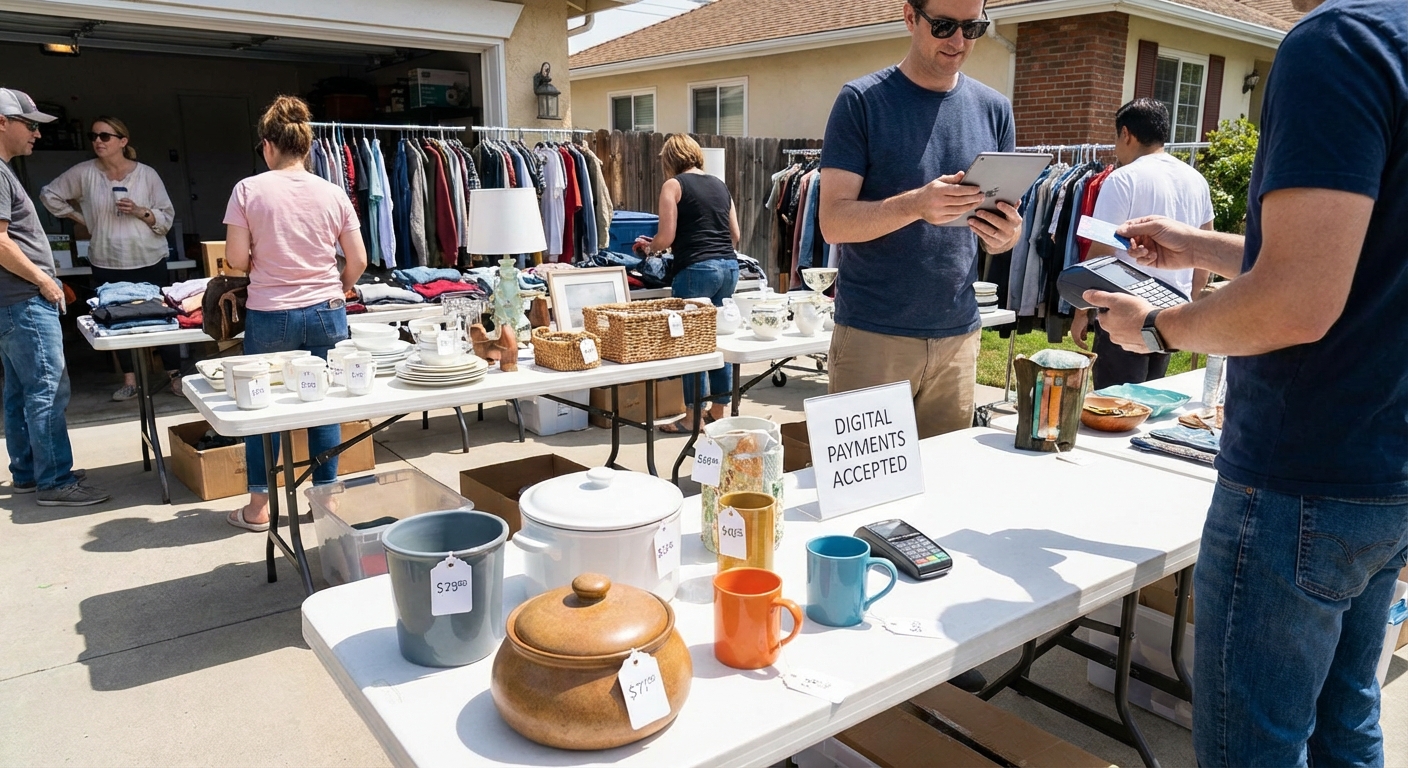
Most people approach a garage sale with a lazy mindset. They drag dirty boxes out to the driveway, slap some masking tape with scribbled numbers on a few items, and sit in a lawn chair waiting for neighbors to haggle them down to quarters. That is not a strategy; that is just slow-motion charity with extra steps. If you want to actually earn money—significant money—you have to professionalize the process.
The difference between making fifty bucks and clearing a thousand dollars in a single weekend isn't usually the quality of your stuff. It is the quality of your strategy. By applying a few retail principles and leveraging the digital tools available to us right now, you can turn a Saturday morning chore into a serious revenue stream.
The Core Idea: From Yard Pile to Pop-Up Shop
We need to shift your perspective. You aren't just cleaning out your basement; you are launching a temporary retail pop-up shop. The goal is to maximize the "yield per visitor." In the retail world, stores track how much money the average person spends once they walk through the door. At a typical garage sale, that yield is often zero because the buyer gets overwhelmed by the mess and leaves.
You need to move from "yard piles" to a "curated micro-shop." When I look at the data coming out of the resale market this year, the trend is clear: buyers are tired of digging. They want a treasure hunt, yes, but they want a map.
This starts with your inventory mix. Experts recommend a specific balance to keep people browsing. You need to categorize your items into "Volume" (low cost, everyday items) and "Anchors" (high-value draws). A good rule of thumb is ensuring that at least 20% of your visible inventory looks like "high value." If a customer walks up and only sees tattered paperbacks and plastic cups, they assume the whole sale is junk. But if they see a vintage lamp, a solid wood chair, or a decent set of tools, their brain switches gears. They assume there is value here, and they start looking closer at the smaller items.
This requires discipline. You have to clean the items. Wipe the dust off the old monitor. Windex the mirror. If you present your items with respect, buyers will pay a respectful price. If you treat your items like trash, buyers will offer you trash prices.
The High-Traffic Merchandising Framework
Now that we have the mindset fixed, let's talk about the physical setup. The biggest mistake I see is people hiding the good stuff near the garage door because they don't want to haul it to the curb. That is a fatal error.
You have to use the "Street-Facing Anchor" technique. This is practically a law of physics in the garage sale game. You must place your largest, most attractive items closest to the curb. I'm talking about furniture, power tools, or those brightly colored children’s playsets. This is your "bait."
Think about the driver going down your street. They are doing a three-second drive-by assessment. If they see clothes on a tarp, they keep driving. If they see a mahogany dresser or a table saw, they slam on the brakes. You need to stop the car. Once they are out of the car, you have a chance to sell them the smaller stuff.
Once they are in your driveway, you need to reduce their decision fatigue. Psychological research tells us that when the brain is overwhelmed by too many chaotic choices, it simply chooses nothing. It shuts down.
Don't just throw everything on one long table. Group items by category. Put all the kitchen gadgets together. Put all the sports gear in one corner. Create "departments." This sounds like extra work, but it pays off in "bundling." When a guy sees a socket wrench next to a hammer and a drill bit set, he is likely to buy all three because his brain categorizes them as a single project. If those items are scattered across three different tables, he might only buy the wrench—or nothing at all.
Practical Pricing & Tech Integration
Let’s talk about money. This is where emotions usually destroy profits. You remember how much you paid for that bread maker in 2018. The buyer does not care. They only care about what it is worth to them right now.
To move inventory while maximizing profit, use the "Decimal Pricing" rule. For general household goods, the sweet spot in 2026 is roughly 10% of the original retail cost. The easiest way to do this is to simply move the decimal point. Did that blender cost $40 new? Price it at $4. Did that jacket cost $80? Price it at $8.
This feels low to some people, but you have to remember your objective: volume movement. You want the stuff gone. If you price it at $20, you will be hauling it back inside at 4:00 PM.
However, pricing is only half the battle. The transaction itself is the other half. We are in 2026. Nobody carries cash anymore. If you are cash-only, you are actively turning away money.
I can't tell you how many times I've walked away from a great item at a sale simply because I didn't have twenty bucks in my pocket, and the seller looked at me blankly when I asked if they had Venmo. You must offer frictionless payments.
You need to have your QR codes printed out and taped to your checkout table. Venmo, CashApp, Zelle—have them all ready. If you are selling higher-ticket items, like antiques or high-end electronics, get a Square reader for your phone so you can take actual credit cards.
Data suggests that sellers who accept digital payments see transaction totals that are 20% higher. Why? Because the buyer isn't limited by the physical bills in their wallet. If they fall in love with a $50 painting but only have $10 cash, the sale dies. If you take digital payment, that $50 is yours. You are removing friction. When you remove friction, you increase speed, and speed creates revenue.
Scaling the Strategy: Marketing and Systems
You cannot rely on a cardboard sign stapled to a telephone pole. That is analog thinking in a digital world. You need to use Omni-Channel Marketing.
Two weeks before your sale, you need to be listing on digital platforms. Apps like Yard Sale Treasure Map and EstateSales.net are where the serious buyers plan their routes. These people don't drive around randomly; they map out their Saturday morning based on photos.
This is where your "Anchor" items come in again. Take clear, well-lit photos of your best stuff and upload them. A listing with photos increases turnout by up to 40% compared to text-only listings. You are essentially running a marketing campaign for your driveway.
This brings me to the importance of systems. I know this sounds intense for a garage sale, but everything in life benefits from a little structure.
I work as a web developer and marketer, often juggling multiple complex projects at once. I have learned the hard way that when I try to "wing it" without a system, I lose focus, I miss deadlines, and I lose money. I have to rely on deep-work bursts and rigid organization to keep everything moving forward. I apply that same logic here. If I treat the sale like a loose, chaotic event, the results will be chaotic. If I treat it like a project with milestones—prep, staging, marketing, execution—the results are predictable and profitable.
Finally, you need a closing strategy. You need to understand the concept of "Dynamic Discounting."
In the morning, when the serious collectors and early birds arrive, your prices are firm. These people are looking for specific items and are willing to pay the "Decimal Price." But as the day drags on, your goal shifts from "maximum profit" to "liquidation."
By 1:00 PM, you should be ready to slash prices. Put up a sign that says "50% Off Everything." The psychological shift this triggers in buyers is powerful. People who were on the fence about a $10 item will snatch it up immediately at $5. You are capturing the revenue that would otherwise walk away.
Conclusion
The garage sale is a humble American tradition, but that doesn't mean it has to be amateur hour. By March 21, the big regional swap meets are going to drive a frenzy of interest in secondhand goods. You can ride that wave if you are prepared.
It comes down to respect. Respect for the value of your possessions, respect for the time of your customers, and respect for your own effort. Don't just dump your life on the lawn. Curate it. Market it. Price it with logic, not emotion.
When you remove the friction and add a little bit of professional polish, you aren't just cleaning out your garage. You are closing deals. And that is a much better feeling than dragging a heavy box of unsold books back into the house.