

If you feel like you are working harder than ever but accomplishing less, you aren’t crazy. You are statistically correct. We have hit a breaking point in the modern workplace where "busy" has completely cannibalized "productive."
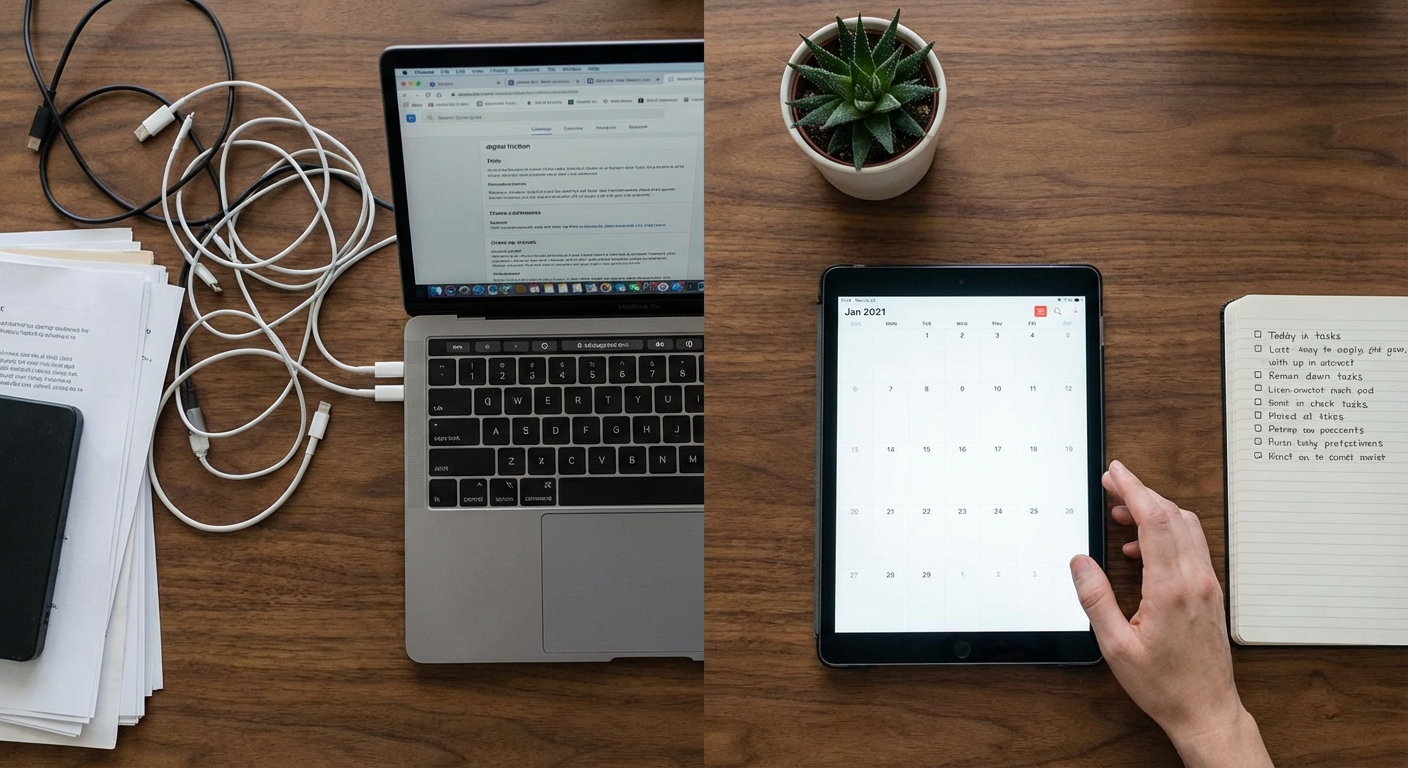
As of early 2026, the data paints a bleak picture of the average workday. While we are physically (or digitally) present for eight hours, the average office worker is only achieving about two hours and 53 minutes of actual, focused work per shift. The rest of the time is lost to friction: toggling between apps, hunting for files, answering redundant emails, and recovering from interruptions.
This gap between attendance and output is becoming dangerous, especially with the rise of Agentic AI. The robots are here, and they are taking the junior-level tasks—the data entry, the basic summarizing, the scheduling. That leaves the humans with the hard stuff: high-level strategy, complex judgment, and creative execution. If you can’t focus because your workflow is a mess, you are in trouble. The mandate for this year isn’t just to show up; it is to exhibit "Precision and Intentional Presence."
To survive this shift, we need to stop looking at tech gurus for advice and start looking at the only professionals who cannot afford to waste a single second: top-tier chefs. We need to adopt the philosophy of Mise en Place.
The Philosophy of the "Meeze"
If you walk into a professional kitchen at 5:00 PM on a Friday, just before the dinner rush hits, you won’t see panic. You won’t see people frantically searching for a knife or wondering where the garlic is. You will see stillness. You will see an almost religious dedication to order.
This is Mise en Place. It is a French term that literally means "putting in place," but to a chef, it means everything. It is a philosophy of readiness. It is the practice of gathering, preparing, and organizing every single ingredient and tool you will need before the first order ticket prints.
This system wasn't born out of a desire for tidiness; it was born out of survival. In the late 19th century, Chef Georges-Auguste Escoffier revolutionized the culinary world by applying a military hierarchy and rigid discipline to the kitchen. Before him, kitchens were chaotic, "free-for-all" environments where quality suffered. Escoffier understood that in a high-pressure environment involving fire, knives, and shouting, a lack of preparation creates a catastrophe.
The "Meeze" is the answer to chaos. It operates on a simple truth: the work doesn't begin when you start cooking. The work begins the moment you start planning. By the time the service starts—or in your case, by the time you open your laptop to start your big project—the thinking should already be done. All that remains is the execution.
When you apply this to knowledge work, you stop reacting to your day and start commanding it. You move from a state of frantic improvisation to a state of elegant routine.
The Framework of Working Clean
You might not have a station on a hot line, but you do have a workspace, and you definitely have a "rush." To adopt the chef’s mindset, we have to translate their physical disciplines into principles for the modern knowledge worker. We call this "Working Clean."
Here is how you apply the framework to your daily workflow.
1. Planning is Prime
In a kitchen, if you don't prep, you go down in flames. In the office, if you don't plan, you spend your day reacting to other people's emergencies.
You must dedicate a specific block of time—let's call it the "Daily Meeze"—before your day officially begins. This is a non-negotiable 30-minute window. Most people make a to-do list, but that is not enough. A list is just a wish. A plan is a sequence.
During your Daily Meeze, you must square your tasks with the clock. Do not just write down "Finish Report." Estimate how long it will take, determine exactly where it fits in your schedule, and most importantly, gather the resources you need before you start. If you need data from the finance team to finish that report, the time to ask for it is during your prep, not when you are halfway through the sentence and realize you are stuck.
2. Arrange Spaces and Perfect Movements
Chefs set up their stations ergonomically. The salt is always in the same spot. The tongs are always on the right hip. They do this to minimize "friction"—the wasted energy of reaching, searching, and fumbling.
I know this struggle personally. I’ve spent years juggling complex web development projects alongside marketing campaigns. There were days I’d stare at a screen for ten hours, switching between code and copy, feeling busy but accomplishing nothing. My digital workspace was a disaster of fifty open tabs and scattered files. It wasn't until I started using deep-work bursts—my own version of a "service" time—that I actually moved the needle. I had to treat my desk like a cockpit, closing every tab irrelevant to the immediate task, or I was going to crash.
You must treat your digital environment with the same respect a chef treats their station. If you are working on a specific project, close every tab and application that is not related to that project. Put your phone in a drawer. Arrange your digital tools so that everything you need is within "reach" and everything else is invisible. Every time you have to minimize a window to find a file, you are breaking your flow.
3. Clean as You Go
This is perhaps the golden rule of the professional kitchen. You never let a mess accumulate. If you spill something, you wipe it immediately. If you finish with a pot, it goes to the wash.
In knowledge work, "mess" looks different, but it is just as destructive. It looks like a desktop covered in screenshots, a Downloads folder with 500 items, and an email inbox with 50 unread messages from the last hour. This digital clutter creates subconscious anxiety.
Practice the art of "coming to zero." Every hour, take three minutes to reset. Close the tabs you are done with. Delete the file versions you don't need. File the emails. Reset your physical desk. By maintaining a state of zero, you prevent cognitive overload. You are telling your brain that you are in control, which lowers your stress levels and allows you to focus on the next task with a clear mind.
4. Make First Moves
Procrastination is often just a fear of complexity. When a task feels too big, we freeze. Chefs don't have the luxury of freezing. When the prep list is a mile long, they identify the "first moves."
You must identify and start your high-priority projects immediately. Do not check your email first. Do not "ease into" the day. Start the fire. Even if it is a small step, making a first move on your most important task reduces the psychological pressure of the looming deadline. It builds momentum. Once the first move is made, the second move becomes obvious.
5. Slow Down to Speed Up
There is a saying in the military that applies perfectly to the kitchen and the office: "Slow is smooth, smooth is fast."
When we rush, we make mistakes. We send the email without the attachment. We overlook a bug in the code. We misread the client's request. These mistakes force us to go back and redo the work, which takes twice as long as doing it right the first time.
Prioritize precision over raw speed. Do not try to type faster; try to think clearer. Deliberate, measured movements always outperform frantic flailing. When you watch a master chef work, they don't look like they are rushing. They look calm. They look like they have all the time in the world, yet they produce twice the volume of the amateur sweating next to them. That is the power of slowing down.
Why It Works: The Science of Structure
You might think this sounds rigid. You might think that you need "freedom" to be creative. But the reality is that structure creates the safety required for creativity.
The effectiveness of Mise en Place comes down to cognitive load. Your brain is like a battery. Every decision you make—where is that file? what should I do next? should I answer this text?—drains a little bit of power. By the time you actually sit down to do the work, your battery is at 50%.
Mise en Place reduces cognitive load by offloading the decision-making to the prep phase. You make all the decisions about how and when to work during your Daily Meeze, so that when you are in the work, you are purely executing. You aren't thinking about the process; you are lost in the product.
This attacks the plague of "performative productivity." Recent data shows that 43% of employees spend more than 10 hours a week just trying to look productive. They are clicking around, moving windows, and attending meetings to appear busy. This is wasted life. It is exhausting.
When you work clean, you don't need to perform. You produce. You replace improvisation with a predictable, coordinated, and intentional structure. In 2026, leaders are moving toward experience-based measures of success. They care about focus quality and output, not how many hours the green dot next to your name was active.
Conclusion
We are living in an era of unprecedented distraction. The tools we use are designed to fragment our attention, and the economic landscape demands higher precision than ever before. You cannot meet these demands with a messy desk and a scattered mind.
Scaling the philosophy of Mise en Place from the kitchen to your life isn't about becoming a robot. It is about respecting your own time and talent enough to give them a proper container. It is about moving from a life of frantic reaction to a life of quiet power.
Clear your surface. Plan your moves. Sharpen your tools. The service is about to begin.

See also in Productivity
10 Strategies for Effective Feedback in Teams
25 Ways to Simplify Your Life
15 Ways to Optimize Processes
Stuck in a Rut? Get out of It with These 10 Strategies
25 Task Batching Strategies
15 Productivity Boosts for Christmas Morning